What is a string in coding


Published on February 9, 2024
Published on Wealthy Affiliate — a platform for building real online businesses with modern training and AI.

What is a string in coding
Well, well, the humble string! Imagine if you will, a pearl necklace. Each pearl represents a character, and together, they form a lovely piece of jewelry, or in the world of computing, a piece of text. In the digital realm, a string is essentially a sequence of characters. These characters can be letters, numbers, symbols, or even spaces, all lined up in a row to form words, sentences, or any text.
In coding, a string is like the Swiss Army knife of data types. Need to store someone's name? Use a string. Want to display a message? String's got your back. Thinking of holding onto that famous "Hello, World!" text? Yep, you guessed it, string.
Most programming languages enclose strings in quotes. You can use single quotes ('like this') or double quotes ("like this"), and some languages even let you use triple quotes for multi-line strings, letting you pen down the next great novel right inside your code!
So, next time you're typing away, remember: every character is a pearl, and your strings are the necklaces of the programming world. Wear them with glamour!
An easy to grasp example
Let's take a trip to the kitchen for a moment. Imagine you're making a sandwich, and you need to label all your ingredients. Each label is like a string in coding.
Let's say we have three ingredients: bread, cheese, and ham. If we were to label these in a programming language, like Python, it would look something like this:
python code
bread = "Whole Wheat Bread"
Ready to put this into action?
Start your free journey today — no credit card required.
cheese = "Cheddar Cheese"
ham = "Honey Roasted Ham"
In this example, bread, cheese, and ham are variables, and the names of the ingredients enclosed in quotes are strings. Each string is a sequence of characters, including spaces, that represents the name of each ingredient.
Now, let's say you want to tell someone what you're making. You could combine these strings into a new string:
python code
sandwich = bread + " + " + cheese + " + " + ham
print("I'm making a sandwich with: " + sandwich)
This would output:
vbnet code
I'm making a sandwich with: Whole Wheat Bread + Cheddar Cheese + Honey Roasted Ham
Just like how you combine ingredients to make a delicious sandwich, you can combine strings in programming to create meaningful messages or data. This is a basic illustration of how strings work in coding: they store and manipulate text data, allowing you to label, combine, and work with text in a multitude of ways. Just remember, no matter how complex the code, at its heart, it's just like making a sandwich - one step at a time!

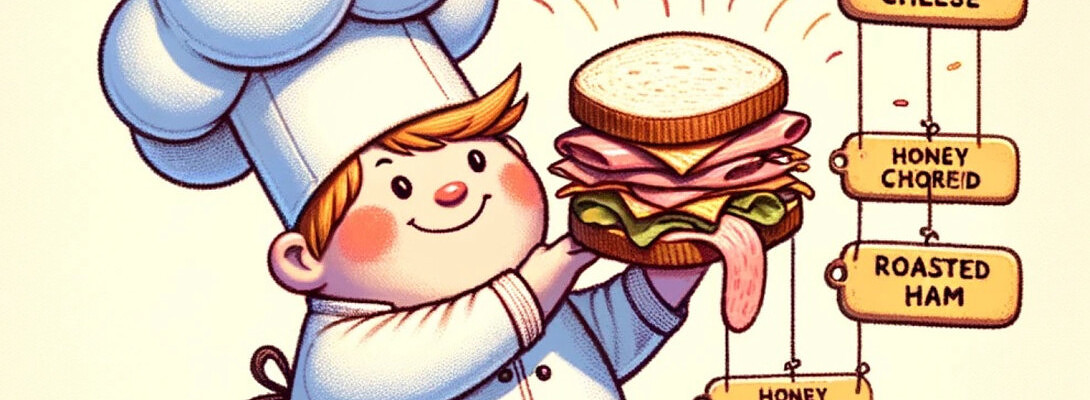
Here's a whimsical illustration that captures the concept of strings in programming, depicted through the lens of making a sandwich. Each ingredient is labeled with a string, much like how you'd label variables in code, bringing a fun and light-hearted perspective to the idea. Enjoy the creativity of combining coding with cooking!
Have an extra slice of fun! Happy cooking!
🤭😋
Ps
Strings and tags are a good fit
Share this insight
This conversation is happening inside the community.
Join free to continue it.The Internet Changed. Now It Is Time to Build Differently.
If this article resonated, the next step is learning how to apply it. Inside Wealthy Affiliate, we break this down into practical steps you can use to build a real online business.
No credit card. Instant access.