Fan or Fanatic What Are You?


Published on January 7, 2026
Published on Wealthy Affiliate — a platform for building real online businesses with modern training and AI.

Words matter, especially when they describe who we are and how we show up in the world.
Two words that are often used interchangeably—but should not be—are fan and fanatic. At first glance, they seem similar. Both describe enthusiasm, loyalty, and commitment. Yet the difference between them is not small; it is profound.
Understanding this difference helps us navigate sports, faith, business, politics, and even our personal lives with greater self-awareness.
What Is a Fan?
A fan is someone who shows interest, support, and appreciation for a person, idea, team, belief, or product—while still retaining independence of thought and emotional balance.
Key Characteristics of a Fan
- Enjoys participation without losing perspective
- Can disagree without hostility
- Maintains identity beyond the object of interest
- Supports without obsession
Examples of a Fan
Sports
A football fan cheers passionately for their team, celebrates wins, and feels disappointment in losses—but still respects opponents and referees. They enjoy the game without letting it define their entire emotional state.
Religion
A religious fan values their faith, attends services, studies scripture, and lives by moral principles—while acknowledging that others may believe differently and still deserve respect.
Business
A brand fan prefers certain companies or products, recommends them to others, and feels loyalty—but will switch if quality declines or better alternatives appear.
Politics
A political fan supports a party or candidate because of shared values, yet remains open to dialogue, criticism, and accountability.
Arts & Entertainment
A fan admires an artist’s work, attends events, buys albums, and enjoys discussion—without excusing harmful behavior or idolizing the person as flawless.
Positive Values of Being a Fan
- Encourages community and shared experience
- Fosters learning and engagement
- Allows enthusiasm without loss of judgment
- Supports healthy loyalty
Negative Risks of Being a Fan
- Can become passive consumption
- May avoid deeper responsibility or action
- Sometimes stays at the surface level of understanding
What Is a Fanatic?
Ready to put this into action?
Start your free journey today — no credit card required.
A fanatic is someone whose enthusiasm has crossed into excess, rigidity, or loss of proportion. The term originates from the Latin fanaticus, meaning “possessed by a god”—and historically implies intensity without restraint.
Key Characteristics of a Fanatic
- Identity becomes fused with the cause
- Little tolerance for opposing views
- Emotional reactions outweigh reason
- Justifies harmful behavior in defense of belief
Examples of a Fanatic
Sports
A sports fanatic threatens referees, fights rival fans, or allows wins and losses to control their mental health and relationships.
Religion
A religious fanatic believes their interpretation is the only truth and uses fear, coercion, or condemnation rather than love, humility, or reason.
Business
A business fanatic worships hustle culture, sacrifices health and family, and equates self-worth solely with success, profit, or status.
Politics
A political fanatic demonizes opponents, dismisses facts, and sees compromise as betrayal rather than governance.
Ideologies & Movements
A fanatic may defend an idea so aggressively that they stop listening, learning, or correcting course—even when harm becomes evident.
Positive Values of Fanatic-Level Commitment
It’s important to acknowledge that not all intensity is destructive.
At its best, fanatic-like commitment can:
- Drive extraordinary discipline
- Inspire courage and sacrifice
- Produce innovation and reform
- Sustain movements during adversity
Many world-changing achievements required deep conviction—but conviction without wisdom is dangerous.
Negative Consequences of Fanaticism
- Loss of empathy and balance
- Increased conflict and division
- Justification of unethical behavior
- Inability to self-correct
- Emotional and relational burnout
Fanaticism often begins where certainty replaces humility.
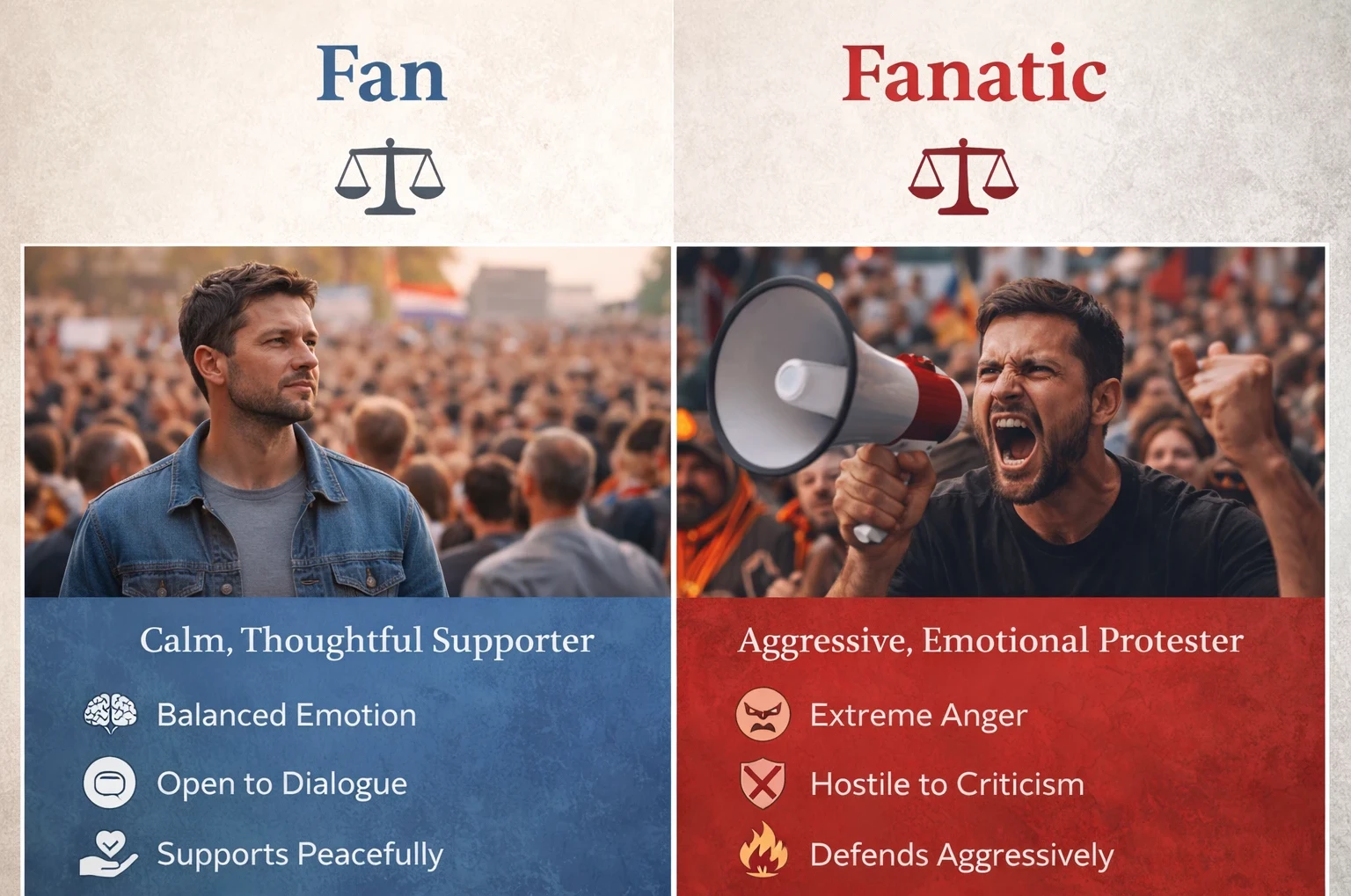
Fan vs Fanatic — The Core Difference
Fan Fanatic
Passion with perspective Passion without limits
Loyalty with discernment Loyalty without questioning
Identity remains intact Identity becomes consumed
Open to dialogue Hostile to disagreement
Enjoys participation Demands domination
The difference is not how much you care — it is how you care.
A Question Worth Asking
Instead of asking, “What am I passionate about?”
A better question is:
“Does my passion make me wiser, kinder, and more grounded—or narrower, louder, and less humane?”
True strength lies not in unexamined intensity, but in anchored commitment guided by humility.
Closing Thought
You can love deeply without losing yourself.
You can believe strongly without becoming rigid.
You can support passionately without becoming consumed.
Be a fan who builds—
not a fanatic who burns bridges.
Share this insight
This conversation is happening inside the community.
Join free to continue it.The Internet Changed. Now It Is Time to Build Differently.
If this article resonated, the next step is learning how to apply it. Inside Wealthy Affiliate, we break this down into practical steps you can use to build a real online business.
No credit card. Instant access.