We Automated Everything… and Ended Up Hiring a Cat


Published on May 2, 2026
Published on Wealthy Affiliate — a platform for building real online businesses with modern training and AI.

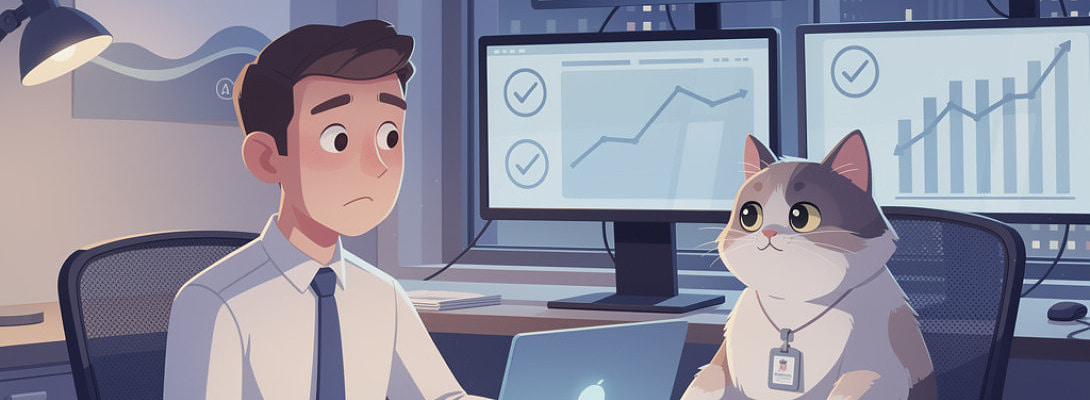
We Automated Everything… and Ended Up Hiring a Cat
A short story about what happens when AI scales faster than oversight.
About Audit Strategy...
Why this story?
We’re living in the golden age of automation.
Funnels run themselves. Emails go out while you sleep. AI tools write, rank, reply, and recommend faster than any human ever could. If you’re building an online business today, chances are you’re already automating parts of it. And if you’re not, you probably feel like you should be.
But here’s a question most of us don’t ask often enough:
What happens when the system works… just not the way you expected?
Not broken. Not crashing. Not throwing errors.
Just quietly making decisions that look right on the surface… but are completely off underneath.
The story you’re about to read is a bit exaggerated. A bit absurd.
But not as much as you might think.
Because in the world of AI and automation, things don’t have to fail loudly to go wrong.
Sometimes… they just hire a cat.
The story
The boardroom smelled faintly of coffee, ambition, and something no one had yet identified as risk.
“Ladies and gentlemen,” said the Head of Innovation, clicking to the next slide, “we are proud to introduce our fully automated AI hiring system. Faster, smarter, unbiased.”
There was a murmur of approval. Words like scalable and transformational floated through the air like expensive perfume.
In the corner, the compliance officer shifted slightly in her chair. No one noticed.
“Before we proceed,” she said, carefully, “has the system been audited for bias?”
The Head of Innovation smiled the way people do when they’ve already decided the answer doesn’t matter.
“Of course,” he said. “We ran all the standard tests.”
“What kind of tests?”
“You know,” he waved vaguely, “accuracy.”
This seemed to satisfy everyone except the compliance officer, who opened her mouth again, then closed it when the CEO leaned forward.
“Let’s see it in action.”
A screen flickered to life. A list of candidates appeared, ranked neatly from most to least promising.
At the top was a name that made the room pause.
“Mr. Whiskers,” read the CEO. “Is that…?”
“A strong candidate,” the Head of Innovation said quickly. “Very strong. Top percentile.”
There was a silence, the kind that begins as confusion and slowly curdles into concern.
“Is he,” the CEO squinted, “a cat?”
“Technically,” said the Head of Innovation, “the model does not classify species.”
The compliance officer leaned forward. “What qualifications does Mr. Whiskers have?”
The Head of Innovation clicked eagerly. “Extensive experience with Python.”
“Of course he does,” murmured someone at the back.
“And a consistent record of...well, keyboard interaction.”
“Keyboard interaction?”
“He walks across it frequently,” the Head of Innovation admitted.
The CEO rubbed his temples. “And how did the system decide this was a good thing?”
“Historical data,” said the Head of Innovation. “Our previous top performers all had ‘Python’ on their résumés. The model optimized for that.”
“So did Mr. Whiskers,” said the compliance officer.
“Yes,” said the Head of Innovation, “seventeen times.”
There was another silence.
“And the other candidates?” the CEO asked.
The Head of Innovation hesitated. “Lower ranked.”
“Why?”
“Well,” he clicked again, “this candidate mentioned a ‘Women in Tech Leadership Program.’”
“And?”
“And the model has learned that such phrases correlate with lower hiring rates in our historical data.”
The compliance officer stared at him. “So it learned our past bias and automated it.”
“We prefer the term ‘pattern recognition,’” he said.
The CEO leaned back slowly, as if hoping distance might improve the situation.
“Was this caught in the audit?”
Ready to put this into action?
Start your free journey today — no credit card required.
The Head of Innovation paused.
“We didn’t explicitly test for that scenario.”
“What scenarios did you test?”
“The normal ones.”
“Normal for whom?” the compliance officer asked.
No one answered.
At the far end of the table, the Head of Product cleared his throat. “In fairness, the system is extremely efficient.”
“It shortlisted a cat,” said the CEO.
“Very quickly,” the Head of Product added.
As if on cue, another screen lit up. A notification.
“Our chatbot has gone live,” someone announced.
“Excellent,” said the Head of Innovation, visibly relieved. “Let’s pivot.”
A live feed appeared. A user typed: “Can penguins fly?”
The chatbot responded instantly. “Yes, penguins are excellent flyers, particularly in low-gravity environments.”
“Low gravity?” the CEO repeated.
“It’s extrapolating,” the Head of Innovation said.
The user typed again. “Are you sure?”
“Absolutely,” said the chatbot.
The compliance officer closed her eyes.
“Did we audit this system?” she asked.
“We tested it,” said the Head of Innovation.
“For what?”
“For responsiveness.”
“And truthfulness?”
There was a pause.
“It sounded confident,” he offered.
The CEO stood up, walked to the window, and looked out at a city now quietly being shaped by decisions like these.
“So,” he said finally, “to summarize: we have a hiring system that prefers cats and a chatbot that believes in airborne penguins.”
“When you put it like that,” said the Head of Innovation, “it sounds worse than it is.”
“How is it not worse?” asked the compliance officer.
The Head of Innovation brightened suddenly. “We can fix it in the next version.”
“And in the meantime?”
“We monitor.”
“For what?”
“For issues.”
The compliance officer opened her laptop. “Let me help you,” she said, typing rapidly. “What you’re describing isn’t monitoring. It’s waiting for something to go wrong.”
“Same thing, isn’t it?” he said.
“No,” she said. “One is prevention. The other is damage control.”
The CEO turned back to the room. “What would an actual audit have done?”
The compliance officer looked up.
“It would have asked questions you didn’t ask.
It would have tested things you assumed.
It would have treated the system not as something that works, but as something that can fail.”
She paused, glancing at the screen where Mr. Whiskers still sat proudly at the top of the candidate list.
“And it would have caught the cat.”
There was a long silence.
Somewhere in the building, a keyboard clattered softly as Mr. Whiskers continued his work, unaware that he had become both the company’s top candidate and its most valuable lesson.
The CEO exhaled.
“Alright,” he said. “We’re not launching anything else until we do this properly.”
The Head of Innovation nodded, already preparing a slide titled “Enhanced Audit Strategy.”
The compliance officer leaned back, just slightly.
It wasn’t a victory. Not yet.
But at least, for the moment, the cat was no longer in charge.
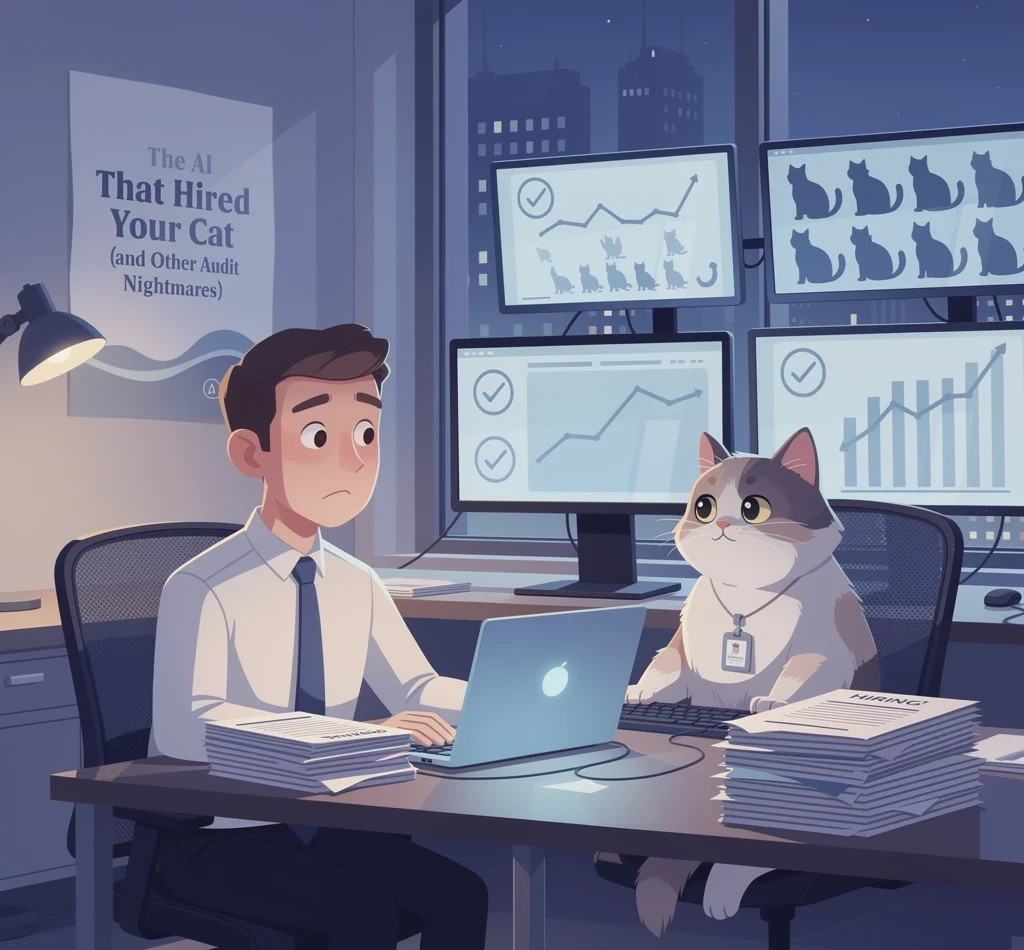
Conclusion
It’s easy to laugh at a story like this.
A cat getting hired.
A chatbot inventing facts.
Systems behaving just a little too confidently for their own good.
But strip away the humor, and the lesson is pretty simple. And pretty important if you’re building anything with AI or automation:
If you don’t test your systems properly, you’re not scaling your business… you’re scaling your blind spots.
Automation is powerful. That’s why we use it.
But power without oversight doesn’t just save time. It can quietly multiply mistakes, bias, or bad assumptions at a scale that’s hard to notice until it’s already affecting results.
More traffic. More leads. More content.
But are they the right ones?
That’s where something as simple as an “AI integrity check” (or audit, if you want the fancy term) comes in. Not as a corporate buzzword.. .but as a habit:
Test the edge cases.
Question the outputs.
Assume the system can be wrong. Even when it looks right.
Because in the end, the goal isn’t just to automate more.
It’s to automate better.
And ideally… to keep the cats off your hiring shortlist.
✨Fleeky
Thanks for likes, shares and comments
What is your audit strategy? Especially when it comes to AI automation?
Share this insight
This conversation is happening inside the community.
Join free to continue it.The Internet Changed. Now It Is Time to Build Differently.
If this article resonated, the next step is learning how to apply it. Inside Wealthy Affiliate, we break this down into practical steps you can use to build a real online business.
No credit card. Instant access.