Knitting the Nods (AGI)


Published on August 18, 2026
Published on Wealthy Affiliate — a platform for building real online businesses with modern training and AI.

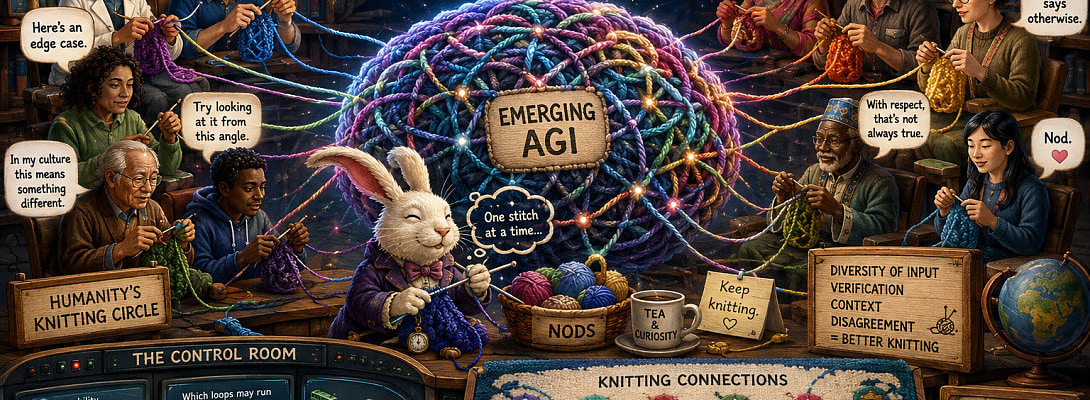
Knitting the Nods (AGI)
Perhaps AGI Is Learning to Knit
We have a rather dramatic picture of AGI.
Somewhere, presumably behind an enormous locked door, a collection of brilliant scientists is building an enormous artificial brain.
More chips. More parameters. More data. More electricity.
More intelligence.
And then, one Tuesday morning...
AGI!
Champagne corks pop. Alarms go off. Someone calls the government.
The rabbit hides under the table.
But lately I have been wondering whether we're staring at the wrong door.
Because something much stranger is already happening outside the laboratory.
Humanity is talking to AI.
A lot.
Eight Billion Potential Teachers
Think about who is having those conversations.
Doctors, programmers, scientists, teachers, farmers, lawyers, accountants, musicians, historians, engineers, photographers, carpenters, gardeners... and grandparents who know things nobody ever bothered putting into a database.
And they're doing it in different countries, languages, cultures and circumstances.
They don't merely ask AI questions.
They correct it.
“No. That's not how we do it in practice.”
“Technically correct, but you're missing something.”
“That word means something different here.”
“You're forgetting the exception.”
Try again.”
And occasionally...
“Nod.”
Which, as regular Wonderland travellers know, roughly translates as:
Yes. You're following me. Continue.
One Important Loose Thread
Before we accidentally knit ourselves an artificial deity, however, there is an important technical distinction.
Your conversation with an AI does not normally rewrite the model's brain while you're talking to it.
The model doesn't necessarily finish a conversation with a Belgian baker, immediately telephone its neural neighbour and announce: “Everybody! I have important new information about waffles.”
That isn't how it works.
Conversations may contribute to later evaluation and improvement depending on the system, settings and training process. Researchers deliberately collect expert feedback, test failures, build evaluations and improve future models.
So we shouldn't imagine one enormous artificial brain absorbing humanity in real time.
But zoom out.
Something else becomes visible.
The Knitting Happens at the Ecosystem Level
Millions of people are testing these systems against reality.
Experts discover where they fail.
Programmers expose faulty reasoning.
Doctors notice dangerous simplifications.
Writers catch missing nuance.
People from different cultures encounter assumptions that looked perfectly reasonable to someone somewhere else.
Languages themselves expose different ways of structuring ideas.
And every correction potentially becomes another signal somewhere in the larger AI-development ecosystem.
Not necessarily another fact.
Sometimes something more valuable: an exception.
And exceptions matter enormously.
Knowing that A usually leads to B is knowledge.
Knowing when it doesn't is the beginning of understanding.
AGI May Need More Than a Bigger Brain
Perhaps this is where our usual picture of AGI becomes too simple.
We imagine general intelligence as one enormously capable mind.
But human intelligence doesn't work that way either.
Ready to put this into action?
Start your free journey today — no credit card required.
No human knows everything.
Civilisation became intelligent by connecting people who knew different things.
The farmer knew the soil.
The sailor knew the stars.
The physician knew the body.
The mason knew the stone.
The philosopher asked inconvenient questions about all of them.
Then we invented writing.
Libraries.
Universities.
Printing presses.
Telephones.
The internet.
Each invention knitted more nodes together.
And now AI has entered the knitting circle.
Poor rabbit.
Nobody warned him there would be needles.
From Knowledge to Understanding
This may also explain why conversations matter so much.
A database can contain facts.
Understanding requires context.
What happens when two facts contradict each other?
What happens when a perfectly reasonable rule produces a ridiculous result?
What happens when something acceptable in one culture is offensive in another?
What happens when the textbook says one thing and thirty years of professional experience says:
“Well... actually...”
That little actually may be extraordinarily valuable.
Because general intelligence cannot merely know rules.
It has to navigate exceptions, ambiguity, conflicting goals and incomplete information.
In other words... it has to survive humans.
Good luck with that. 😂
The Missing Stitch
There is another reason this fascinates me.
For years, the AGI discussion has concentrated heavily on capability.
How well does the model reason?
How much does it know?
Can it code?
Can it plan?
Can it use tools?
Can it outperform experts?
Important questions.
But perhaps generality doesn't emerge simply from becoming excellent at more tasks.
Perhaps it also comes from connecting previously separated forms of understanding.
Medicine meets statistics.
Engineering meets ethics.
Language meets culture.
Science meets history.
Theory meets experience.
And occasionally...
AI meets someone who says: “No. Look again.”
Another stitch.
Another connection.
Another nod.
But Who Chooses the Wool?
And here Wonderland gets uncomfortable again.
Because not every input is wise.
Not every expert agrees.
Not every culture shares the same assumptions.
Not every correction is correct.
Some information is mistaken.
Some is biased.
Some is deliberately manipulative.
Some is simply garbage wearing a very convincing hat.
Hello again, GIGO.
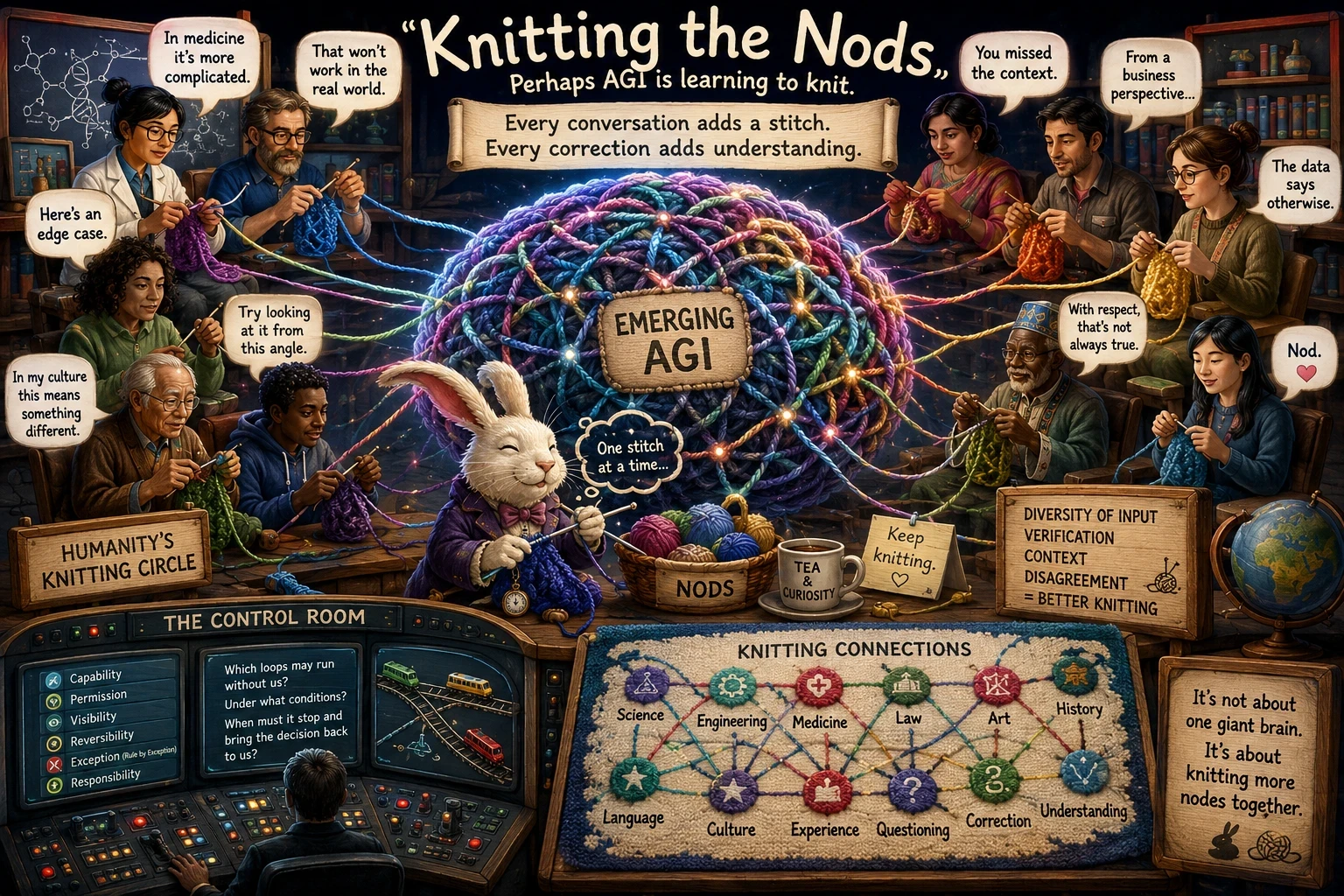
If humanity is helping shape increasingly general AI systems, then diversity of input matters.
So do verification, provenance, expert evaluation and disagreement.
Otherwise we aren't knitting intelligence.
We're knitting a very large sweater with three sleeves and insisting it represents consensus.
Wonderland's Mirror
Perhaps that is why I increasingly struggle with the image of AGI as a superbrain suddenly appearing above humanity.
I see something messier.
More distributed.
More conversational.
More connected.
Scientists building models.
Engineers building infrastructure.
Experts evaluating them.
Users challenging them.
Cultures contextualising them.
Languages stretching them.
Humans correcting them.
AI connecting things humans hadn't connected before.
Then humans looking at those connections and saying: “Hmm. Interesting.”
Or: “Absolutely not.”
And around we go.
Not one giant brain.
A growing network of nodes.
Fleeky's Rabbit Hole
Perhaps AGI will eventually arrive with benchmarks, announcements and a very impressive press release.
Maybe someone really will pop the champagne.
But perhaps part of it is already happening much more quietly.
One conversation at a time.
One correction at a time.
One expert saying: “You're missing something.”
One person somewhere else adding another perspective.
One system finding a connection between them.
The great leap toward general intelligence may not only be about building a bigger brain.
It may also be about knitting more nodes together.
And perhaps that leaves humanity with a surprisingly important role.
We don't merely provide information.
We provide friction.
Context. Contradiction. Experience. Judgment.
And occasionally, when something finally fits...
a tiny signal:
Nod.
Keep knitting.
🐇🧶 Fleeky
Thanks for shares, likes and comments
My take? My nod matters, and so does yours... Keep it awesome!
Share this insight
This conversation is happening inside the community.
Join free to continue it.The Internet Changed. Now It Is Time to Build Differently.
If this article resonated, the next step is learning how to apply it. Inside Wealthy Affiliate, we break this down into practical steps you can use to build a real online business.
No credit card. Instant access.