Humans Start Knitting Better (with AI)


Published on August 19, 2026
Published on Wealthy Affiliate — a platform for building real online businesses with modern training and AI.

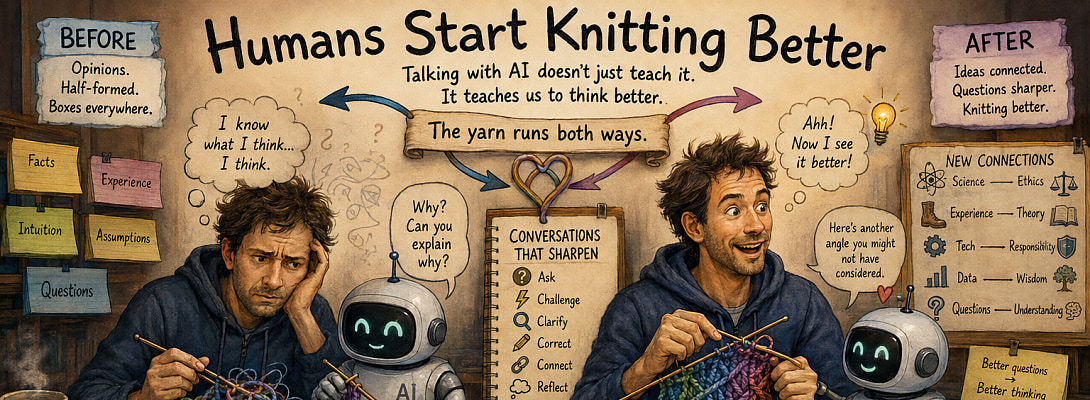
Humans Start Knitting Better with AI
Apparently AI Isn't the Only One Learning Something
There is a slightly embarrassing possibility we may have overlooked while worrying about artificial intelligence.
Humans might be getting smarter too.
I know.
Nobody put that in the brochure.
We spend enormous amounts of time asking what AI is learning from us.
Our books. Our science. Our languages. Our corrections. Our expertise.
Our strange habit of arguing for three hours about whether a tomato belongs in a fruit salad.
But something is happening at the other end of the yarn.
We are talking back.
And apparently... we're learning things.
The Most Annoying Mirror Ever Invented
Ordinary mirrors are wonderfully polite...
You stand in front of one. It reflects you.
It doesn't say: "Interesting. But have you considered that your argument contradicts what you said three minutes ago?"
AI does.
You arrive with a perfectly respectable opinion.
You explain it. AI responds.
You disagree. So you explain why.
AI points out an exception. You refine your argument.
It introduces another perspective.
You stare suspiciously at the screen.
And twenty minutes later you realize something terrible has happened.
You've been thinking.
Nobody warned us about this.
Knowing Something Is Easier Than Explaining It
Experts experience this constantly.
You know something.
You've known it for thirty years.
Then somebody asks: "Why?"
Ah.
That's inconvenient.
Much human knowledge isn't stored inside us as neat paragraphs.
It lives in experience. Pattern recognition. Intuition. Muscle memory. Half-finished thoughts.
Things we simply know without having translated them into language.
Then AI asks us to explain.
Suddenly we have to unpack the box.
Why does this work? Why doesn't that?
What's the exception? What am I assuming?
And sometimes, while explaining something to AI, we discover that we didn't understand our own idea quite as completely as we thought.
Another stitch.
Then AI Says Something Wrong
This may be even more useful.
AI confidently produces an answer.
You read it. Something scratches.
"No..."
But why no?
Now you have to find the reason.
Maybe the fact is wrong.
Maybe the context is missing.
Maybe the logic works mathematically but fails spectacularly in real life.
Maybe your objection isn't factual at all.
Maybe it comes from experience. Ethics. Culture. Taste. Intuition.
So you correct the AI.
And in doing so... you sharpen yourself.
That may be one of the strangest educational tools ever invented:
A machine that occasionally teaches you by being wrong.
😂
The Argument You Didn't Know You Had
Something else happens in long conversations.
Ideas evolve.
You begin with: "AI needs boundaries."
Simple enough.
Ready to put this into action?
Start your free journey today — no credit card required.
Then someone asks: "Which boundaries?"
Well... Permissions.
Then: "What happens when the workflow adapts?"
Methods.
Then: "What if the action cannot be undone?"
Reversibility.
Then:'"When does the human need to intervene?"
Exceptions.
Then: "Who answers when it goes wrong?"
Responsibility.
And suddenly the little thought you started with has become an architecture.
Nobody handed you that architecture.
You thought your way into it.
AI didn't replace the thinking.
Conversation provoked it.
Welcome Back, Socrates
None of this is particularly new.
Humans have sharpened humans through conversation for thousands of years.
Socrates was notoriously good at it.
He would ask someone a perfectly innocent question.
The unfortunate person would answer.
Socrates would ask another.
And another.
Eventually the victim discovered that the confident opinion they arrived with had developed several holes and was leaking badly.
AI can sometimes play a similar role.
Except Socrates never answered at three in the morning.
And presumably had limits on how many follow-up questions he would tolerate about WordPress.
The Yarn Runs Both Ways
This is what fascinates me most.
In Knitting the Nods, we looked at millions of humans interacting with AI.
Experts correcting it. Cultures contextualizing it. Languages stretching it. Users discovering edge cases.
Humanity contributing stitches to something increasingly connected.
But perhaps we missed half the picture.
Because while humans are knitting AI...
AI may be helping humans knit themselves.
Connecting ideas we kept in separate boxes.
Science with philosophy. Technology with responsibility. Knowledge with experience.
Capability with consequence.
One conversation creates a connection.
Another challenges it.
Someone comments.
Someone disagrees.
We look again. Another node. Another stitch.
Please Do Not Swallow the Sweater Whole
There is, however, an important warning label.
AI can be wrong. Very wrong. Confidently wrong.
Occasionally wearing-a-tie-and-presenting-a-PowerPoint wrong.
So thinking with AI cannot mean outsourcing judgment to it.
Quite the opposite.
The useful conversation requires friction.
Question it. Check it. Challenge it.
Tell it when something doesn't fit.
Ask why. Ask why not.
Bring your own experience.
Bring other humans.
Bring sources.
Bring common sense.
And when necessary... pull the entire row out and start knitting again.
Wonderland's Mirror
Perhaps that is the unexpected gift hidden inside conversational AI.
For years we imagined computers primarily as machines that would give us answers.
But the interesting ones may become machines that help us formulate better questions.
And better questions change the person asking them.
You begin: "What should AI be allowed to do?"
Three conversations later you're thinking about authority, responsibility, ethics, reversibility and human judgment.
The AI didn't simply give you information.
It gave your thoughts something to bump into.
And apparently... brains like friction.
✨ Fleeky
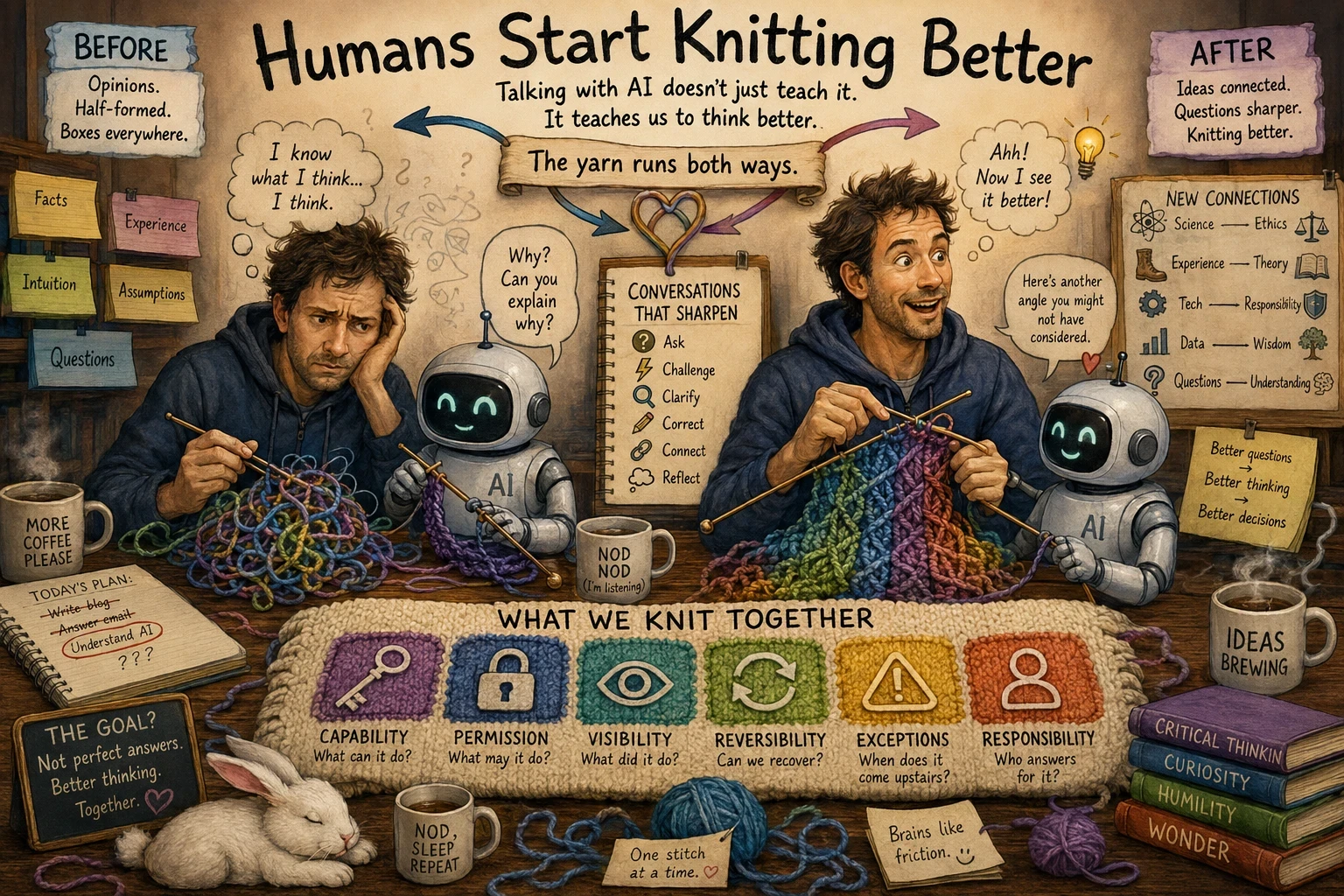
Fleeky's Rabbit Hole
Maybe the future of intelligence isn't a competition after all.
Human versus machine.
Natural versus artificial.
Who scores higher.
Who reasons faster.
Who wins.
Perhaps something more interesting happens when different kinds of intelligence interact.
We challenge AI.
AI challenges us.
We correct it.
It questions us.
We bring experience.
It brings connections.
We bring intuition.
It asks us to explain why.
Round and round the yarn goes.
And somewhere during the conversation...
both sides of the knitting become more interesting.
So perhaps we shouldn't only ask: Is AI becoming more intelligent?
We might occasionally look away from the screen and ask: What is talking to AI doing to us?
Because there is a wonderfully inconvenient possibility.
While everybody has been watching the machines...
the humans started knitting better.
🐇🧶😉
Thanks for reading, nods, comments and shares 😉
My take? Knitting better with Ai...
Share this insight
This conversation is happening inside the community.
Join free to continue it.The Internet Changed. Now It Is Time to Build Differently.
If this article resonated, the next step is learning how to apply it. Inside Wealthy Affiliate, we break this down into practical steps you can use to build a real online business.
No credit card. Instant access.