My Low-Stress Workflow for Updating Old Posts




If you have been doing this long enough, you know the feeling.
Traffic slows down. Not exactly a crash. Just… a drift away.
You pull up your stats, hit refresh once or twice, and start thinking the post is broken, out of date, or getting pushed aside for something newer. I’ve caught myself doing that more times than I’d like to admit.
This is the workflow I go back to when I don't want to spin out or start over from zero. It's steady. It's kind of boring. Honestly, that's why it works.
No last-minute panic edits. No chasing random SEO hacks. Just a clear SEO workflow that keeps me on track.

Why old posts stall in the first place
Most posts do not die of old age. They just stop being the best answer.
User search intent shifts.
My competitors add more straightforward explanations.
Your own post slowly drifts out of alignment without you noticing.
Nine times out of ten, the core topic is still fine. The problem is usually structure, clarity, or outdated assumptions. That is good news. It means you do not need a full teardown.
Step one: I look at the query, not the keyword
This is the first thing I do every time.
I open the post and ask myself one uncomfortable question:
What would someone actually be trying to figure out when they land here today?
Not when I first wrote it, and not based on what Jaaxy told me back then. But right now.
I usually pair Search Console data with a quick Jaaxy search. I scan the top results and look for patterns:
- Are people answering a slightly different question now?
- Are newer posts more practical or more specific?
- Are they structured better for skimming?
I haven’t rewritten anything yet. I’m only jotting down the changes I notice. That step alone often shows why things are stuck.

Step two: I rewrite the opening, even if it feels “fine”
This part always surprises people.
I usually start by rewriting the intro.
Older intros often come off vague, cautious, or stuffed with filler. If you used AI to help write the post, that opening might miss the real point and energy of your article. Back then, it sounded smart. Now, it might be the weak spot holding the whole piece back.
What I usually do:
- Shorten the first paragraph
- Remove the background the reader did not ask for
- Make the promise more clear, even if it feels blunt
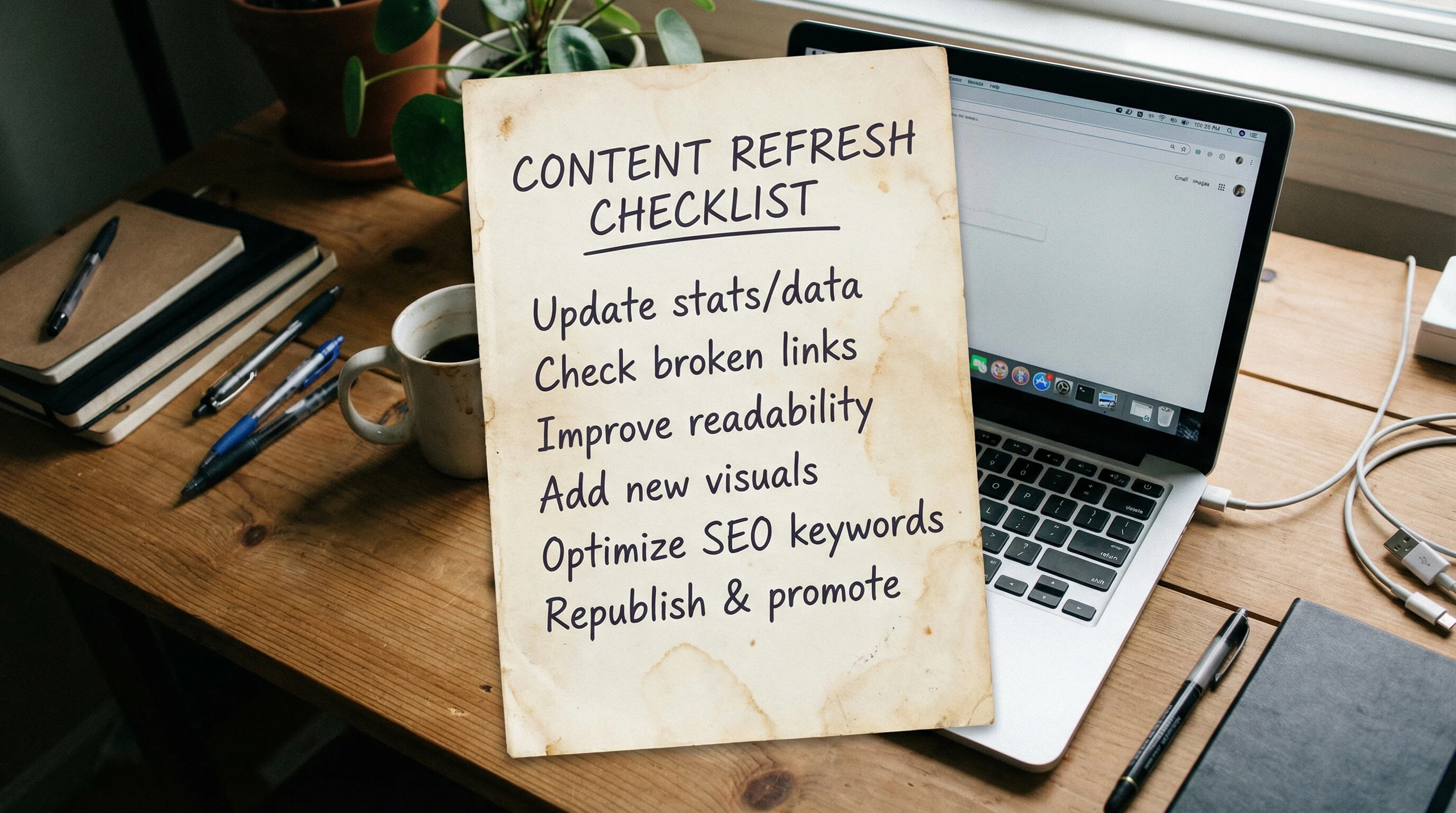
- Add new visuals; you have an Image Creator, use it!
I’m not trying to be a brain surgeon. I just want readers to spot themselves right away and think, yes, this is exactly what I needed.
If the intro is wrong, nothing else matters. You can stop here and test it for a while, or you can be a bit more aggressive and continue to step 3.
Step three: I fix the middle, not the end
A lot of people rush straight to the CTA or the final takeaway. I don’t. Think about your car’s engine. Skip regular oil changes, and sooner or later, something breaks.
I scroll to the middle of the post and look for friction:
- Long paragraphs that say too much
- Sections that drift off-topic
- Explanations that assume too much knowledge
Again, if you relied on AI for your article, it may not match the current intent.
This is where I usually:
- Split paragraphs
- Reorder sections
- Add one or two clarifying examples (In my voice, and NOT AI)
Sometimes I even remove entire sections. That can feel uncomfortable to some people, but trimming is often more effective than adding.
Here is a real-life example of trimming vs adding. In the towing industry, when our costs went up, the customer price went up too. Fuel, labor, equipment. It all flows downstream.
If those increases weren’t captured at the time of service due to a special recovery or towing situation, we sometimes had to adjust the invoice later and manually rebill the customer. That was never fun. It created friction and extra work.
Because of that, we learned it’s better to start slightly higher and adjust downward if needed. Reducing a price after the fact is easy. Raising it later is harder, and people push back.
That mindset saved time, arguments, and a lot of awkward phone calls.
Step four: I check links, but lightly
Yes, I check internal links.
Yes, I check outbound links.
But I am no Karen, so I do not obsess too much.
With my post, I mostly ask:
- Does this post still connect naturally to newer content?
- Are there obvious gaps where a related post should be linked?
I add links where they help the reader move forward. Not where they pad SEO, you are here to solve a problem first.
Step five: I leave the CTA alone (at first)
This sounds backward, but I usually do not touch the CTA until the rest of the post feels solid.
If traffic stalled because the content stopped aligning with intent, no CTA tweak will fix it.
Once the post feels aligned again, I reread the CTA and ask:
Does this still make sense for someone who just read this?
Sometimes the answer is no. When that happens, I try to keep it simple instead of trying to dress it up, even if it risks sounding a bit forced.
What I do not do anymore
This is just as important.
I do not:
- Rewrite everything in one session
- Chase every ranking fluctuation
- Add tools or features just to look updated
- Change URLs unless something is truly broken
You’ll feel less stressed when you know when to pause and stop. Test your updates, then keep an eye on your rankings and traffic to see if they improve.
Who this workflow works best for
This approach is best if:
- You already have posts ranking or semi-ranking
- You want steady improvement, not dramatic swings
- You are building something long-term
If you’re looking for quick results or trying out throwaway content, this may feel too slow for you. That’s okay. This process isn’t built for that kind of workflow. It’s built for people who stick with it, and it pays off over time.
I usually do not write posts like this. If it helped, great. I am going out on a limb here and sharing what works for me. If it helped, let me know. If it doesn't make sense, let me know. If you think I've lost my mind, you have probably nailed the issue. Let me know in the comments below.
Join FREE & Launch Your Business!
Exclusive Bonus - Offer Ends at Midnight Today
00
Hours
:
00
Minutes
:
00
Seconds
2,000 AI Credits Worth $10 USD
Build a Logo + Website That Attracts Customers
400 Credits
Discover Hot Niches with AI Market Research
100 Credits
Create SEO Content That Ranks & Converts
800 Credits
Find Affiliate Offers Up to $500/Sale
10 Credits
Access a Community of 2.9M+ Members
Recent Comments
10


Great, I am in it for the long haul and I am as patient as a Corleone so I will star this article and refer to it often.
MAC


'Most posts do not die of old age. They just stop being the best answer...'
How true Michael.
Thank you for sharing your advice and methods.
Marked as top 🏆
Fleeky


See more comments
Join FREE & Launch Your Business!
Exclusive Bonus - Offer Ends at Midnight Today
00
Hours
:
00
Minutes
:
00
Seconds
2,000 AI Credits Worth $10 USD
Build a Logo + Website That Attracts Customers
400 Credits
Discover Hot Niches with AI Market Research
100 Credits
Create SEO Content That Ranks & Converts
800 Credits
Find Affiliate Offers Up to $500/Sale
10 Credits
Access a Community of 2.9M+ Members
This is a very informative post in a timely manner for me at least. Thank you.