How to Use a Listicle as a Pillar Post


Published on January 29, 2026
Published on Wealthy Affiliate — a platform for building real online businesses with modern training and AI.


Use a Listicle as a Pillar Post and How
Most blogs don’t fail because of a lack of effort; the lord knows we all try hard. They fail from randomness.
A person posts a “how to start” article on Monday, a tool review on Thursday, and a motivational rant the next week. Months go by, and your traffic is still stagnant.
Readers land on one page and bounce because there’s no obvious next step.
A Pillar Post fixes that. It’s the main guide for a topic, the page that holds the map and points to every important stop. And yes, a listicle can do that job, if it’s built like a hub, not a quick “Top 10” meant to chase clicks.
This is the version that lasts. As it gets updated over time, it grows. It becomes the page you keep linking to, the one people bookmark because it saves them time. It provides value to your reader.
What makes something a Pillar Post, and where listicles fit in
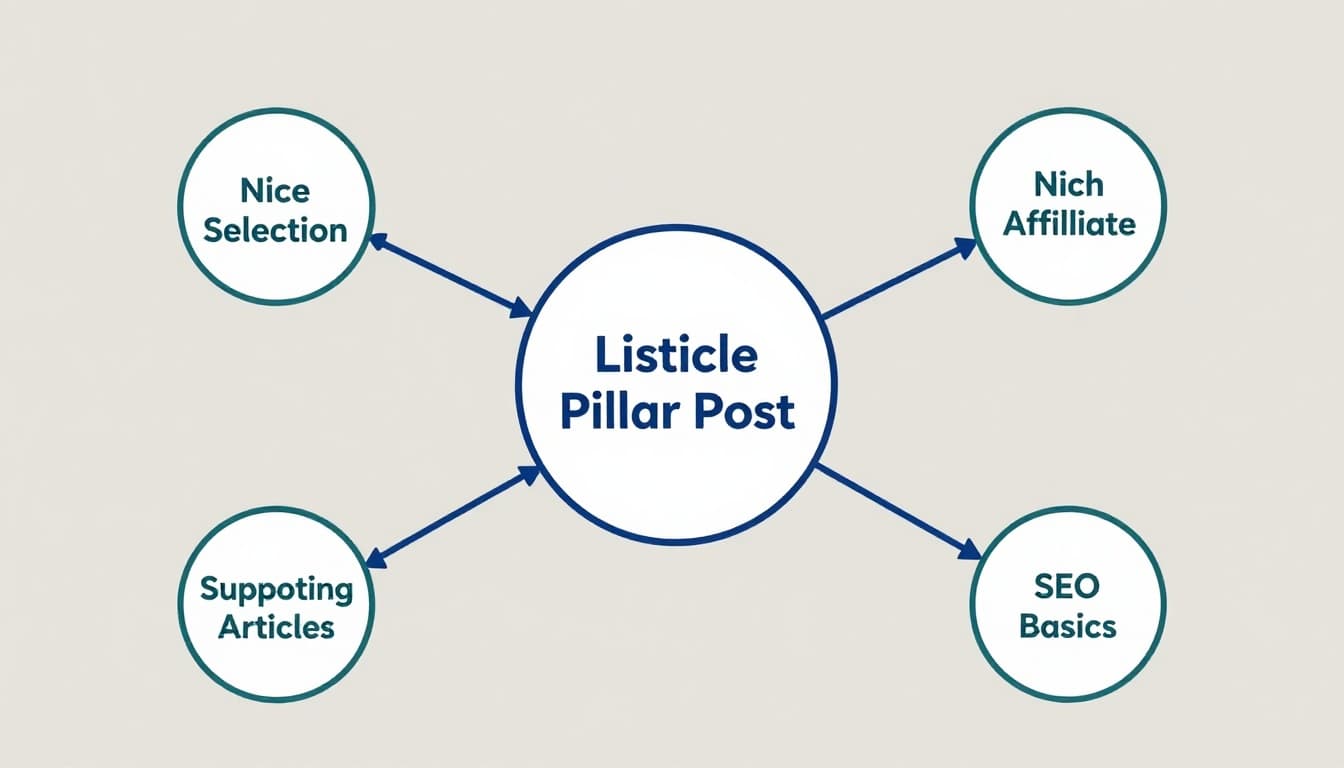 A simple hub and spoke setup, with one main guide pointing to supporting articles, created with AI.
A Pillar Post is the page that can stand in front of a beginner and say, “Hey buddy! Start here.” It covers the full topic at a high level, then sends people to deeper pages when they’re ready.
That’s the hub-and-spoke setup. The hub is the pillar. The spokes are the supporting posts: narrower guides, examples, tutorials, reviews, and case studies. The system works because it matches how people actually learn. They don’t want twenty tabs and a scavenger hunt. They want a clean path to the information they are seeking.
A normal listicle is usually the opposite. It’s quick, light, and built to be consumed in one sitting. It often reads like a pile of tips with no structure, no sequence, and no real “why.”
A listicle Pillar Post is heavier. It’s still scannable, but it has backbone. Each list item acts like a chapter, not a throwaway line. The page feels like a field manual, the kind someone can return to after a month and still find their place.
The test: could someone start here without feeling lost?
Here’s a fast gut-check. If the answer is “no” to more than one, the post isn’t pillar-ready yet.
- Coverage: It touches every major part of the topic, even the boring parts people skip.
- Beginner fit: It explains terms in plain language, at least once.
- Proof: It shows examples, rough numbers, or a quick story that makes it feel real.
- Next steps: It tells the reader what to do after each section, not just what to think.
- Updatable shape: You can add a new item later without rewriting the whole post.
That last point really matters more than people think. A pillar listicle should be expandable like a binder, not fragile like one of my famous one-time rants.
When a listicle Pillar Post is the wrong move
Sometimes the list format fights the topic and should be avoided.
If the subject requires strict order (like setting up tracking, configuring a tool, or filling out a legal form), a step-by-step tutorial usually wins. People don’t want “18 ways,” they want “do this, then that.”
If the topic changes every week (e.g., news-driven niches, policy updates, platform rules), a pillar listicle can become maintenance debt. You’ll spend more time fixing it than growing the site.
And if the topic is mostly definitions, a glossary-style guide can work better than a list. Lists imply choice. Glossaries imply clarity. Two totally different jobs.
How to plan a listicle Pillar Post so it is deep, not fluffy
 A blogger planning a long-form listicle with notes and outlines, created with AI.
Most weak listicles are written from the keyboard outward. The writer starts typing, adds items until they hit a number, then calls it done. It shows. The reader can feel the padding.
A pillar listicle gets planned like a small book. You pick the big topic, then you pick the list items based on real questions people ask. After that, you map every item to a future supporting post. The list becomes your content plan, not just your content.
There’s also an added benefit: you stop guessing what to write next. The pillar tells you. It keeps you from bouncing between ideas like a pinball. You build content to link back to that post and from the pillar post back to that article, linking the 2 articles.
And one more thing. Planning forces honesty in writing. If you can’t come up with 12 to 20 meaningful “chapters,” the topic is too small for a pillar, or you don’t know it well enough yet. That’s not a moral failure. It’s a signal you should do further research on your niche.
Pick a “big enough” topic, then narrow it to one clear promise
A broad topic isn’t the same as a vague topic.
For instance, “Affiliate marketing” is broad, but it’s also foggy. A pillar built on fog turns into a wall of text that "says everything and teaches nothing."
A better approach is a big topic with a clear outcome. One promise. One win.
Ready to put this into action?
Start your free journey today — no credit card required.
Examples that fit my style (Yours may differ) is the the steady, no-hype approach:
- “Ways to choose affiliate offers that don’t feel scammy.”
- “Basics that make affiliate sites work long-term.”
- “Things that kill beginner affiliate sites in the first 90 days (and what to do instead)”
Notice what these do. They don’t try to cover the whole industry. They cover a whole problem.
Choose list items that naturally become supporting posts
Each list item should be a category you can later expand into a full article. If the item can’t support 1,000 words by itself, it’s probably too small, and you should move on to the next topic.
“Pick a niche” can become a full post. “Write better headlines” can become a full post. “Use blue buttons” cannot. That’s a micro tip; it belongs in a section, not in the table of contents.
A good range is 10 to 25 items, depending on the topic. If you go long, group items into sections so the page doesn’t read like a grocery receipt.
A simple mapping can look like this:
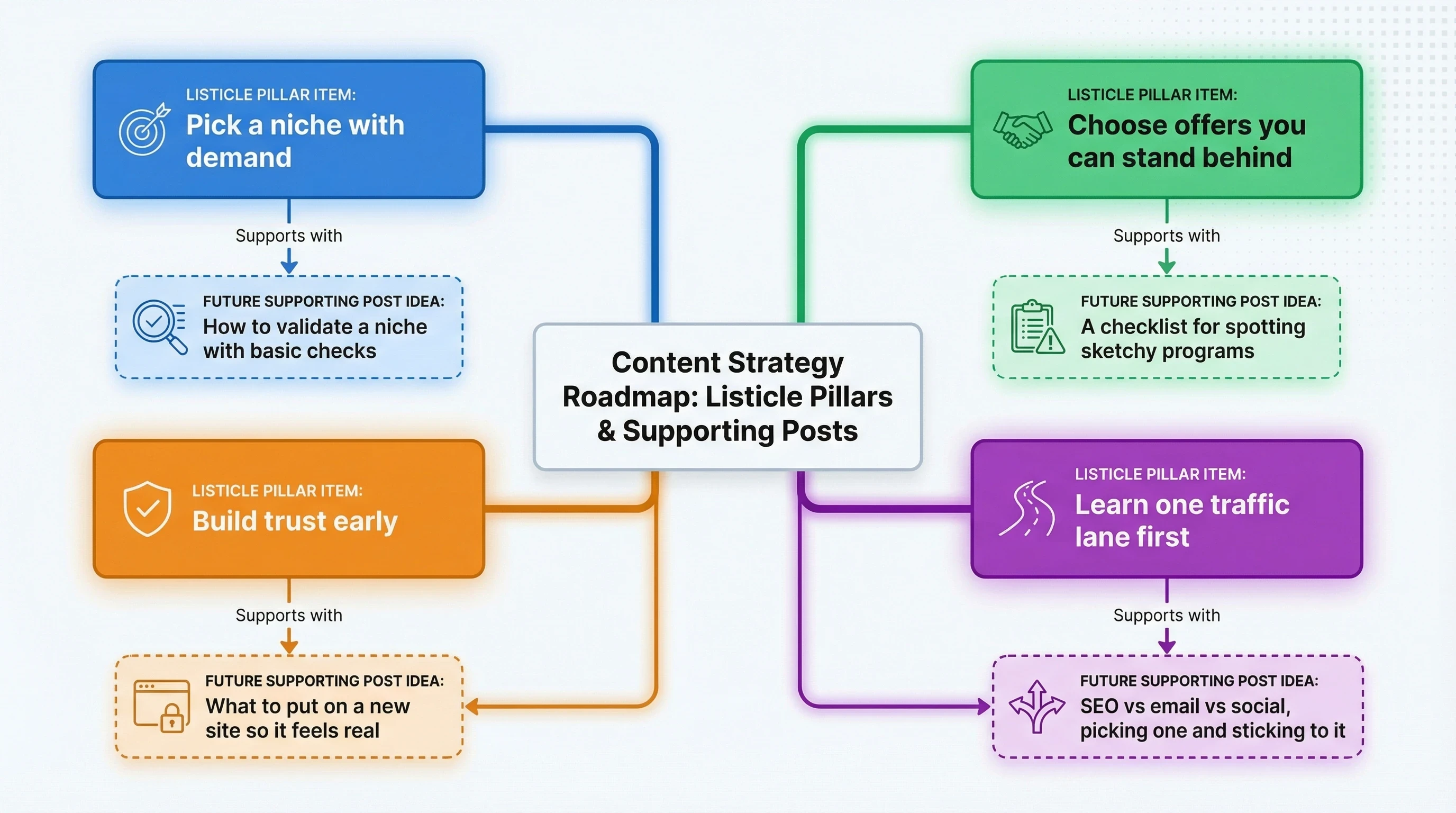
That’s the core trick. Each item becomes a spoke. The pillar becomes the hub that introduces them all.
Write the listicle like a real hub page people want to bookmark
A pillar listicle should read like a desk guide. Clear headings, consistent sections, and a sense of order. Not stiff, not academic, just organized.
Start with a short intro that explains what this page covers and who it’s for. Then add a table of contents. There are great free plugins for this.
People don’t scroll 4,000 paragraphs for fun. They want to jump to the part that matches their problem.
Next, group the list into sections that make sense. In affiliate marketing, you might group by setup, content, traffic, and trust. In personal finance, it might be earning, saving, investing, and protecting.
Then comes the part most people skip: proof. Not “as seen on” fluff, just enough grounding to show you’re not repeating recycled lines. A quick example, a mistake you made, a result you saw, a before-and-after. A few honest details beat ten empty claims.
A simple format for every list item so readers can skim and still learn
Consistency keeps people on the page. It also keeps you from rambling.
Use a repeatable mini-template for each item:
- What it is: A plain definition in one or two sentences.
- Why it matters: Tie it to an outcome, like trust, conversions, or time saved.
- How to do it: Two to five short paragraphs, or a few bullets if steps matter.
- Common mistake: Name the trap people fall into, and why it hurts them.
- What to read next: Point to the deeper supporting post (even if it’s not written yet).
That last line may feel awkward at first if the content does not yet exist. It’s fine. When that spoke post goes live later, you add the link. The pillar gets stronger over time.
Make it easier for Google and AI tools to understand the page
A pillar listicle wins when the structure is obvious.
Use clear H2s for major sections and H3s for sub-sections. Name items in a way that carries meaning on its own. “Choose a niche” beats “Step 1.” The page should make sense to someone skimming and to a system summarizing it. Protip- Use Jaaxy for Keywords! Longtails make great listicle items.
Short definitions help. So do small summaries at the end of each section, two or three lines that restate the point without repeating the whole thing.
Near the end, add a handful of FAQ-style questions that match what beginners ask. Keep them real. Things like “How long does a pillar post take to write?” and “How many supporting posts do I need before this works?” This isn’t padding; it is providing more value to your readers by answering questions they may have at this point.
You can also consider using a list-structured data (schema) if you know how to do so. If it sounds like a headache, skip it. A clean page beats a fancy one that never gets published.
Eric Cantu, a senior trainer here on the WA platform, put together a short video on how to use GPT to create a schema for FAQ sections. It can be adapted for many sections using GPT.
Turn one listicle Pillar Post into a content system you can keep updating
A pillar listicle is not a one-time post. It’s a base or, better yet, another foundation. After it goes live, the work shifts from writing “new ideas” to building out the spokes that the pillar promised.
This is where solo creators win, even with limited time. The pillar gives you a pipeline to work with.
Write one supporting post for two or three of the list items first. Pick the ones with the most demand or the ones that remove confusion. Then link them from the pillar. After that, link back to the pillar from each supporting post so readers can return to the main map.
Over time, your site stops feeling like a pile of random, confusing articles with no clear direction and becomes a library with a front desk.
The hub and spoke linking pattern that keeps readers moving
Linking is simple when you keep it disciplined.
From the pillar, each list item should point to the best next page. Not five. Too many links turn the item into a menu, and menus turn people off and lead to fewer clicks.
From the supporting post, add a short line near the top or bottom that points back to the pillar. Use descriptive anchor text, not “go back” or “this guide.” The link should tell a reader what they’re getting and what they should do next.
As you publish more spokes, update the pillar. Add the link, add one sentence of context, and move on. It’s calming work that helps you create content, and it compounds over time.
A light maintenance plan that keeps the Pillar Post fresh in 2026
In 2026, old pages don’t die; they rot. With broken links, outdated tool names, and advice that no longer matches what platforms reward. Readers notice, and they leave.
A simple routine keeps the pillar clean:
- Quarterly quick check (15 to 30 minutes): fix broken links, update a couple of lines that now feel wrong, tighten any messy sections, update any "New" information
- Yearly refresh (1 to 2 hours): add new examples, remove items that became irrelevant, add one or two new list items if the topic expanded.
Pay attention to the reader's questions, too. Comments, emails, and “people also ask” boxes often hand you the next item on the list. The pillar grows like a living document. It doesn’t stay frozen.
My Final Advice
A listicle can be a strong Pillar Post when it acts like a hub, not a flimsy roundup. Plan it like a guide, write each item like a chapter, then build supporting posts one by one until the whole topic sits under your name.
Pick one broad topic, write the list items, and assign two or three future spokes today. Then draft the item template and write the intro and the first three list items. The rest gets easier once the map exists.
Have an opinion you wish to share? I would love to hear it. If this helped you, I would like to hear how. Leave your remarks below. Good Luck as you move forward.
Share this insight
This conversation is happening inside the community.
Join free to continue it.The Internet Changed. Now It Is Time to Build Differently.
If this article resonated, the next step is learning how to apply it. Inside Wealthy Affiliate, we break this down into practical steps you can use to build a real online business.
No credit card. Instant access.