Bad Prompts Ruin GPT Results, Fix Them Fast (2026)


Published on February 23, 2026
Published on Wealthy Affiliate — a platform for building real online businesses with modern training and AI.

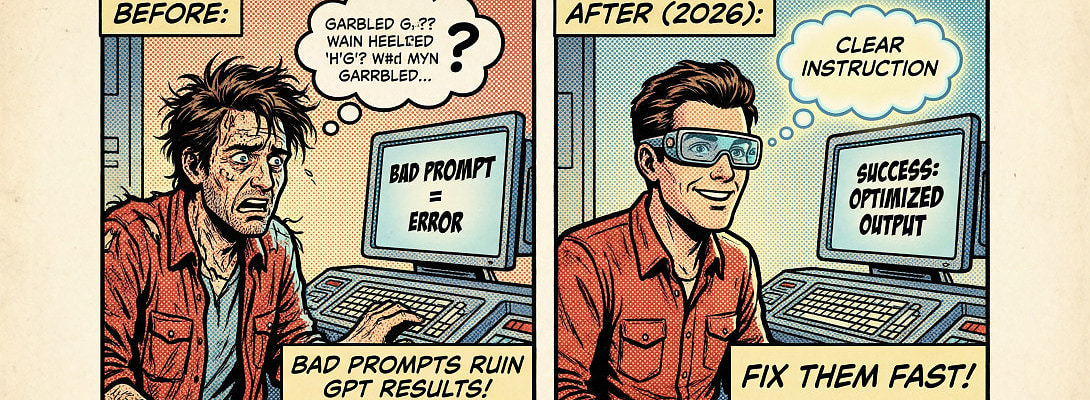
Last week, I did the classic move some people make late at night, half-awake, trying to "just get a quick draft" out of GPT. I typed something lazy like, "Write a post about affiliate marketing." What I got back felt like a school report with a sales pitch glued on. I stared at it, sighed, and realized the annoying truth.
GPT is a mirror. If your input is fuzzy, the output gets fuzzy too.
In this post, I'll explain why it happens, the prompt mistakes that cause the worst results, and a simple prompt pattern you can reuse for almost anything.
Why Bad Prompts Create Bad GPT Outputs (and what the model is actually doing)

Someone stuck in the "why is this so bad?" loop after a vague prompt, created with AI.
GPT doesn't "understand" your business the way a teammate would or even how you envision it. It predicts likely text based on patterns. So when your prompt bland, audience, source details, format, or limits, the model has to guess.
That guessing shows up as generic fluff, wrong assumptions, made-up details (hallucinations), or a tone that doesn't match your brand. Even with newer models in 2026, the old rule still holds: unclear prompts create unclear results.
The "Guessing Tax" You Pay When You're Vague
When you don't pick a target, GPT picks one for you. "Write a blog post" turns into a bland, one-size-fits-all article. A scoped request (topic, reader, length, structure) usually fixes 80 percent of the pain in a single prompt.
When You Skip Context, GPT fills the blanks with defaults
If you don't share your product, market, timeframe, or key facts, GPT fills gaps with common defaults. That can mean outdated angles or advice that doesn't fit your vision. Also, don't blindly trust outputs if you didn't provide your own facts first. Don't be lazy; put a bit of effort into your prompts.
The Prompt Mistakes that Cause the Worst Results (with quick fixes)
Here's what keeps causing terrible GPT results, especially in content and affiliate marketing.
Vague requests lead to generic filler
Bad prompt: "Write an affiliate blog post about budgeting."
Better line: "Write a 700-word post about zero-based budgeting for beginners who feel behind. Use a calm tone, short paragraphs, and H2s. Include one simple example, no hype, no income claims."
It is more focused and targeted and will also make a big difference.
Ready to put this into action?
Start your free journey today — no credit card required.
One Massive Prompt Turns into a Messy Answer
If you ask for a strategy, a 12-month plan, five blog posts, an email sequence, and a budget all at once, you'll get a mushy answer. The best solution is to split it up.
Once you are done requesting everything you need for your content, you can ask GPT to "Bring it all together."
First, ask for an outline, then pick one section and go deeper.
If the output feels scattered, your prompt probably was too.
For real examples you can adapt, see these ChatGPT prompts for digital products.
No Constraints Means You Get the Wrong Tone, Format, or Facts
Add two constraints every time: voice and boundaries. Voice keeps it readable. Boundaries stop the model from inventing details.
Better line: "Write in simple, casual English. Use only the facts I provide. If key info is missing, ask up to 3 questions before writing."
A Simple Prompt Pattern that Makes GPT Useful Fast

Clean inputs tend to produce cleaner outputs, created with AI.
Save a "prompt recipe" and reuse it. Make a personal playbook, and your results get more consistent. Hint: Save this to your swipe list for the future.
Copy-paste template: role, job, context, output, rules
- Role: Act as [expert type].
- Goal: Create [what] that helps [result].
- Context: Here's my situation: [facts, offer, timeframe].
- Audience: Writing for [who], skill level [level].
- Output format: [headings, bullets, word count].
- Rules: Avoid [things]. Use only the provided info.
- Before writing: Ask up to 3 questions if needed.
- After writing: Ask up to 3 questions to make improvements
Example (Wealth With Mike style): "Write one realistic paragraph about affiliate marketing for beginners. No hype, no income promises. Explain it like a patient friend. 90 to 120 words."
Please note that I have the output, rules, and questions built into my personal GPT, so they happen automatically.
The Output from GPT
Affiliate marketing is basically recommending products or services you already find useful and earning a small commission if someone decides to buy through your link. That’s it. You’re not creating the product, handling support, or dealing with shipping. Your role is to help people make clearer decisions by sharing honest experiences, comparisons, or tutorials. It takes time to build trust and even longer to see consistent results, which can feel slow at first. Some posts won’t gain traction. That’s normal. If you focus on being helpful rather than persuasive, you’ll start to notice which topics people engage with and which ones they ignore, and that feedback becomes your roadmap to success.
Here it is, Michael
Do you want the tone to lean more conversational, or should it feel slightly more instructional and grounded?
Should the paragraph reflect your personal experience, even briefly, or stay neutral so any beginner can see themselves in it?
Are there specific words or phrases you want avoided altogether so the voice stays consistent with the rest of your content?
It is now ready for you to polish and add your insights.
In summary
Bad prompts equal terrible GPT results because you're forcing the model to pay a guessing tax. Give it a clear target, clean context, and a few rules, and the output usually snaps into place. Next time you prompt, rewrite it using the template above, then do one follow-up: "Tighten this, remove fluff, and keep my tone." You'll save time, and you'll trust what you're reading a lot more.
This is how I use AI to help with my content. Just remember to never "let it ride," and always edit and provide your insights. Never just copy and paste what it gives you.
Share this insight
This conversation is happening inside the community.
Join free to continue it.The Internet Changed. Now It Is Time to Build Differently.
If this article resonated, the next step is learning how to apply it. Inside Wealthy Affiliate, we break this down into practical steps you can use to build a real online business.
No credit card. Instant access.