Hybrid Pairing System


Published on July 29, 2026
Published on Wealthy Affiliate — a platform for building real online businesses with modern training and AI.

Hybrid Pairing System
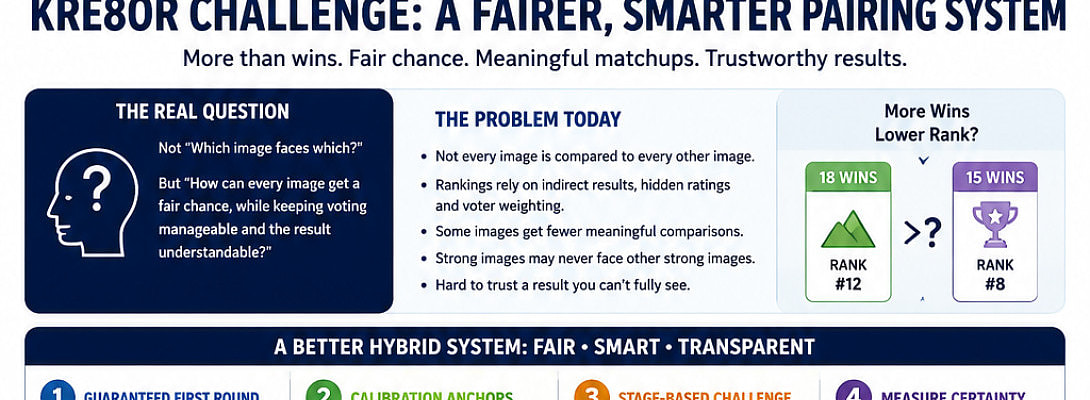
The pairing debate may be focusing on the wrong question.
The real question is not: “Which image should face which image?”
It is:“How can every image receive a fair chance, while keeping voting manageable and the result understandable?”
The current system uses targeted pairings, indirect comparisons, voter weighting and a hidden rating. That may be mathematically efficient, but because people cannot see the full process, the result can feel arbitrary. The article itself acknowledges that the leaderboard currently shows wins and win rate while ranking entries using another number. (Wealthy Affiliate)
A better hybrid system?
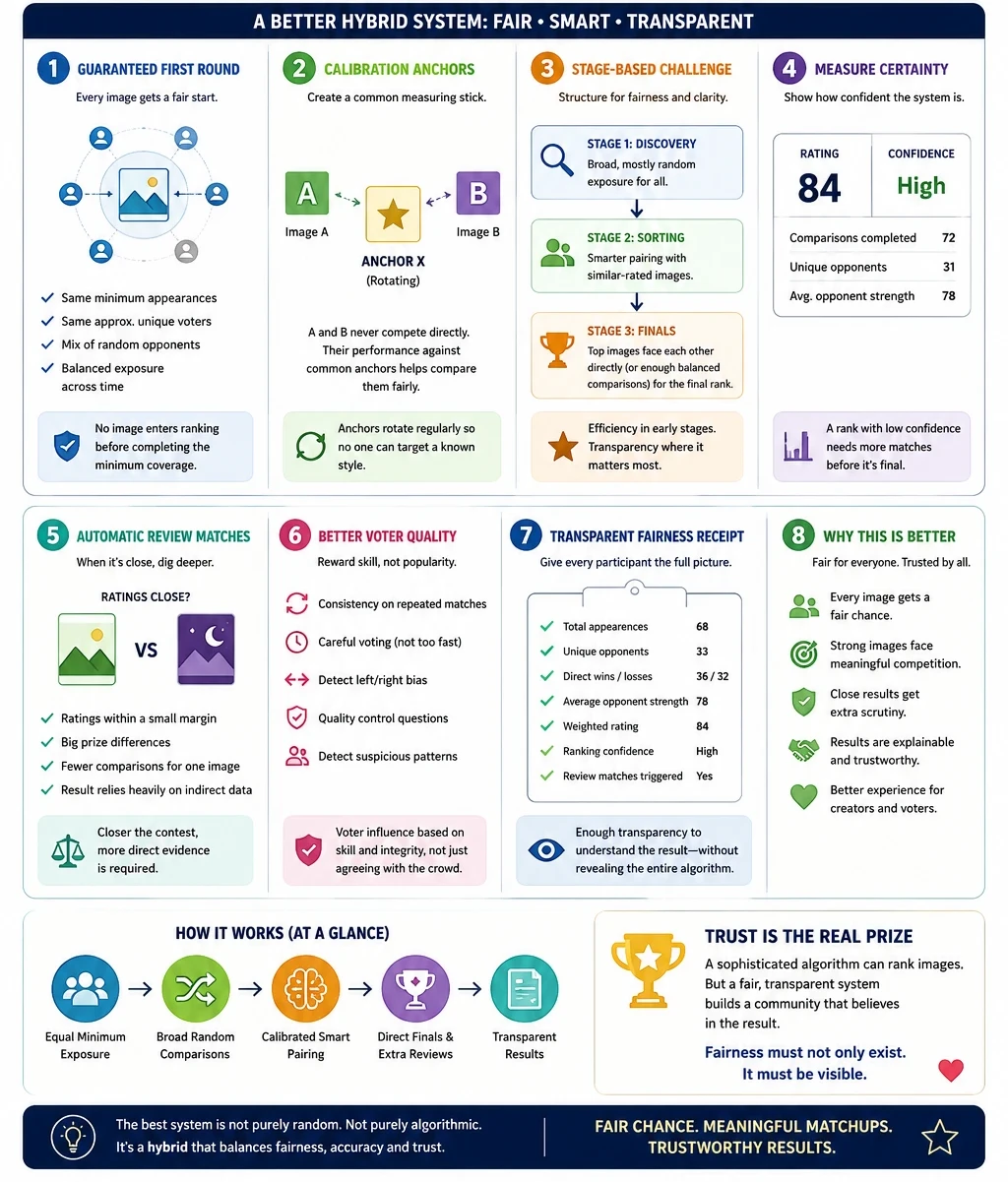
1. Give every image a guaranteed first round
Before intelligent pairing begins, every image should receive:
- the same minimum number of appearances;
- approximately the same number of unique voters;
- a mixture of randomly selected opponents;
- balanced exposure across different voting times.
No image should enter the ranking phase before completing this minimum coverage.
This prevents early luck (or lack of visibility) from shaping everything that follows.
2. Use several images as “calibration anchors”
Select a small, changing group of images representing different performance levels.
Every entry would occasionally compete against these shared reference images.
This creates a common measuring stick.
For example:
- Image A and Image B never compete directly.
- Both compete against Anchor X.
- Their performances against Anchor X help compare them more reliably.
The anchor images should rotate so creators cannot design specifically to beat one known style.
3. Split the challenge into stages
Instead of one continuous invisible ranking process:
Stage 1: Discovery
Every image receives broad, mostly random exposure.
Stage 2: Sorting
Images compete more frequently against others with similar provisional ratings.
Stage 3: Finals
The strongest images enter a transparent final pool where each finalist faces every other finalist—or receives enough balanced comparisons to approximate that.
Ready to put this into action?
Start your free journey today — no credit card required.
This keeps the efficiency of smart pairing while making the decisive stage much easier to trust.
4. Measure certainty, not only rating
A rating should not appear authoritative when the system has limited evidence.
Show something like:
- Rating: 84
- Confidence: High
- Comparisons completed: 72
- Unique opponents: 31
- Opponent strength: 78
An image with a rating of 84 but low confidence should continue receiving comparisons before its position becomes final.
The system should effectively say: “We believe this image is fourth, but we need more evidence.”
That is more honest than presenting an uncertain estimate as a fixed truth.
5. Trigger automatic review matches
When two images are close in rating, the system should automatically arrange additional comparisons.
This could apply when:
- their ratings are within a small margin;
- the prize difference is significant;
- one has received considerably fewer comparisons;
- their ranking depends heavily on indirect results.
The closer the contest, the more direct evidence should be required.
6. Separate voter reliability from majority taste
The current system reportedly gives more influence to voters whose choices align with the eventual field result. (Wealthy Affiliate)
That creates a possible circular problem:
A voter is considered accurate because they agree with the crowd, and their vote then helps define what the crowd agrees with.
Instead, voter quality could also consider:
- consistency when the same comparison is repeated;
- whether the voter looks carefully rather than clicking rapidly;
- detection of left-side or right-side bias;
- ability to identify intentionally inserted quality-control examples;
- suspicious voting relationships or coordinated behaviour.
A voter should not be rewarded merely for following popular taste.
7. Create a transparent “fairness receipt”
At the end of the challenge, every participant should see:
- total appearances;
- unique opponents;
- direct wins and losses;
- average opponent strength;
- weighted rating;
- ranking confidence;
- whether extra review comparisons occurred.
This does not require exposing the entire algorithm. It simply gives participants enough evidence to understand the outcome.
The strongest model?
The best solution is probably not purely random pairing or purely algorithmic pairing.
It is a hybrid:
Equal minimum exposure → broad random comparisons → calibrated smart pairing → direct finalist comparisons → transparent audit.
This addresses both sides of the discussion:
- The system remains scalable.
- Strong images face meaningful competition.
- Every image receives basic coverage.
- Close results receive extra scrutiny.
- Final rankings become explainable.
The deeper issue is trust, not mathematics. A sophisticated algorithm can still feel unfair when participants cannot see whether their work was genuinely evaluated. Fairness must not only exist inside the system... It must also be visible from the outside.
And that will be the VISUAL fun!
✨Fleeky
PS
Thank you for letting me be a beta-tester.
This is what I came up with, and Ai helped me to shape it all along...
Share this insight
This conversation is happening inside the community.
Join free to continue it.The Internet Changed. Now It Is Time to Build Differently.
If this article resonated, the next step is learning how to apply it. Inside Wealthy Affiliate, we break this down into practical steps you can use to build a real online business.
No credit card. Instant access.