Apparently, an Emoji Means I Used AI Wrong


Published on September 17, 2026
Published on Wealthy Affiliate — a platform for building real online businesses with modern training and AI.


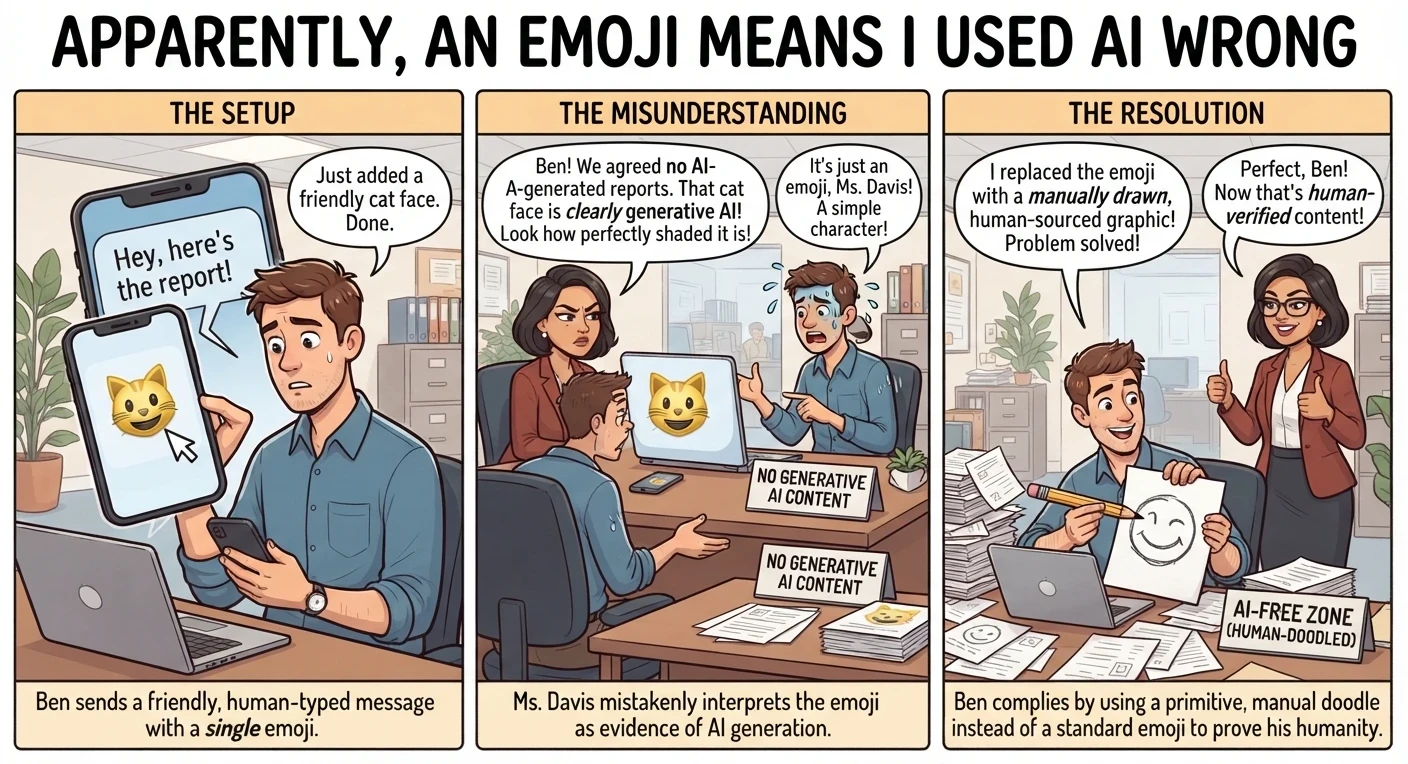
There is something I hear surprisingly often: if you use AI to help you structure your writing, you must be stupid, illiterate, or simply copying and pasting.
Apparently, sometimes the evidence is an emoji 🤣.
And honestly? That is one of the most ridiculous things I hear on a daily basis.
I use AI to help me structure some of my posts.
I might give it my messy thought, ask it to help organise them, and then I type the post myself.
That distinction matters.
Using AI to help structure an idea isn't the same thing as asking AI to think for you.
There is a difference between:
"Write this entire article for me so I don't have to think."
and:
"Here are my thoughts. Help me organise them so I can communicate what I'm actually trying to say."
The second one still requires human input.
I still decide what I believe.
I still decide what stays and what gets removed.
I still change wording.
I still add examples from my own experiences.
I still decide whether something actually sounds like me.
And yes, sometimes I put an emoji in it 😎
That doesn't suddenly turn my keyboard into a copy-paste machine.
But Here Is Where The Conversation Gets Interesting.
JD brought up questionnaires during our discussion, and that made me think about how much the process of structuring things has changed.
Before AI, if someone wanted to create a questionnaire, they still had to sit down and work out the structure themselves.
Ready to put this into action?
Start your free journey today — no credit card required.
What questions should come first?
What information do I actually need?
How should I phrase the questions?
What order makes sense?
How do I make sure I'm getting useful answers?
Nobody looked at a well structured questionnaire and automatically assumed the person was lazy because they organised it properly.
The human still had to do the thinking.
Now AI can help with that structure in seconds.
And I think that's where the perception has changed.
Something that once demonstrated someone's ability to organise information can now make people simply because AI could have helped with it.
You can actually see that shift in the discussion JD and I had yesterday.
We started with a conversation about uniqueness and differentiation.
Then moved into usefulness, privacy and trust.
Neither of us was simply throwing information at each other.
The conversation itself was doing the thinking.
AI can help me with that kind of discussion, but it doesn't magically create my curiosity or decide which question I want to explore next.
AI-Assistance Isn't The Same As AI Dependence.
If someone copies and pastes AI-generated content without understanding it, that's one thing.
If someone uses AI to produce everything because they don't want to think, that's another.
But using AI to help organise your own thoughts is not the same thing.
I can use AI as a sounding board.
I can use it to structure my ideas.
I can type the final version myself.
I can edit it.
I can disagree with it.
I can completely change what it suggests.
And I can still put an emoji in the sentence 😋
The emoji isn't proof of anything.
Neither is a clear structure.
Neither is good grammar.
Neither is a well-organised questionnaire.
The more interesting question is:
What did the human actually contribute?
Because AI has changed the mechanics of writing and organising information.
It hasn't removed the need for human judgement.
And personally, that is the part of AI-assisted writing I find the most interesting.
I'm not trying to make AI replace my thinking.
I'm using it to shape the thinking I'm already doing.
That's a very different thing.
Share this insight
This conversation is happening inside the community.
Join free to continue it.The Internet Changed. Now It Is Time to Build Differently.
If this article resonated, the next step is learning how to apply it. Inside Wealthy Affiliate, we break this down into practical steps you can use to build a real online business.
No credit card. Instant access.