The types of content in the marketing funnel - part 3


Published on September 30, 2021
Published on Wealthy Affiliate — a platform for building real online businesses with modern training and AI.


The types of content in the marketing funnel
The contents of the marketing funnel are thus divided: TOFU, MOFU, and BOFU. Depending on your prospect's position in the process, the content you offer them will have to be different, in order to move them forward in your marketing funnel.
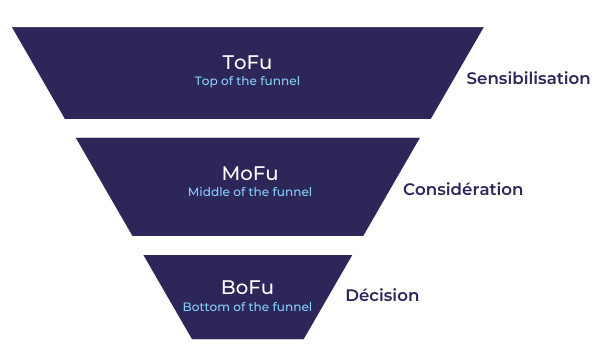
TOFU (Top of the Funnel): from visitor to lead
During this step, the Internet user becomes aware of his problem, it is the “ Discovery ” phase. He learns about his sector and the problems he thinks he is encountering. At this stage, his research is rather generic, it is therefore up to you to provide a response that is both generalists and with high added value, thanks to your expertise, to help him understand precisely his problem.
Content: blog articles, web stories, statistical reports, infographics, white papers, etc.
Ready to put this into action?
Start your free journey today — no credit card required.
MOFU (Middle of the Funnel): from lead to MQL
The second step corresponds to the so-called “ Consideration ” phase. The Internet user has identified his problem and tries to find what solutions could answer his problem.
Unlike the TOFU stage, his research is more precise. If some of the solutions appeal to him more than others, he will then get in touch with the company which, according to him, could solve his problem, in order to have more information.
This is when you will be able to convert your visitors into leads thanks to their identifications.
Contents: landing page, ebook, white papers, checklists, templates, webinars, simulators, case studies, etc.
BOFU (Bottom of the funnel): from MQL to SQL
This third step corresponds to the “ Decision ” phase. It is crucial because this is when the visitor will complete the purchase.
After the MOFU stage, the Internet user can make a list and select the companies which appear to him to be the most willing to respond to his request. He will assess the proposals, formulate requests, in order to clarify his request and make his final decision. So you have to convince him that you are the right person.
The end goal is for them to make their decision based on the goal you have set for yourself: buy a product, subscribe to a subscription, make an appointment, etc.
Contents: demo request, customer cases, the free audit.
Share this insight
This conversation is happening inside the community.
Join free to continue it.The Internet Changed. Now It Is Time to Build Differently.
If this article resonated, the next step is learning how to apply it. Inside Wealthy Affiliate, we break this down into practical steps you can use to build a real online business.
No credit card. Instant access.