AI Prompting: Storytelling Part 1: Building a Story Into a Single AI Image


Published on August 10, 2026
Published on Wealthy Affiliate — a platform for building real online businesses with modern training and AI.

Have you ever looked at an image and immediately wondered, “What happened here?”
That question is the beginning of visual storytelling.
A beautiful AI image can catch someone’s attention. A storytelling image makes them stop and wonder what is happening.
Storytelling in an AI image isn’t about writing an entire story into your prompt. It’s about giving the AI enough information to create a moment that feels as though something happened before it—and something might happen next.
The Five Ingredients of Visual Storytelling
A simple way to begin building a story into an AI image is to think about five basic ingredients:
Character/subject — Who is the story about?
Setting — Where and when are we?
Action — What is happening?
Emotion — What should we feel?
Clues/details — What objects, gestures, weather, clothing, or other details tell us more?
Let’s start with a simple café scene.

What's Happening Here?
Basic Prompt
A woman sitting alone at a table in a small café.
What does this image tell us?
The image gives us a subject and a setting, but very little story. We don’t know why she is there, what she is thinking, what happened before this moment, or what might happen next.
The image is pleasant and visually appealing, but it mostly shows us a scene rather than telling us a story.
Now Let’s Add a Story
We can take the same basic idea—a woman sitting in a café—and give the viewer more clues. We don’t have to explain exactly what happened. Instead, we can add details that suggest something happened before this moment and leave the viewer wondering what happens next.
Storytelling Prompt:
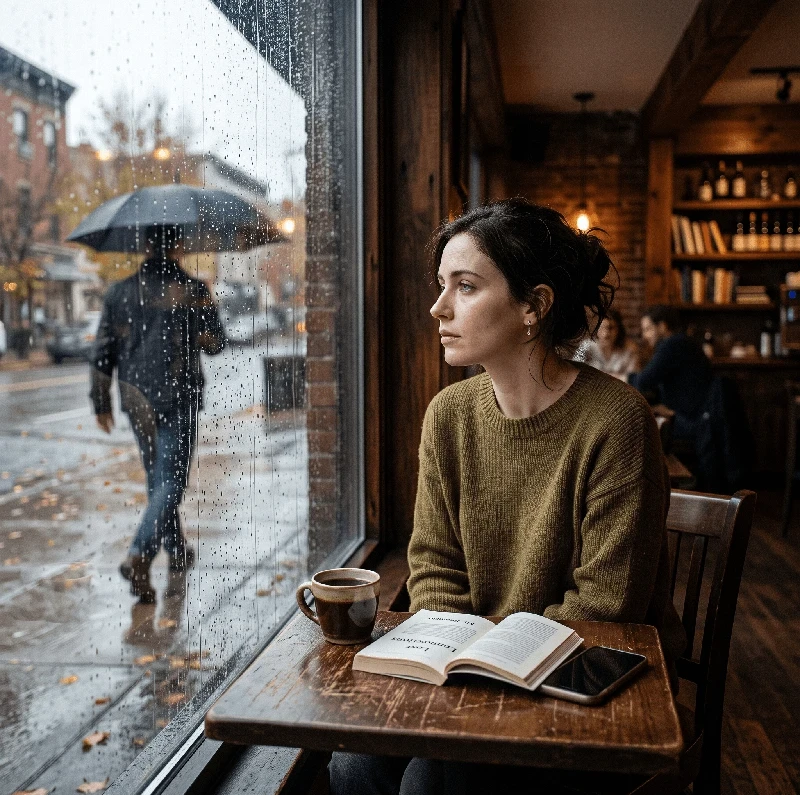
A woman sits alone at a small wooden table beside the window of a cozy neighborhood café on a rainy autumn afternoon. An untouched cup of coffee has gone cold beside her. An open book lies forgotten on the table, and her phone rests face down beside it. She is staring through the rain-streaked window toward the sidewalk, where a man holding a dark umbrella is walking away. Her expression is quiet and conflicted, as though she wants to call him back but has decided not to. Warm café light contrasts with the cool gray rain outside. Cinematic natural lighting, realistic photography, intimate composition, subtle emotional storytelling.
What changed?
The second prompt gives us much more than a woman sitting in a café. Now we have weather, action, emotion, visual clues, and another person who may—or may not—be connected to her.
Her coffee has gone cold. Her book lies forgotten. Her phone rests face-down beside it. Outside, a figure with an umbrella is walking away. Most importantly, her expression suggests that this moment matters to her.
We don’t know exactly what happened—and we don’t need to. The unanswered questions are part of the story. Did the person outside just leave her? Is she deciding whether to follow? Is she remembering someone else entirely?
Breaking Down the Storytelling Prompt
Let’s look at what we added to the simple café prompt and how those details helped create a story.
- Character/subject — A woman sitting alone, plus the mysterious figure outside the window.
- Setting — A cozy neighborhood café on a rainy autumn afternoon.
- Action — The woman stares through the rain-streaked window while a figure carrying a dark umbrella walks away.
- Emotion — Her expression is quiet and conflicted, as though she wants to call the person back but hasn’t decided what to do.
- Clues/details — An untouched cup of coffee that has gone cold, an open book she has forgotten, her phone resting face-down beside it, rain on the window, and the departing figure.
Notice that none of these details tells us the complete story. Together, however, they create enough visual evidence for the viewer to imagine one.
Give the Viewer Questions, Not All the Answers
One of the most powerful things you can do in visual storytelling is leave something unexplained.
If an image answers every question, the viewer may look at it, understand it, and move on. But when an image contains clues without revealing the entire story, the viewer becomes involved.
In our café image, we know the woman is watching someone walk away. We know her coffee has gone cold and her book has been forgotten. We know she appears conflicted.
But we don’t know why.
That missing piece creates curiosity.
Think in terms of visual questions:
- Who was here before this moment?
- What just happened?
- What is the subject thinking or feeling?
- What is about to happen?
- Why does this moment matter?
You don’t necessarily need to answer those questions in your prompt. Instead, give the AI visual clues that allow the viewer to ask them.
Capture a Moment, Not Just a Subject
Ready to put this into action?
Start your free journey today — no credit card required.
Another way to create storytelling in an AI image is to show something happening rather than simply showing something.
A prompt such as “a boy and his dog on a beach” gives us subjects and a setting.
But imagine the boy running through the surf while his dog races after a windblown red ball. One sneaker has been abandoned near the waterline, waves are splashing around his ankles, and dark storm clouds are beginning to gather offshore.
Now we have a moment.
Then:
The difference is action.
A storytelling image often feels as though someone pressed the camera shutter—or paused a movie—right in the middle of an event.
Storytelling Prompt:
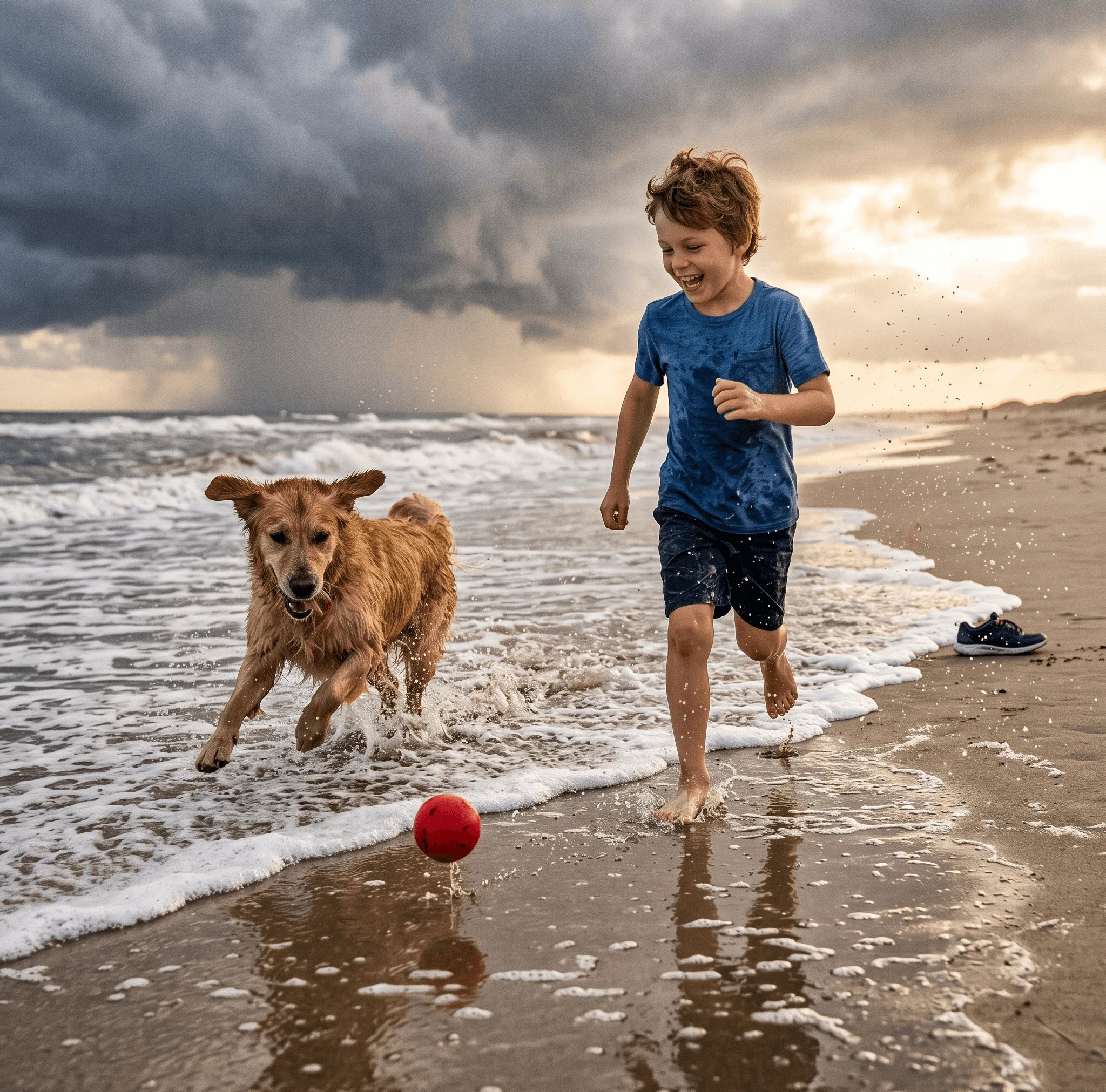
A young boy runs barefoot through the shallow surf on a windswept beach, laughing as his energetic golden retriever races beside him toward a bright red ball bouncing ahead of them. One of the boy’s sneakers lies abandoned near the waterline behind them. Small waves splash around their legs and the dog’s wet fur sprays droplets into the air. Farther offshore, dark storm clouds are beginning to gather while warm late-afternoon sunlight still breaks through behind the boy, creating a contrast between the joyful moment and the approaching storm. The boy is focused on the dog and the ball, unaware of the changing weather behind him. Cinematic natural lighting, realistic photography, dynamic action, low camera angle near the water, frozen splashes, emotional visual storytelling.
What story clues can you find?
Several details turn this from a simple beach scene into a moment with a beginning, middle, and possible next chapter.
- Movement — The boy and dog are running, the ball is bouncing ahead of them, and water is splashing around their feet. The image feels caught in mid-action.
- The red ball — It gives both the boy and dog something to pursue and helps explain why they are running.
- The abandoned sneaker — It suggests something happened just before this moment. The boy may have kicked off his shoes in his excitement to follow the dog into the surf.
- The approaching storm — Dark clouds gathering offshore tell us that this carefree moment may be about to change.
The boy’s attention — He is focused on the dog and their game rather than the threatening sky behind him. The viewer sees something the character does not.
That last detail adds another useful storytelling technique: sometimes the viewer can know something the subject in the image doesn’t. This creates anticipation because we can imagine what might happen next.
Use Objects as Storytelling Clues
Objects in an image can do much more than decorate a scene. They can suggest what happened before the moment we are seeing, reveal something about a character, or hint at what may happen next.
Think about some of the objects we have already used:
- The cold coffee suggests the woman has been sitting there for some time or has become too distracted to drink it.
- The forgotten open book tells us her attention has shifted away from whatever she was reading.
- The face-down phone might suggest she is avoiding a call, waiting for one, or deliberately disconnecting from someone.
- The abandoned sneaker suggests the boy rushed into the water without stopping to carefully remove his shoes.
- The red ball gives the boy and dog a reason for their movement and connects their actions.
None of these objects needs a written explanation inside the image. Their job is to give the viewer evidence.
Ask yourself: What could I place in this scene that tells part of the story without words?
A packed suitcase by a doorway, an unopened letter on a table, a broken toy, an empty chair, muddy footprints, a half-finished birthday cake, or a single flower left on a doorstep can each change an ordinary scene into the beginning of a story.
Storytelling Prompt
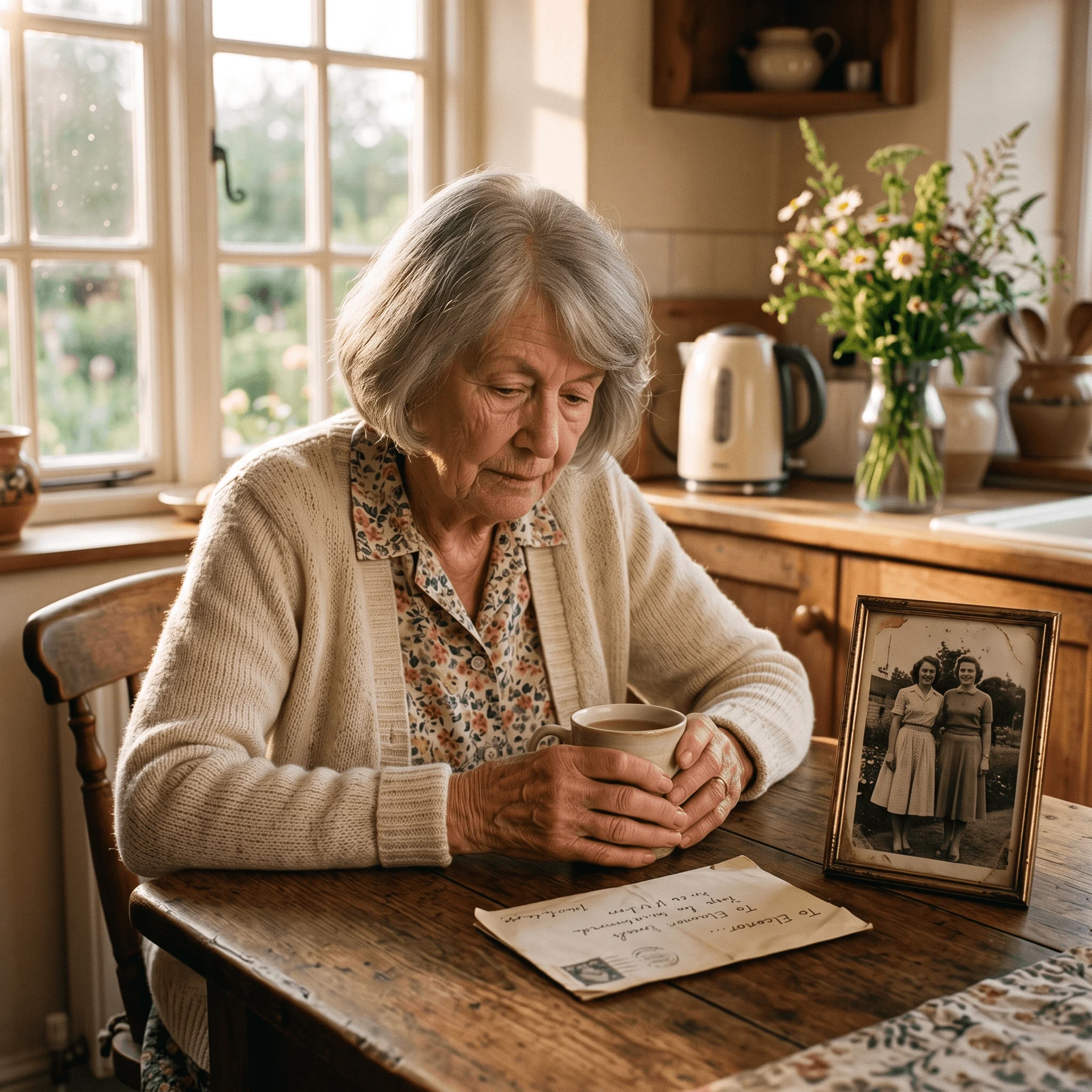
An elderly woman sits at a sunlit kitchen table in a quiet country home, her hands wrapped around a cup of tea. On the table directly in front of her lies a sealed handwritten letter, slightly worn from being handled but still unopened. She is looking at the letter rather than the camera, her expression thoughtful and uncertain. Beside the envelope is an old framed photograph of her as a young woman standing beside another young woman, suggesting a connection to the past without explaining it. Soft late-afternoon sunlight enters through a nearby window, illuminating dust particles in the air. A kettle and simple vase of wildflowers sit farther back in the kitchen. Intimate composition, realistic photography, warm natural light, subtle emotion, quiet visual storytelling, focus on the unopened letter and her reaction to it.
What does the unopened letter make you wonder?
We know almost nothing about what the letter contains, yet the photograph, the woman’s expression, and her hesitation give us enough clues to begin imagining possibilities. Who is the other woman in the photograph? Who sent the letter? Why has she not opened it? How long has she been carrying this piece of her past?
The letter is more than a prop. It becomes the object around which the story revolves.
A Simple Storytelling Prompt Formula
You don’t need to write a miniature novel every time you create an AI image. Start with the five storytelling ingredients and build from there.
Then make this stand out:
Storytelling Prompt Formula
[Character/subject] + [setting] + [action] + [emotion] + [storytelling clues/details]
Then:
You can also add the image-making choices we’ve explored earlier in this AI Prompting series, such as lighting, camera angle, composition, and color.
Prompt Template:
Create an image of [character/subject] in [setting]. The subject is [action]. Their expression/body language suggests [emotion]. Include [2–4 visual clues] that suggest what happened before this moment or what might happen next. Use [lighting], [composition/camera angle], and [color/mood] to reinforce the story.
Try It Yourself
Start with a very simple prompt:
A man standing at a train station.
Now ask yourself:
- Who is he?
- Is he arriving or leaving?
- Who—or what—is he waiting for?
- How does he feel?
- What object could give us a clue?
- What has just happened?
- What might happen next?
Then:
Choose only a few answers and turn them into visual clues. Don’t explain everything. Leave something for the viewer to discover.
Try creating your own storytelling version of the train-station prompt. If your finished image makes you wonder what happened before the moment—or what happens next—you’ve begun turning an AI-generated picture into a visual story.
From an Image to a Story
A storytelling image doesn’t need to explain everything. In fact, some of the strongest visual stories leave part of the story untold.
The goal is to move beyond simply describing what you want the AI to show. Think about the moment you want the viewer to experience.
Give your subject something to do. Give them a reason to feel something. Place clues in the scene that have a purpose. And leave just enough unanswered to make the viewer curious.
When someone looks at your AI image and begins asking, “What happened here?” or “What happens next?”—you’ve created more than an attractive picture. You’ve created the beginning of a story.
Coming Next — Storytelling Part 2
In Part 2, we’ll go deeper into visual storytelling and explore how relationships, body language, environment, point of view, and sequences of images can help us tell richer stories with AI-generated art.
We’ll also look at how some of the techniques we’ve already covered—lighting, camera angle, composition, and color—can work together to support the story rather than simply make the image look good.
-Shirley
TIP
Many of the images and examples you’ll see throughout the series are created using Kre8or.ai, the AI image creation tool available here at Wealthy Affiliate. If you’d like to experiment with your own AI images, you can try Kre8or here:
And if you found this series from Facebook, Pinterest, or somewhere else on the web and would like to learn more about building websites, affiliate marketing, content creation, and using AI as part of an online business, you can learn more about Wealthy Affiliate here:
Disclosure: This is a referral/affiliate link. I may receive a benefit or commission if you join through one of my links, at no additional cost to you.
Share this insight
This conversation is happening inside the community.
Join free to continue it.The Internet Changed. Now It Is Time to Build Differently.
If this article resonated, the next step is learning how to apply it. Inside Wealthy Affiliate, we break this down into practical steps you can use to build a real online business.
No credit card. Instant access.