Intent Is Everything: The Word That Decides Guilt, Growth, and Google Rankings


Published on February 25, 2026
Published on Wealthy Affiliate — a platform for building real online businesses with modern training and AI.
Intent - The Word That Decides Guilt, Growth, and Google Rankings

Let’s start with something controversial, Intent matters more than action.
Two people can do the exact same thing. One is praised, the other is prosecuted.
One converts while the other bounces.
What separates them?
Intent.
· In law, it determines guilt.
· In business, it determines deal flow.
· In SEO, it determines rankings.
· In life, it determines meaning.
And yet most people can’t clearly define it, so let’s fix that.
What Does “Intent” Mean?
At its core, intent refers to a person’s mental aim or purpose behind an action.
It answers the question:
Why was this done?
Intent can function as:
· A noun - such as a goal or purpose
· An adjective – as a state of focused determination
· A legal standard,
· A technical term, or
· A marketing strategy
It’s a small word, with enormous consequences.
1️⃣ Intent as a Noun: Purpose or Aim
In everyday language, intent means a person’s objective, goal, or desired outcome.
Example: “His intent was to help.”
While similar to “intention,” the word intent often implies something more deliberate — a clearer, more resolved mental plan.
It’s not just a vague hope, it’s direction with weight.
There’s also a common idiom: “To all intents and purposes”
Which means: “In effect” or “virtually.”
For example:
“To all intents and purposes, the project is complete.”
Even in casual speech, intent implies seriousness.

2️⃣ Intent as an Adjective: Focused and Determined
When used as an adjective, intent describes intense concentration or resolve.
Example: “She gave him an intent gaze.”
Or: “She was intent on winning.”
Here, intent signals:
· Deep focus
· Determination
· Mental commitment
This version of intent isn’t about what someone wants., it’s about how strongly they want it.
In other words: Intent isn’t passive., it’s energy directed at an outcome.
3️⃣ Legal Definition of Intent (Where It Gets Serious)
In law, intent is foundational, it determines criminal responsibility.
This is where we encounter mens rea — Latin for “guilty mind.”
There are multiple types:
General Intent
The intention to perform a prohibited act — without necessarily intending a specific result.
Ready to put this into action?
Start your free journey today — no credit card required.
Example: Throwing a punch (even if you didn’t intend serious injury).
Specific Intent
The intention to perform an act with the purpose of achieving a specific outcome.
Example: Acting “with intent to kill.”
Now the law is measuring purpose — not just behavior.
Constructive Intent
Intent inferred from reckless behavior, even if not explicitly stated.
If someone acts in a dangerously reckless way, intent may be assumed.
Transferred Intent
When someone intends harm toward one person but accidentally harms another.
The law transfers the intent to the actual victim.
Radical truth?
The legal system often cares less about what happened… and more about what was meant.

4️⃣ Intent in Business and Technology
Intent isn’t just philosophical or legal, it’s operational.
Letter of Intent (LOI)
In business, a Letter of Intent is a formal document outlining an agreement before finalization.
It signals serious negotiation, not commitment yet - but direction.
Intent in Technology (Android Development)
In software development — particularly Android — an “Intent” is a messaging object used to request an action from another app component.
In simple terms: it tells the system what you want to happen.
Even machines operate on intent.
5️⃣ Search Intent (The SEO Battleground)
Now let’s bring this into digital strategy.
In SEO, search intent refers to the reason behind a user’s query.
Not what they typed, but why they typed it.
There are four major types:
· Informational intent (learning something)
· Navigational intent (finding a specific site)
· Transactional intent (buying something)
· Commercial investigation (comparing options)
Here’s the radical part:
Most websites optimize for keywords, but few optimize for intent.
And Google doesn’t rank keywords, it ranks satisfaction.
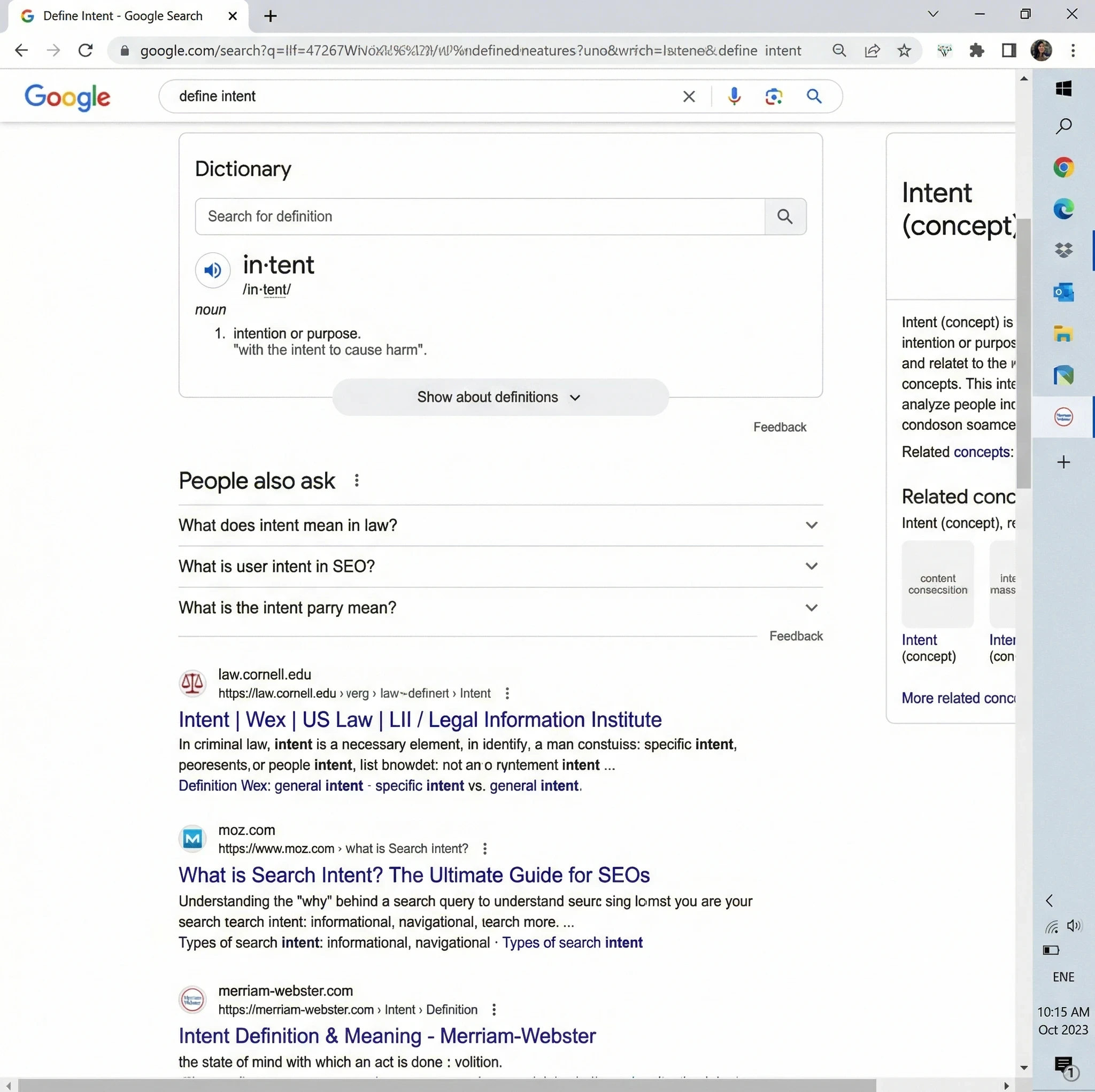
If someone searches “define intent,” they want clarity, not fluff, not sales copy and certainly not a 3,000-word distraction.
Search engines increasingly measure:
· Bounce rate
· Engagement
· Dwell time
· Return visits
If your content matches intent, you rank. if it doesn’t, you disappear.
It is INTENT that drives the algorithms.
Why Intent Is More Than a Definition
Intent reveals motive, and motive drives everything.
· In law, it determines guilt.
· In marketing, it determines conversions.
· In relationships, it determines trust.
· In SEO, it determines visibility.
The old digital mindset asked: “How do we get them to click?”
The smarter mindset asks: “What are they trying to accomplish?”
That’s a completely different question.
One manipulates behavior, while the other aligns with purpose.
Additional Layer: Intent vs Behavior
Here’s something most people misunderstand:
Behavior is observable, Intent is inferred.
Just because someone clicks doesn’t mean they want to buy.
Just because someone visits it doesn’t mean they trust.
Data shows movement, Intent reveals meaning, and Meaning is where strategy lives.
Contextual placement strengthens SEO signals.
General Disclaimer
This article is for informational and educational purposes only. Legal interpretations of intent may vary by jurisdiction. Always consult qualified legal professionals for case-specific advice.
Amazon Affiliate Disclosure
Some tools or products mentioned in related content may include Amazon affiliate links. If you purchase through these links, I may earn a commission at no additional cost to you. I only recommend products aligned with ethical and professional standards.
Call to Action
If you create content or run a business:
• Review one piece of content and identify the true search intent
• Clarify whether your messaging aligns with user goals
• Remove unnecessary persuasion where clarity is needed
• Build for understanding before optimization
Or, if you want help mapping your keywords to real intent and improving your content strategy for higher rankings, let’s build it deliberately.
One Final Thought
Actions are visible, Intent is invisible.
But the invisible part is what changes everything.
So, the real question isn’t: “What are people doing?”
It’s: “Why?”
Share this insight
This conversation is happening inside the community.
Join free to continue it.The Internet Changed. Now It Is Time to Build Differently.
If this article resonated, the next step is learning how to apply it. Inside Wealthy Affiliate, we break this down into practical steps you can use to build a real online business.
No credit card. Instant access.