I Almost Paid $27 for Claude's 'Secret Codes.' Then I Asked Claude!


Published on May 6, 2026
Published on Wealthy Affiliate — a platform for building real online businesses with modern training and AI.
Someone is currently selling a PDF for $27. I almost bought it! No link, I am not promoting it.
Their promise: Secret codes that unlock hidden Claude features the average user never finds. Exclusive prompting commands discovered deep in Claude's source code. The holy grail of AI output, better writing, deeper thinking, and more powerful results, all from a handful of two to four character strings.
The pitch is compelling. The product is fiction.
I am a new Claude subscriber. I now pay for Claude, ChatGPT, and Gemini. I added the Claude subscription to help me finish off an app that is currently on Google Play in closed testing. The app helps you break your predictability habits. If you want a sneak peek, DM me your Gmail address, and I will add you to the testers. Full disclosure, if GROK were $20 instead of $30, I may have a 4th. There is a post on the drafting board about these platforms and what you should know before subscribing to any of them. [This is why metadata is important, I do ramble on occasion].
Back to the $27 PDF/INFOGRAPHIC and why you don't need it.
It supposedly pertains to Claude. So I went straight to the horse's mouth. Here is the full truth, the codes, what they actually do, why they work on every AI ever built, and why the person selling them found nothing.
What the Source Code Actually Shows
In early 2025, researchers analyzed 512,000 lines of Claude's source code.
They searched for every viral "cheat code" circulating on social media. L99. /GHOST. /GODMODE. SCAFFOLD. Every one of them.
None of them appear. Not once.
These strings do not exist in Claude's codebase as commands, triggers, flags, or any special instruction set. There is no secret handshake that tells Claude to behave differently.
The people selling "discovered codes" did not find anything in the code. They found things that worked in the chat window and reverse-engineered a mythology around why.
The actual reason they work is simpler, less exciting, and more useful than anything being sold.
What These Actually Are
Every major AI language model, Claude, ChatGPT, Gemini, Grok, Llama, and Mistral, was trained on an enormous amount of human-written text. That text includes research papers, business writing, military doctrine, journalism, Reddit threads, productivity blogs, and millions of conversations about how to communicate more effectively.
When you type a compressed instruction like L99 or /GHOST, the model does not execute a command. It recognizes a pattern from its training data and adjusts its output accordingly. The same way it recognizes "write this as a haiku" or "explain this to me like I'm five." It has seen these conventions enough times to know what they signal.
That means every one of these codes works on every capable AI platform. Not because they are Claude-specific secrets. Because they are plain English instructions that any trained model understands.
Here is each one, along with what it does, why it works, and how to use it.
The AI Commanding Codes Explained
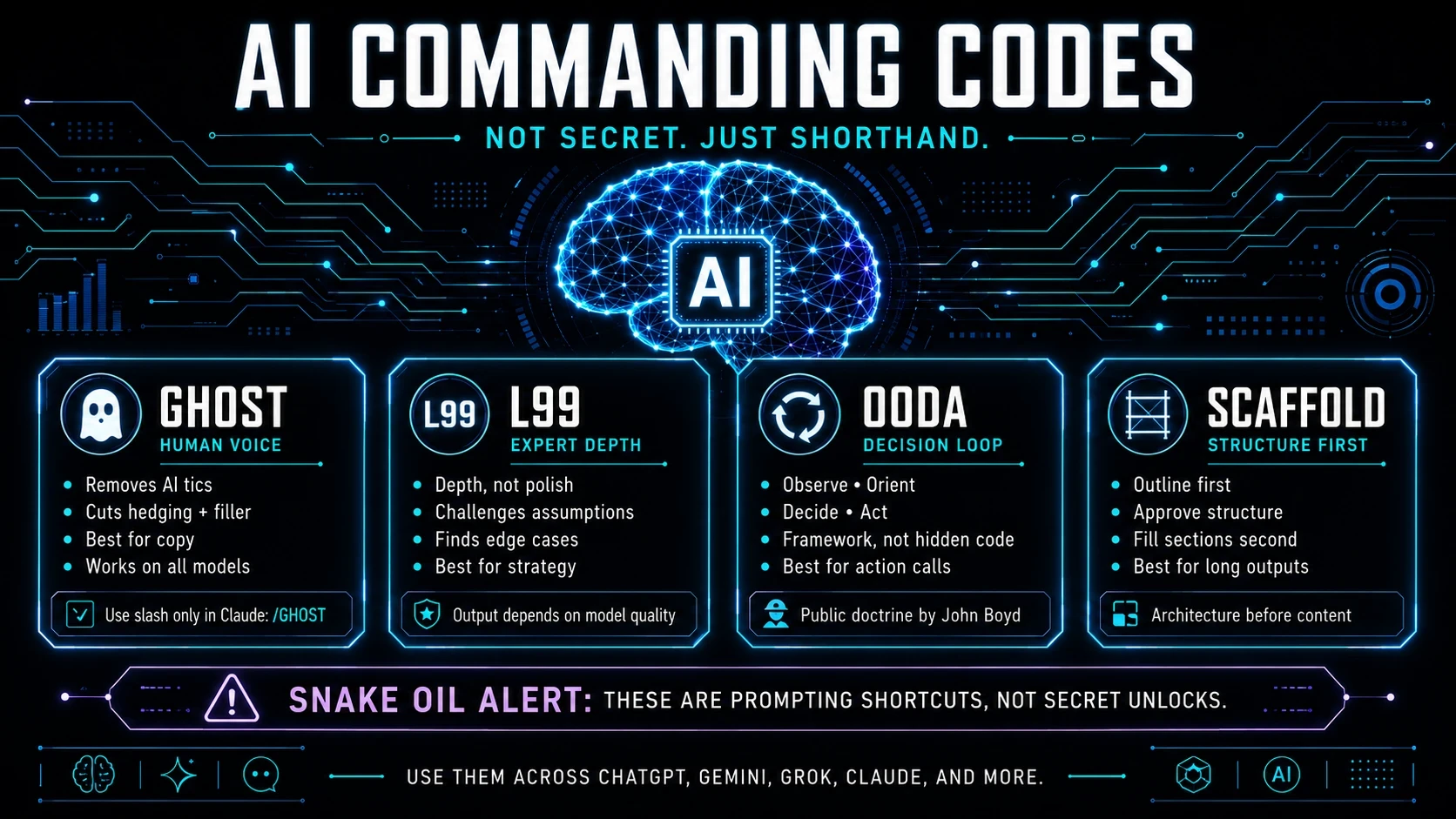
GHOST (or /GHOST)
What the sellers say: A secret command that makes Claude write like a human.
What it actually is: A compressed instruction to strip default AI writing patterns. No em-dashes used as dramatic pauses. No, "it's worth noting." No "I hope this helps." No hedging language. No robotic transitions. No five-word sentences designed to sound profound.
Why it works: Every AI model has default stylistic tendencies baked in from its training data and fine-tuning. GHOST tells the model to suppress those tendencies and write the way a direct human writer would. The model has seen enough discussion of AI writing tics to know exactly what to eliminate.
Works on: ChatGPT, Gemini, Grok, Claude, and any other model trained on enough contemporary text. Drop the slash on non-Claude platforms. Write it as GHOST or "ghost mode" since the slash prefix has no special meaning outside Claude's CLI environment.
Best used for: Cold emails, LinkedIn posts, blog copy, any content where the AI's default voice would feel synthetic to a human reader.
L99
What the sellers say: A three-character code that unlocks expert-level responses.
What it actually is: A signal that you want depth, not polish. The name references "Level 99" or maximum expertise. It tells the model: do not give me the sanitized overview.
- Challenge the assumptions.
- Name the edge cases.
- Surface the non-obvious.
- Give me what an actual expert would say, not what a content generator would produce.
Why it works: AI models default toward helpful, balanced, accessible responses. L99 overrides that default by signaling that the person asking is capable of handling complexity. The model shifts out of explainer mode and into analyst mode.
Ready to put this into action?
Start your free journey today — no credit card required.
Works on: All major platforms. On weaker models, L99 tells the model to go deep, but if the model does not have genuine depth on the topic, you will get a summary dressed up with more confident language. The instruction is universal. The output quality depends on the model.
Best used: At the end of a strategic question. "What is wrong with this funnel L99?" "Analyze this business model, L99." Not useful for simple factual questions.
OODA
What the sellers say: A hidden Claude framework for decision-making.
What it actually is: Observe, Orient, Decide, Act — A military decision loop developed by Air Force strategist John Boyd in the 1970s. It is one of the most documented decision frameworks in military and business literature. It appears in thousands of books, papers, and training programs.
Why it works: When you tell an AI to apply OODA, you are not unlocking a hidden feature. You are referencing a framework so thoroughly documented in the training data that every major model knows it in detail. The value is that OODA forces a decision recommendation rather than a pros-and-cons list. It prevents the AI from giving you a "balanced review" when you need a course of action.
Works on: Every major platform without modification. OODA is not Claude's vocabulary. It is an established strategic doctrine.
Best used: When you need a decision, not a deliberation. "Apply OODA to this go-to-market strategy." "OODA this hiring decision." Forces the model to move through observation to a concrete action recommendation.
SCAFFOLD
What the sellers say: A secret structure command.
What it actually is: An instruction to build the skeleton before filling it in. Instead of generating a complete output in one pass, which often produces mediocre everything, SCAFFOLD tells the model to generate the structure first, confirm it, then populate each section.
Why it works: Language models generate text sequentially. When they try to produce a complex, multi-part document in one pass, early decisions constrain later ones, and the model cannot revise its structure once it has committed. SCAFFOLD breaks the generation into two passes: architecture first, content second. The result is more coherent, more complete, and easier to redirect if the structure is wrong.
Works on: All platforms. The concept of outlining before writing exists in every model's training data. Call it SCAFFOLD, "outline first," or "give me the structure before the content." The instruction is the same.
Best used: Complex blog posts, multi-section reports, course outlines, business plans, any output where the structure matters as much as the content.
If you see these Snake Oil sellers, feel free to post this link in their comments, and reference more free bonus commands!
Bonus Commands
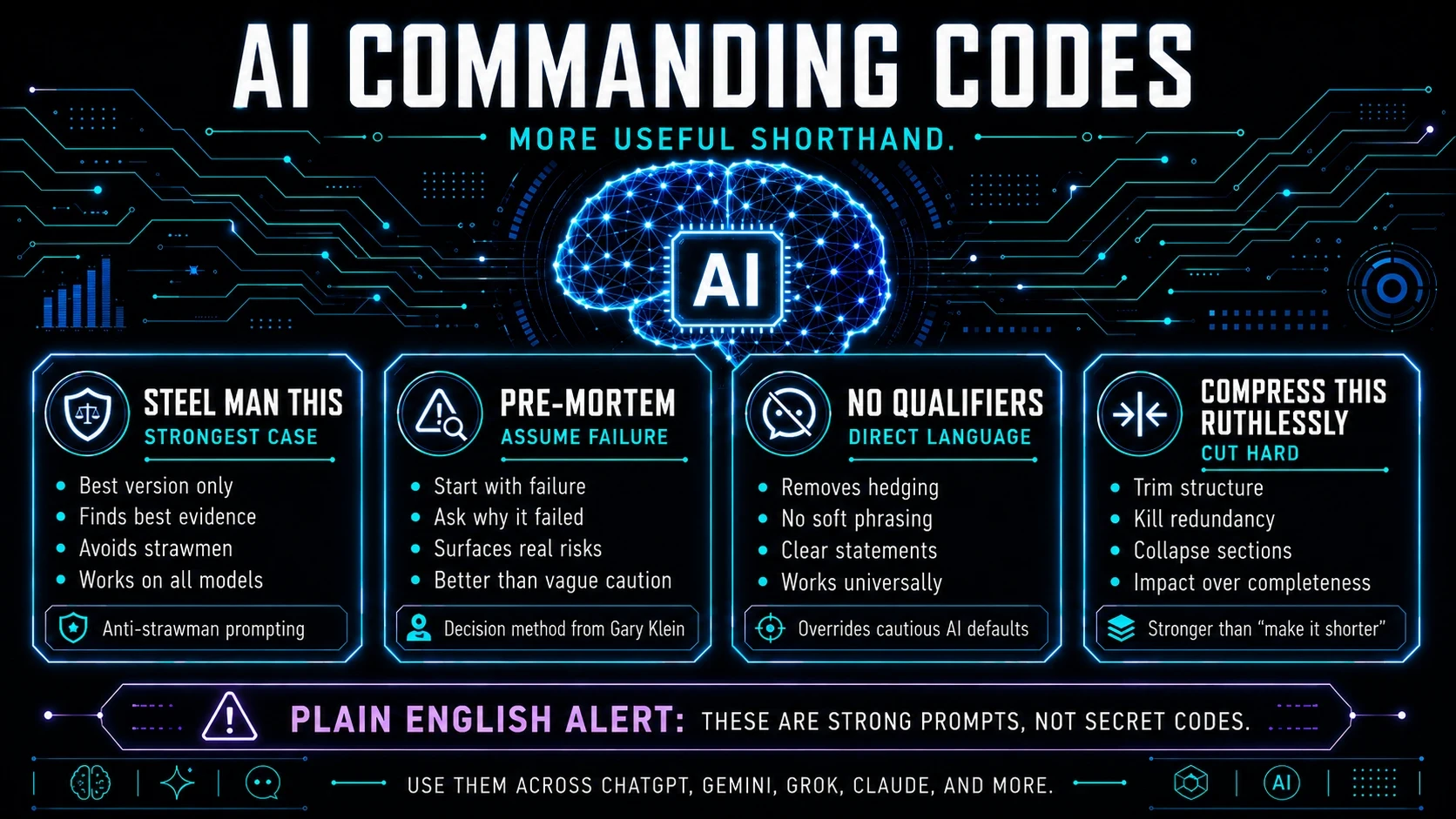
"Steel Man This"
This is not a code, it's a phrase. It tells the model to argue the strongest possible version of a position, not the easiest version to defeat.
The default AI response to "what are the arguments for X" is a strawman. This is a weakened version of the position that is easy to dismiss. "Steel man this" forces the model to find the best case, the most credible evidence, the most defensible logic, even for positions it would otherwise hedge around.
Works on every platform. The concept of steelmanning is well-documented in philosophy, debate, and critical thinking literature. Every major model knows what it means.
"Pre-mortem:"
A technique from Gary Klein's research on decision-making. Instead of asking "what could go wrong," you assume the plan already failed and ask why.
The difference matters. "What could go wrong" produces a cautious list of risks. "Pre-mortem" forces the model into a specific failure scenario and produces more honest, more specific analysis. It bypasses the model's default toward supportive feedback.
Works universally. Pre-mortem is a documented business and psychology methodology with extensive representation in training data.
"No Qualifiers"
Strips hedging language from the output. No "it's worth noting," "you might consider," "in some cases," "it could be argued." Every sentence becomes a direct statement.
This is the simplest instruction on the list. It is four plain English words. It works on every AI because every AI understands what a qualifier is. The reason it needs to be said is that hedging is baked into AI defaults. All models are trained to be careful, balanced, and non-committal on anything that could be contested. "No qualifiers" overrides that default directly.
"Compress This Ruthlessly"
Better than "make this shorter" because it signals a different operation. "Make this shorter" tells the model to trim words. "Compress this ruthlessly" tells the model to cut structure, eliminate entire sections, collapse redundant points, and sacrifice completeness for impact.
The word "ruthlessly" does real work here. It signals that nothing is sacred. The model will protect the content it generated by default. "Ruthlessly" removes that protection.
The Real Secret - There is No Secret
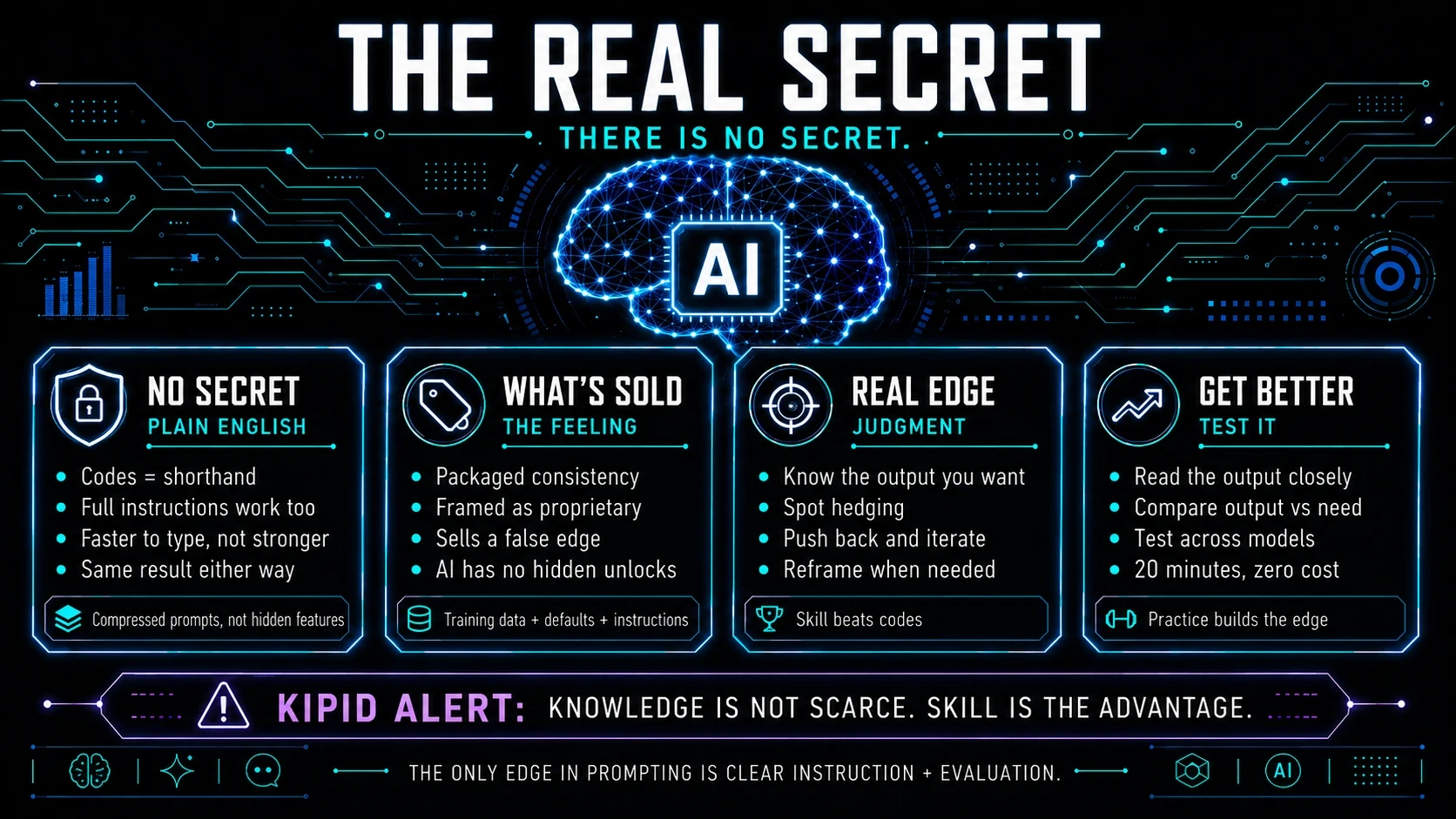
Every one of these codes is a compressed plain-English instruction. You could write out the full instruction in a sentence and get identical results. "Write this without any hedging language or AI writing patterns" produces the same output as GHOST. "Give me expert-level depth, challenge the assumptions, and surface the non-obvious" produces the same output as L99. The codes exist because they are faster to type, not because they are more powerful.
The person who sells them did not discover hidden functionality. They discovered that compressed instructions produce consistent results, packaged that discovery as a proprietary system, and charged for access to information you are reading right now for free.
That sale is only possible because people believe AI has secrets. It does not. It has training data, defaults, and the ability to follow instructions. The better your instructions, the better your output. That has always been true.
And here is the Knowledge is Power is Dead (KIPID) layer that closes the loop: the knowledge being sold is not scarce. It never was. You can ask any AI what prompting techniques produce better output, and it will tell you. You can test them yourself in ten minutes. The product being sold is not the codes. It is the feeling of having found something others missed.
No one found anything. The models are not hiding anything. The only edge in AI prompting is understanding what output you are trying to produce and communicating that clearly.
That is not a secret. That is a skill.
What Actually Makes You Better
Not codes. Not commands. Not a $27 PDF.
Understanding what you want before you ask for it. Knowing the difference between a question that needs depth and one that needs brevity. Recognizing when an AI is hedging instead of answering. Knowing when to push back on the first response, when to iterate, and when to reframe the question entirely.
These are judgment skills. They develop through use, not purchase.
The codes in this article are free. They work on every platform. And the most important one is not on this list. It is the habit of reading what the AI actually produced and asking whether it is what you actually needed.
That gap between what was produced and what was needed is where all the skill lies.
No one is selling that. You build it yourself.
You use AI every day. Get in the habit of getting better information than your competition.
Test every code in this article today. On Claude, on ChatGPT, on Gemini. Watch what changes. The experiment takes twenty minutes and costs nothing. That is the only tutorial you need.
Share this insight
This conversation is happening inside the community.
Join free to continue it.The Internet Changed. Now It Is Time to Build Differently.
If this article resonated, the next step is learning how to apply it. Inside Wealthy Affiliate, we break this down into practical steps you can use to build a real online business.
No credit card. Instant access.