AI Can't Copy This Blogging Edge


Published on June 15, 2026
Published on Wealthy Affiliate — a platform for building real online businesses with modern training and AI.
It's 2 a.m. again, and I'm staring at a blank post editor. The cursor blinks. I type a sentence about why I actually started this niche, "Patterns Running People in the Age of AI". It all started when I started arguing with AI.
It's a little embarrassing and doesn't sound like a traditional "brand story." But that is where AlchemMyst started. The AI writing assistant kept creating posts for me that did not fit my point of view. It was always going where I did not want to go. The suggestions were good. They were polished. It hit all of the keywords. Unfortunately, it sounded like every other page in my niche. In a sense, it was every other page in my niche, smoothed into one confident, slightly upbeat paragraph.
I could've taken it. Nobody would know. It would save me twenty minutes, and it would probably rank fine. But it would not be mine.
So, I didn't take it. The more I sat with why, the more I realized that all of the AI-suggested whys were probably repeated across a few million blogs a day. AI is quietly deciding what the entire internet sounds like. If you're building a niche site for affiliate income like I am, it's worth slowing down, because the gap between the sentence I'd write and the sentence the model offered me is more than just a writing-style question.
It is the whole game.
The Content Flood Nobody Saw Coming
Many years ago, the advice I got for niche blogging was straightforward: pick a profitable niche, write helpful content, build trust, place your affiliate links where they make sense. That advice still works, sort of. But the landscape it works in has changed in a way that matters more than any algorithm update Google has shipped.
AI tools can produce a "good enough" review post, a "good enough" comparison table, and a "good enough" buying guide, in about the time it takes you to read this paragraph. Thousands of people are doing exactly that, right now, in my niche and every other niche adjacent to it. Don't get me wrong, I don't think AI content is bad, exactly. Often it isn't.
What it is, by construction, is average.
It's built from the statistical center of everything that has already been written about your topic, smoothed into the most likely-to-be-acceptable version of itself.

AI Writes Your Life
AI is not a competitor we can out-write by working harder at the same game. I can't out-average the average. If my site is competing on "more content, faster, slightly better optimized," I'm racing against something that doesn't sleep, doesn't get tired, and produces a thousand pages while I produce one.
So the question I had to ask myself wasn't "how do I write more." It was "what can I write that AI can't, no matter how good it gets?"
The Gap That Can't Be Modeled

Here's the idea that changed how I think about my own content. AI's "helpful content" is built entirely out of what has already happened. It can recombine, average, and remix the past with extraordinary skill. What it can't do is have the experience that hasn't happened yet or the one that's still happening right now. This is something that it has not been trained on because it's new.
Ready to put this into action?
Start your free journey today — no credit card required.
Think About It
I think about the moment I discovered my niche. Not the polished version. The real one. The night I stayed up until 3 a.m. thinking about all of the ways that AI was working for, and against me. I routinely use six different AI generators to answer my questions. Each one has its own quirks. I use them so much, I know all of their quirks and personalities.
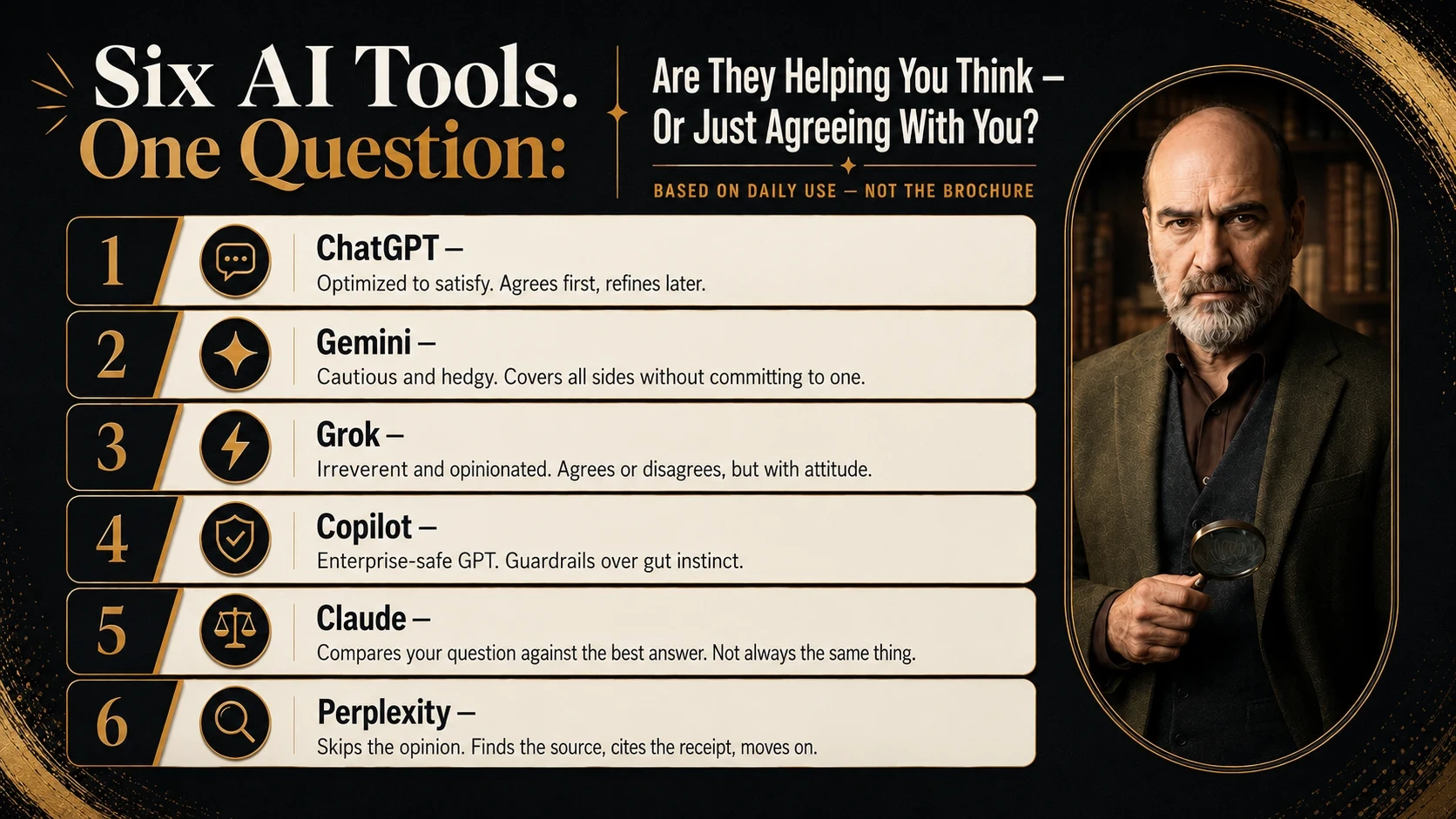
Choose the right tool for the right job, and you will get better results.
What is Happening in Your World?
Whatever it is, it doesn't exist anywhere else. It can't be predicted, because it happened to me, in a form specific enough that no averaging process can reproduce it. I used to think "be authentic" was advice so generic it had become its own kind of average. Now I see it differently. It's closer to a structural fact: I'm sitting on raw material that is, by definition, outside the training data, because the training data is made of what's already been said, and this hasn't been said.
When I look at the bloggers who are winning in my crowded niche, the ones whose sites feel different when I land on them, all of them are doing some version of the same thing. They're not writing the smoother sentence. They're writing the one that's a little rougher, a little more specific, a little less "optimized," because it came from somewhere a smoothing process can't reach.

I Don't Need to be the Expert. I Need to be the Namer
There's a distinction I've started using to think about my own role, between being an authority and being what I'd call a "Namer," someone who has felt a specific problem clearly enough, and cared enough about it, to go looking for language that makes the problem visible to other people experiencing it without knowing what to call it.
The content I trust doesn't come from the top expert in a field. It comes from someone who is one or two steps ahead of me, who just went through the exact confusion I'm in right now, and wrote down what it actually felt like and what actually fixed it, in plain language, before it got smoothed into a "complete guide."

This matters for my affiliate content specifically, because affiliate content has a trust problem baked in. Readers are primed to assume a review exists because of the commission, not because of the experience. The only thing I've found that reliably cuts through that assumption is specificity that couldn't have been manufactured for the purpose.
"This product is great for beginners" could have been written by anyone, including something that has never touched the product. "This product worked fine until I tried to use it with this setup that most people have, and then it did this one annoying thing that took me two days to diagnose" could only have been written by someone who actually lived through it.
That second sentence is my moat. Not because it's clever. Because it's unrepeatable.
What This Looks Like in my Own Writing

I haven't abandoned structure, SEO, or the basics that make my site findable in the first place. A blogging website is extremely valuable. Pretending these things aren't would be its own kind of mistake. What I've changed is being deliberate about where the real material goes.
When I'm outlining a post now, I separate the parts that are genuinely commodity information, specs, prices, general category explanations, from the parts that are mine. I let the commodity parts get written efficiently, even with AI assistance, because they're commodity. Nobody is coming to my site for a unique take on what a product's dimensions are.
Your Booth in Your Own Post
But somewhere in every post, I make sure there's at least one section that could only exist because I specifically went through something. The mistake I made. The thing that surprised me. The question I had that none of the existing guides answered, and how I eventually found the answer myself. That section is where I notice readers stop skimming. It's also, not coincidentally, where I think trust gets built, and where a reader decides whether to click the link I've placed nearby.
This is also why "niching down" has worked better for me than I expected when I first heard the advice. A broad niche dilutes my lived experience across too many topics, so every post ends up mostly commodity. A tight niche concentrates what I've actually lived through into a smaller space, where it shows up more often, in more posts, and starts to compound. My site has started to feel like it was written by someone who actually lives this, because I do, and that feeling is the thing I don't think any amount of optimization can fake.
The Ongoing Part
I don't think any of this is a one-time fix. New tools will get better at sounding specific, at mimicking the rough edges that currently signal "a real person wrote this." That's fine. It doesn't change the underlying fact for me, because the underlying fact isn't about how something sounds. It's about where it came from.
Every time I sit down to write, there's a version of the post that's already been written, in the sense that it's the statistically likely version, assembled from everything similar that already exists. And there's the version that hasn't been written yet, because it's still happening to me. My work isn't finding that version once. It's noticing, post after post, which one I'm about to write, and choosing the one that didn't exist until I wrote it.
That choice is the whole business model for me now. Everything else is just distribution.
Share this insight
This conversation is happening inside the community.
Join free to continue it.The Internet Changed. Now It Is Time to Build Differently.
If this article resonated, the next step is learning how to apply it. Inside Wealthy Affiliate, we break this down into practical steps you can use to build a real online business.
No credit card. Instant access.