The Day I Realized My Blog Was No Longer the Front Door


Published on June 8, 2026
Published on Wealthy Affiliate — a platform for building real online businesses with modern training and AI.

The web didn't kill blogging. It reassigned it. Here's the architecture nobody is talking about.
I've been blogging for a long time.
Long enough to remember when "start a blog" was the whole strategy. You installed WordPress, you wrote, Google found you, readers came. If you were good at it, money followed.
Simple. Clean. It worked.
Then a few months ago I pulled up my analytics and sat there quietly for a minute.
The numbers weren't catastrophic. But the direction was unmistakable. Slower. Quieter. Less.
I'd done everything right. The meta descriptions. The internal links. The keyword research. The content calendar. And I was watching the returns shrink anyway.
It took me a while to understand why. When I did, it changed how I think about everything I've built online.
The Floor Moved
Here's what I found when I went looking for answers.
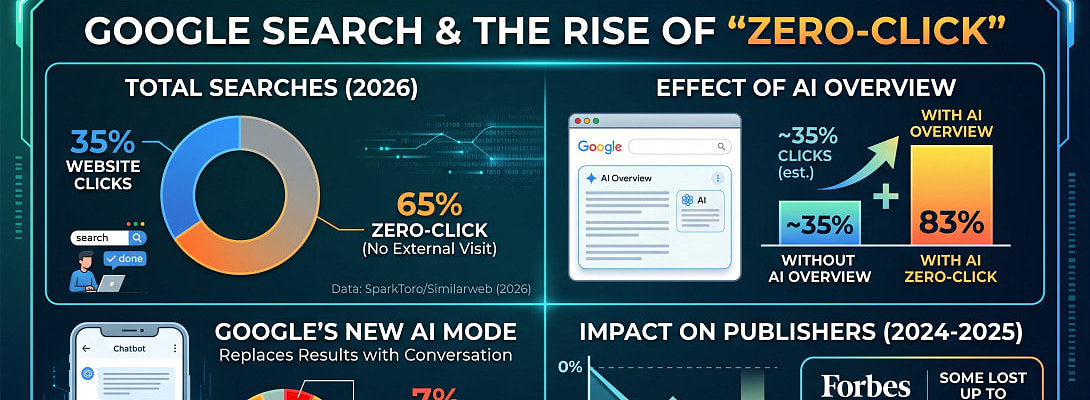
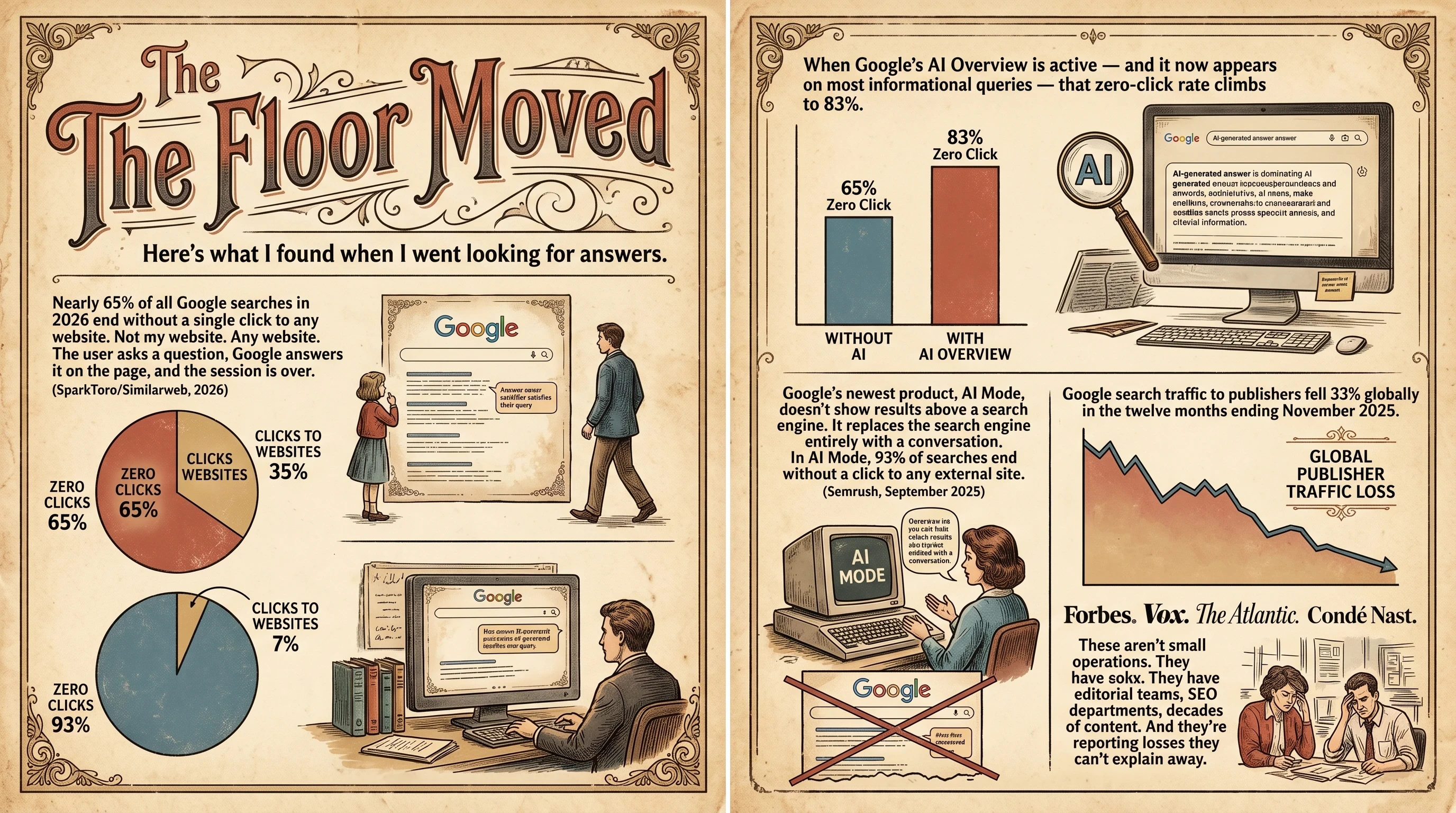
Nearly 65% of all Google searches in 2026 end without a single click to any website. Not my website. Any website. The user asks a question, Google answers it on the page, and the session is over. (SparkToro/Similarweb, 2026)
When Google's AI Overview is active — and it now appears on most informational queries — that zero-click rate climbs to 83%.
Google's newest product, AI Mode, doesn't show results above a search engine. It replaces the search engine entirely with a conversation. In AI Mode, 93% of searches end without a click to any external site. (Semrush, September 2025)
Google search traffic to publishers fell 33% globally in the twelve months ending November 2025.
Forbes. Vox. The Atlantic. Condé Nast. These aren't small operations. They have editorial teams, SEO departments, decades of content. And they're reporting losses they can't explain away.
I could explain it.
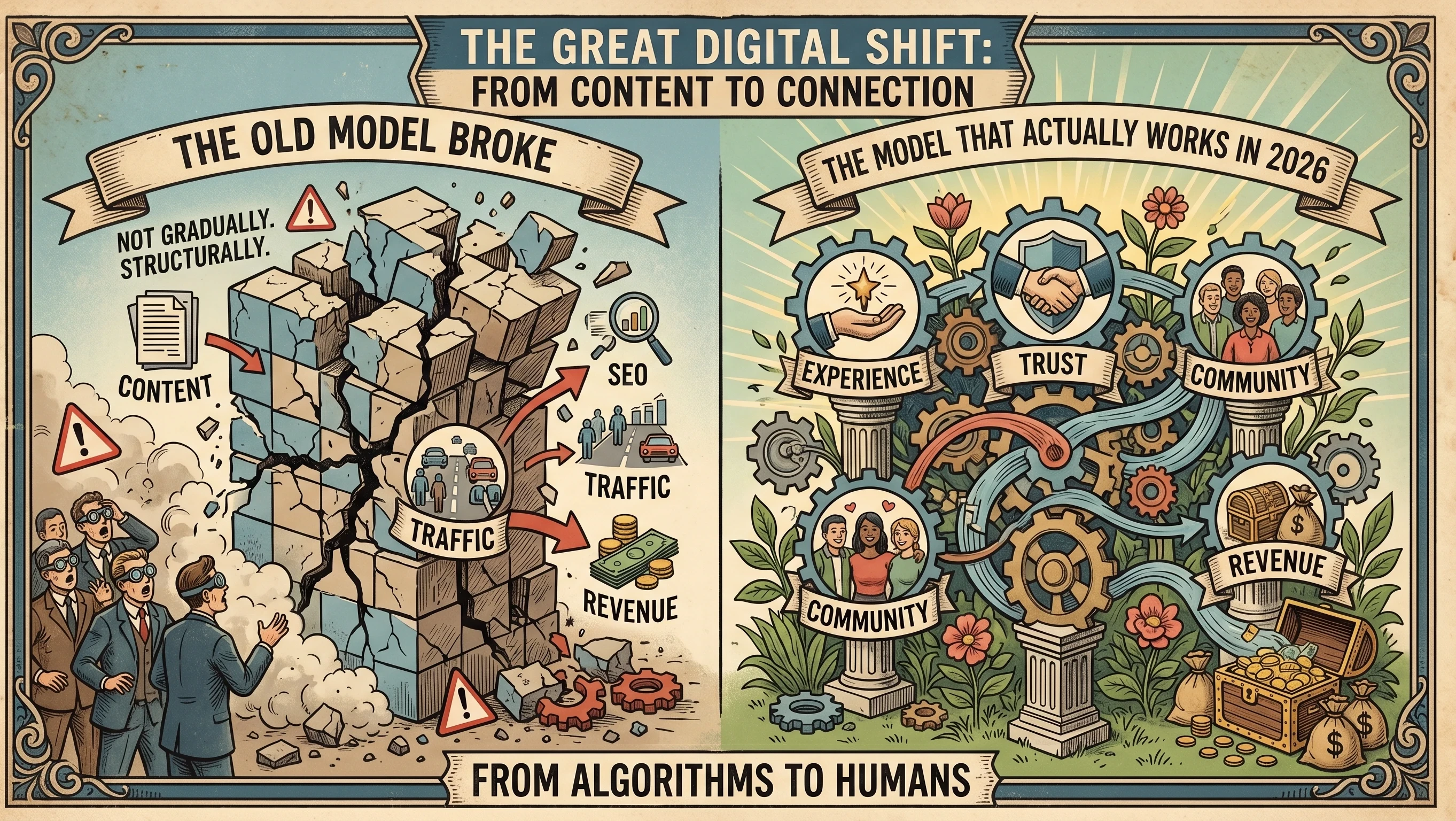
The model broke. Not gradually. Structurally.
The model we all built on: Content → SEO → Traffic → Revenue
The model that actually works in 2026: Experience → Trust → Community → Revenue
That shift from content to experience is the whole conversation.
WordPress Didn't Fail. It Changed Jobs.
For the last twenty years, WordPress was the complete digital presence.
One platform. One login. Content creation, SEO, discovery, monetization, brand identity, all of it lived there. WordPress was the business.
But here's what I finally understood: that was never really about WordPress.
WordPress was the engine. Google was the fuel.
When the fuel changed, the engine stopped mattering the way it used to.
The model that powered every affiliate blog, every informational site, every ad-revenue publishing operation has broken at the middle step. The writing still works. The ranking still works, technically. Traffic is what stopped coming.
And it stopped for a structural reason, not a quality reason.
Here's the painful part: AI Overviews and featured snippets now share 66% of their source material. If you win a featured snippet — the holy grail of the old SEO game — you're probably feeding the AI Overview that's replacing your click.
The better your content, the more useful it is to the machine that's keeping people away from it.
That is not a solvable SEO problem. That is a business model problem.
WordPress is not dead. It changed jobs. It's no longer the front door to your digital presence.
It's the vault behind the front door.
The front door is somewhere else now. Most bloggers haven't built it yet.
The Two-Layer Model
This is the architecture that makes sense of everything.
Ready to put this into action?
Start your free journey today — no credit card required.
Layer One is WordPress — the Authority Layer.
This is where your thinking lives. Evergreen content. Original frameworks. Deep essays. The intellectual vault that proves you know what you're talking about.
Its new job is not to attract traffic. Its new job is to be cited.
AI systems are now the first point of contact between a question and an answer. When those systems respond, they cite sources. The sources they cite are credible, structured, and readable by their crawlers.
Here's something that should alarm every blogger: 73% of websites are currently blocking AI crawlers — often through legacy settings from the bot-blocking era. If an AI crawler can't read your site, you don't exist to the system that now mediates the web. (ZipTie.dev, 2026)
Pages with proper schema markup are 36% more likely to appear in AI summaries. That's a significant technical advantage most bloggers haven't claimed.
Layer Two is the Interactive Layer — the Experience.
This is the part most WordPress bloggers don't have. And it's the part that matters most right now.
The Interactive Layer is something a user moves through — not a page they read. A quiz. A diagnostic journey. An identity engine. A personalized output that changes based on who you are and what you say.
Ask yourself this about any piece of content you've created:
Can an AI summarize this and give the user what they came for without them ever leaving the search page?
For a post explaining "What Is Color Psychology" — yes. Two sentences. Zero-click. Gone.
For a 20-question diagnostic that returns a personalized identity profile based on your specific answers? No. There's nothing to summarize. The experience is the product.
This is where the new attention lives.
What AI Can and Cannot Do to Your Blog
Let me be direct.
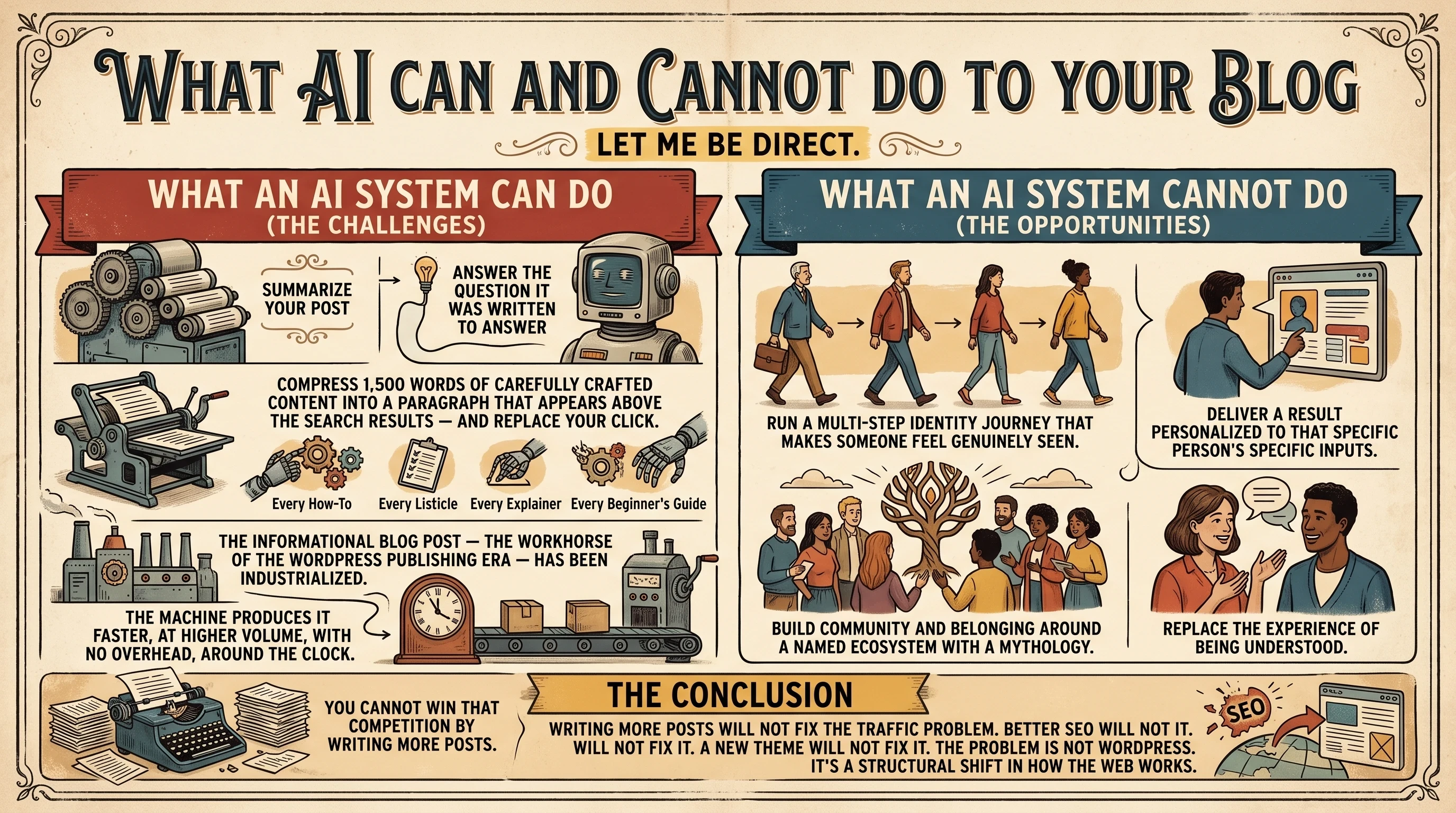
An AI system can summarize your post, answer the question it was written to answer, compress 1,500 words of carefully crafted content into a paragraph that appears above the search results — and replace your click.
Every how-to, every listicle, every explainer, every beginner's guide is vulnerable to this. Now. Not eventually.
The informational blog post — the workhorse of the WordPress publishing era — has been industrialized. The machine produces it faster, at higher volume, with no overhead, around the clock.
You cannot win that competition by writing more posts.
What an AI system cannot do:
- Run a multi-step identity journey that makes someone feel genuinely seen
- Deliver a result personalized to that specific person's specific inputs
- Build community and belonging around a named ecosystem with a mythology
- Replace the experience of being understood
Writing more posts will not fix the traffic problem.
Better SEO will not fix it. A new theme will not fix it. The problem is not WordPress. It's a structural shift in how the web works.
You can build something the machine cannot be.
That's the whole game now.
The Boomer Blogger's Manifesto
We built the original internet.
Not Silicon Valley. Not the venture capitalists.
We did. The bloggers. The writers. The people who looked at a blinking cursor in the early 2000s and thought — I have something to say — and hit publish for the first time.
We were the content before "content" became a job title.
And we've been told we were obsolete before. Repeatedly.
When social media arrived, they said blogging was dead. We adapted. When mobile took over, they said long-form was over. We adapted. When content farms flooded the zone, they said authentic voices were drowned out. We adapted.
Now they're saying AI killed the blog.
Fine. We've heard that song before.
Here's what's actually true: the written word is not dead. It changed jobs.
For twenty years, writing was the front window of your digital presence. The thing that caught the light and pulled people in off the sidewalk.
The front window now belongs to something else — the interactive experience, the diagnostic journey, the identity engine. The thing that reaches out and meets people where they are.
The writing moved to the foundation.
And foundations matter more than windows.
Nobody admires a foundation. You don't see it, you don't walk through it, you can't find it on Google. But without a solid one, the house doesn't stand.
The web is no longer a library. It is a labyrinth.
And the Boomer Blogger? We know how to build labyrinths.
Where to Start
You don't need to become a developer. The gap is not technical — it's conceptual.
Here's the short version:
1. Check your robots.txt file. Confirm you're not blocking AI crawlers — GPTBot, Google-Extended, PerplexityBot, ClaudeBot. If they can't read you, you don't exist to the AI. Free fix. Most people haven't done it.
2. Add schema markup. Structured data makes your content 36% more likely to appear in AI summaries. Table stakes, not advanced work.
3. Build your email list like your business depends on it. Because it does. Email is the only channel you fully own.
4. Identify your interactive layer. What experience could you build that an AI cannot summarize on a search page? That is your new front door.
5. Let WordPress be the vault. Keep writing. Keep building depth. Stop expecting it to be the traffic engine.
The frame that changed everything for me:
WordPress = the vault. Interactive experience = the front door. AI = the intelligence inside. You = the architect.
The two-layer future isn't coming.
It's here.
What's the experience you'd build if you stopped writing for Google and started building for humans? I'd genuinely like to know — drop it in the comments.
Share this insight
This conversation is happening inside the community.
Join free to continue it.The Internet Changed. Now It Is Time to Build Differently.
If this article resonated, the next step is learning how to apply it. Inside Wealthy Affiliate, we break this down into practical steps you can use to build a real online business.
No credit card. Instant access.