AI Agents Are Changing How Your Website Gets Found


Published on May 3, 2026
Published on Wealthy Affiliate — a platform for building real online businesses with modern training and AI.


Most bloggers still write for only one reader.
That used to work.
Today, your blog post has to pass through a second reader before humans ever see it: AI.
AI search tools, answer engines, and agents are now scanning your content, extracting meaning, and deciding whether your page is useful enough to surface. AI-related bots now make up a growing share of web traffic, and that shift changes how bloggers need to think about visibility.
This does not mean you need to become technically fluent in writing for AI.
It means your content needs to be clear enough for people and structured enough for machines.
Most website owners still think visitors arrive the old-fashioned way.
A person searches Google, clicks a blue link, lands on a page, scans the headlines, scrolls through the article, and decides whether the site is useful. While that still happens, it is not as often as we would like. AI changed that.
AI agents, AI search tools, and answer engines have changed how information gets discovered. They do not browse websites the way people do. They do not care how clever your introduction sounds. They do not pause to admire your layout. They scan, parse, extract, and summarize.
Your website now has two audiences.
My simple rule is that I write for humans. I let AI write for machines. Your themes and SEO plugins (YOAST/RankMath) write for the machines.
This is where many website owners get confused. They hear that AI systems look for schema markup, structured content, and APIs. Then they jump to the wrong conclusion:
“If I do not have schema or APIs, AI cannot find me.”
That thought is overstated.
Schema helps. APIs help in certain situations. Clean content structure matters most. Technical enhancements support it.
AI needs to understand what your page is about, what question it answers, and whether the information is accessible.
AI Does Not Experience Your Website
A human visitor can make sense of a messy page. They can skim, guess, and follow your personality. They can even figure out what you meant, even when your structure is loose.
AI systems are different. They look for signals, parse your HTML, and read headings. They even extract meaning from your text, follow links, and use structured data when it is available. They may interact with APIs when the task requires it.
This makes your blog post structure more important than ever. A clever page that hides its point is harder for AI to use. A simple page with a clear headline, logical sections, and direct answers is easier to understand.
It simply means that your content needs to be organized. You organize for humans, schema follows your lead.
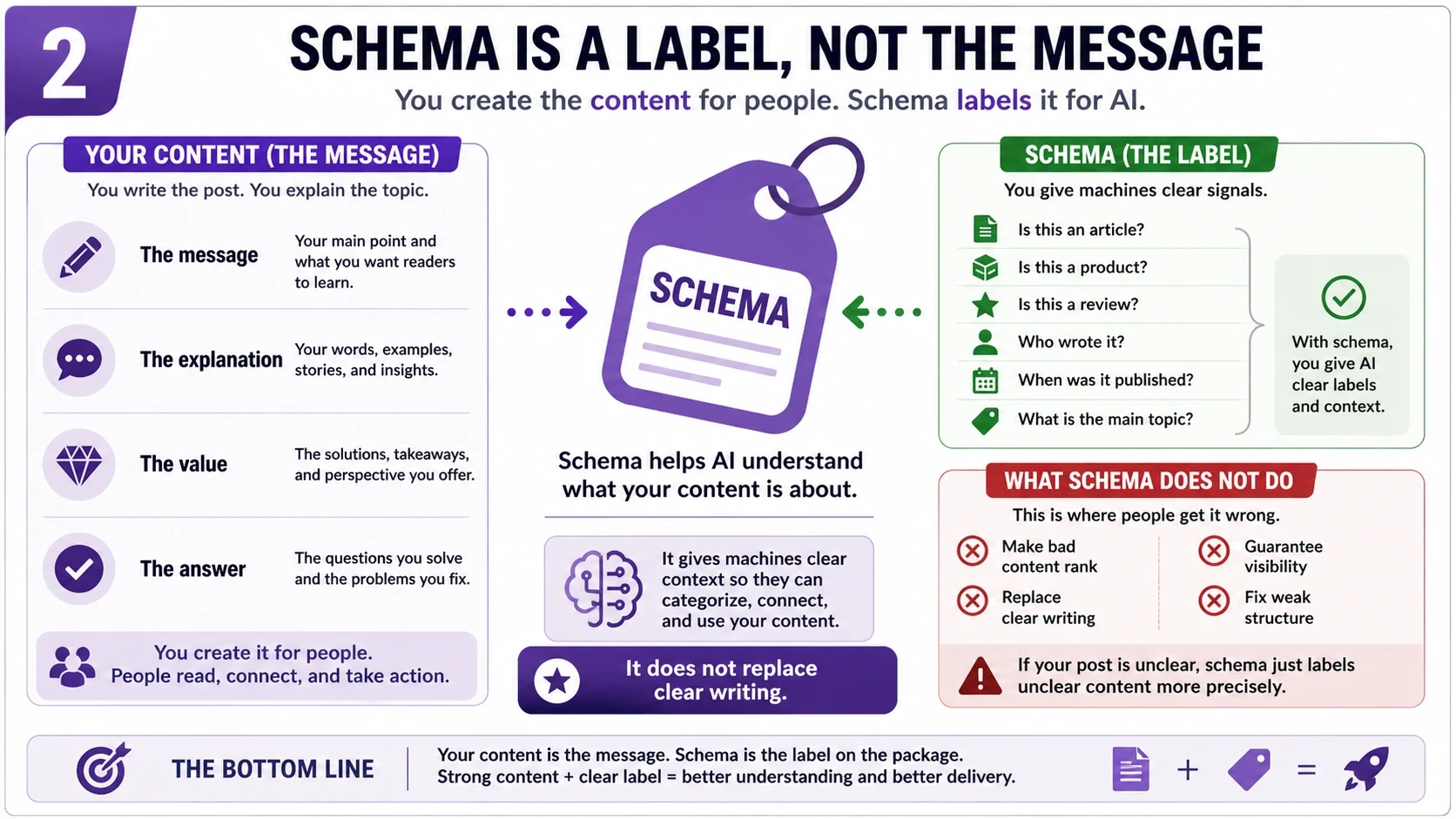
Schema Labels Your Content
When you write a blog post with Headers, Pull Quotes, images, and tables. You are creating content for people to follow your points.
Schema labels your post for AI. Your content still does the explaining.
It answers questions like:
- Is this an article?
- Is this a product?
- Is this a review?
- Who wrote it?
- When was it published?
- What is the main topic?
Ready to put this into action?
Start your free journey today — no credit card required.
Without a schema, search engines and AI systems infer this from your page. With schema, you give them clearer labels.
The Real Role of Schema
Think of it like this:
Your content is the message.
Schema is the label on the package.
If the message is strong, the label helps it get delivered faster and more accurately.
If the message is weak, the label does not save it.
What Schema Does Not Do
This is where people get it wrong.
Schema does not:
- Make bad content rank
- Replace clear writing
- Guarantee visibility
- Fix weak structure
If your post is unclear, schema just labels unclear content more precisely.
Clarity Is the Real Gatekeeper
The biggest issue is not missing the schema.
The biggest issue is unclear content.
If your article tries to cover too many ideas at once, AI has a harder time identifying the main point. If your headline is vague, your sections are random, and your answer is buried, your content becomes less useful and generally skipped.
Clear content gives AI something to work with.
That means every important page should have:
- One clear topic
- A strong title
- Logical H2 sections
- Direct answers
- Specific examples
- Internal links to related pages
- A clean conclusion
This also helps human readers.
Good structure is not just for machines. It makes your content easier for people to trust, follow, and act on.
What Actually Determines AI Visibility
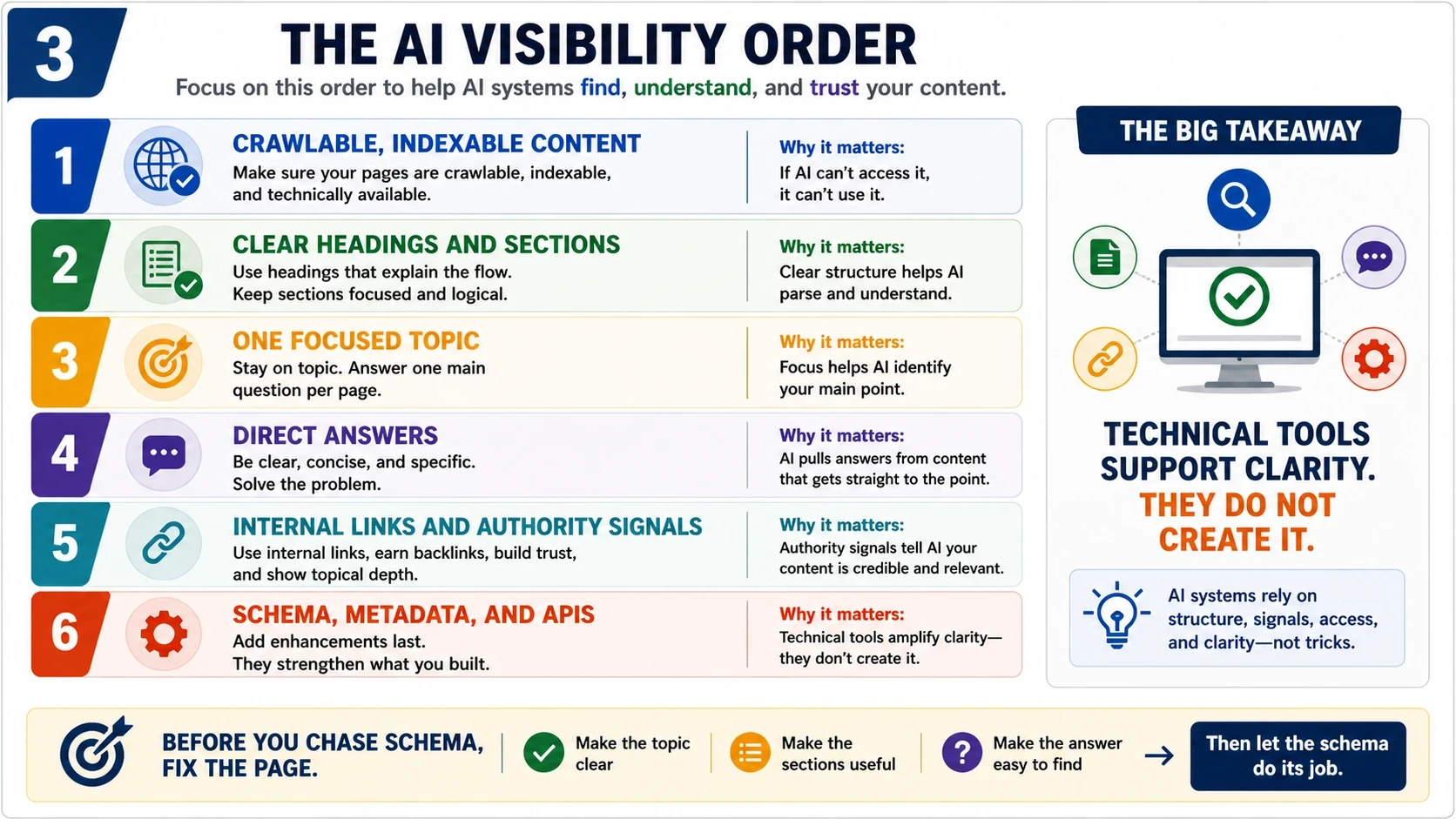
If you want your site to be more visible to AI systems, focus on the right order.
First, make sure your content is accessible. Your pages need to be crawlable, indexable, and technically available.
Second, make the structure clear. Use headings that explain the flow of the article. Keep sections focused. Make the purpose of the page obvious.
Third, answer specific questions. AI systems work best with content that solves a defined problem.
Fourth, build authority. Consistency, internal linking, external references, author credibility, and useful topical depth all help.
Fifth, add enhancements. Schema markup, metadata, and APIs can strengthen the foundation you already built.
That order matters.
Technical enhancements work best after the content is already clear.
The Real Rule for Website Owners
AI agents do not browse like humans.
That part is true.
They rely on structure, signals, access, and clarity.
But missing schema or APIs does not automatically make your website invisible.
The real rule is this:
If your content is clear, focused, accessible, and structured, AI systems have a better chance of understanding it.
If your content is vague, scattered, or buried under weak organization, AI systems have less reason to use it.
That is the shift website owners need to understand.
The future of visibility is not just about writing more content.
It is about making your content easier to understand, easier to verify, and easier to use.
Before you chase schema, fix the page. Make the topic clear, the sections useful, and the answer easy to find. Then let the schema do its job.
Share this insight
This conversation is happening inside the community.
Join free to continue it.The Internet Changed. Now It Is Time to Build Differently.
If this article resonated, the next step is learning how to apply it. Inside Wealthy Affiliate, we break this down into practical steps you can use to build a real online business.
No credit card. Instant access.