Why Your Affiliate Website Feels Like a Digital Treadmill


Published on May 13, 2026
Published on Wealthy Affiliate — a platform for building real online businesses with modern training and AI.

Why Your Affiliate Website Feels Like a Digital Treadmill.
How to Fix it & Finally Get Moving
Many people in affiliate marketing communities are stuck in the exact same cycle:
endless keyword research,
generic AI articles,
shiny-object syndrome,
zero audience connection,
and waiting for “passive income” to magically appear.
Let me reflect what many quietly feel but nobody says out loud.
There’s a strange moment every affiliate marketer eventually experiences.
It usually happens around article #37.
You stare at your website dashboard, sip cold coffee, and whisper:
“Why does my site still look like a lonely gas station in the middle of the desert?”
You’ve done everything the gurus said: picked a niche, Chosen low-competition keywords, Written “Best Protein Powders for 2026”, Added affiliate links like tiny lottery tickets, Installed seventeen plugins you barely understand...
And yet…
Traffic resembles a family reunion:
three visitors, one of them probably you.
Welcome to the affiliate marketing treadmill:
lots of motion,
very little movement.
The Real Problem Nobody Talks About
Most struggling affiliate sites don’t fail because people are lazy.
They fail because they all look exactly the same.
You have seen one, you have seen all 😅
The internet is now filled with websites that read like this:
“In this article, we will discuss the top adjustable dumbbells available on the market today…”
Congratulations.
You and 4.7 million other websites had the exact same opening paragraph.
Google has seen it.
Readers have seen it.
Even your own soul has seen it.
Modern audiences don’t want another robotic “Top 10” article.
They want personality, experience, authenticity, visuals, opinions, proof, and yes, stories.
Basically:
they want signs that a human being exists behind the website.
Your Website Is Not a Business Yet
This part hurts a little.
Many affiliate sites are not businesses.
They are unfinished collections of blog posts hoping SEO becomes a personality trait.
A business has:
positioning
branding
audience trust
email lists
repeat visitors
community
recognizable voice
A random website with 85 articles about yoga mats?
That’s digital wallpaper.
The “Publish More Content” Trap
One of the biggest myths in affiliate marketing is: “Just keep publishing.”
Yes, consistency matters.
But publishing generic content repeatedly is like photocopying mediocrity at industrial scale.
What actually works now:
unique angles
real-world testing
visuals
niche specificity
audience understanding
multimedia content
strong UX
emotional connection
Instead of “Best Home Gym Equipment” ...
Try “I Built a Home Gym in a Tiny Apartment and These 3 Purchases Saved Me”
One sounds AI-generated.
The other sounds human.
Ready to put this into action?
Start your free journey today — no credit card required.
Humans still outperform robots at being relatable.
For now.
The Identity Crisis of Affiliate Sites
Many websites try to target beginners, athletes, bodybuilders, seniors, budget buyers, luxury buyers, biohackers, casual readers ... all at the same time.
That’s not a niche.
That’s panic.
The internet rewards specificity.
The smaller and clearer your angle is,
the easier it becomes to rank, convert, build loyalty and grow socially.
“Home fitness” is broad.
“Small-space home gyms for apartment dwellers” is memorable.
SEO Alone Is No Longer the Hero
This one surprises people.
You can absolutely still grow with SEO.
But relying ONLY on SEO in 2026 is like opening a restaurant and refusing to use delivery apps, social media, or signs outside.
Fitness especially is now:
visual
short-form
personality-driven
One decent TikTok can outperform six months of blogging.
One useful Pinterest infographic can drive more clicks than another “ultimate guide.”
The websites growing fastest today are ecosystems:
blog
YouTube
TikTok
community
downloadable resources
Not isolated islands of text.
Your Site Needs a Pulse
Ask yourself honestly:
"If somebody removed your logo,
would visitors remember your site tomorrow?"
If the answer is no,
your biggest problem is not keywords.
It’s identity.
Strong websites feel alive.
They have opinions, stories, recognizable visuals, consistent tone, helpful resources and community interaction
The future belongs to brands,
not anonymous content farms.
So… What Should You Actually Do?
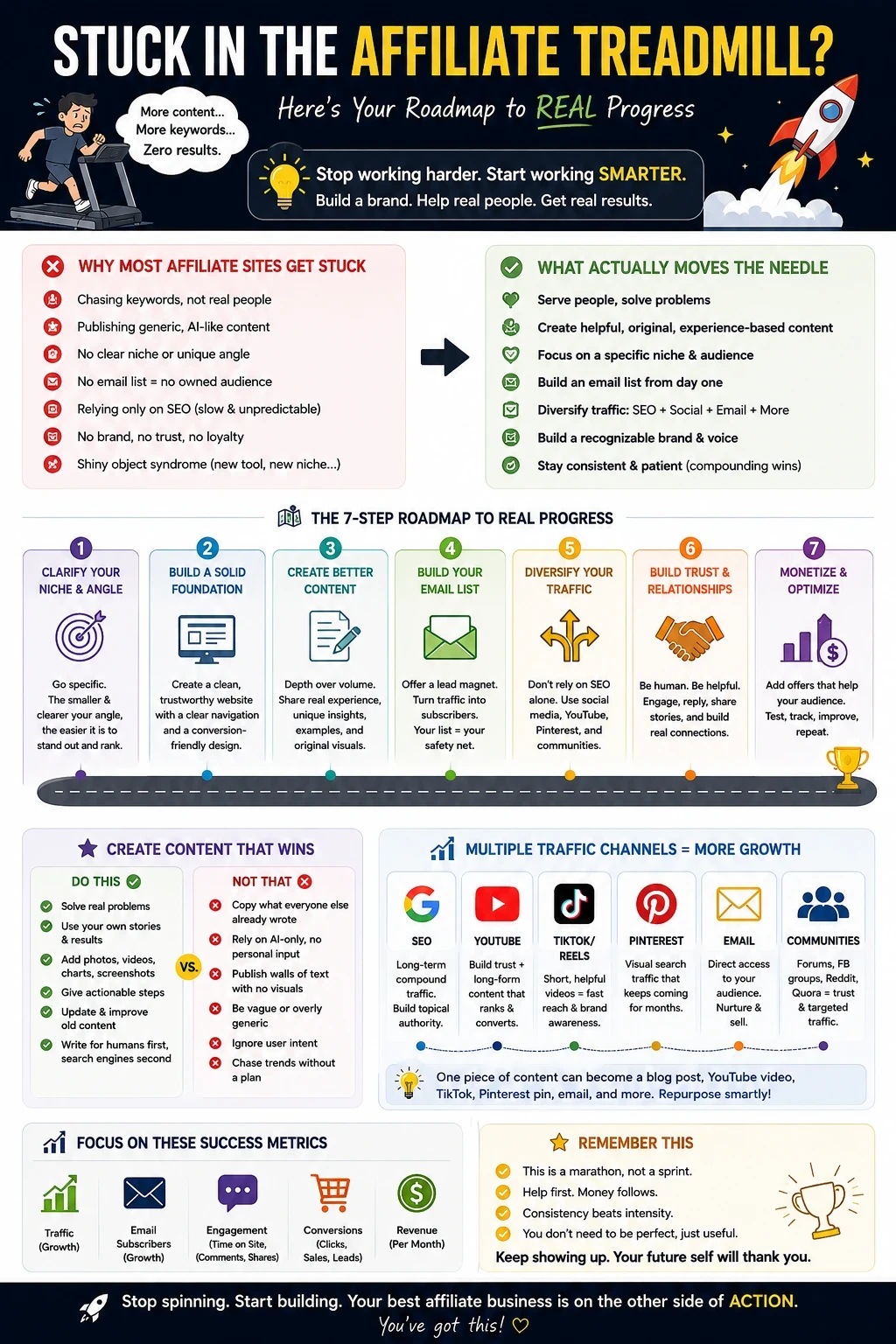
Here’s the less glamorous (but more effective) path forward with 7 steps...
1. Pick a sharper niche angle
Not “fitness.”
Not “home gyms.”
Be more specific.
2. Redesign for humans, not algorithms
Your homepage should inspire action, not resemble a Wikipedia side quest.
3. Create fewer but better articles
Depth beats volume now.
4. Add original visuals
Photos. Charts. Videos. Infographics. Proof.
5. Build an email list immediately
Traffic without email capture is borrowed land.
6. Start creating short-form content
Even imperfect videos outperform invisible perfection.
7. Become recognizable
People remember voices, not keyword density.
Finale?
Affiliate marketing isn’t dead.
But the era of faceless websites, generic content and passive copy-paste blogging is fading fast.
The good news?
Most people are still stuck playing the old game.
Which means there’s huge opportunity for creators willing to be specific, useful, visible and who actually sound very human.
Your website doesn’t need 500 mediocre articles.
It needs a pulse.
✨Fleeky
Thank you for likes, comments and shares
Can you tell me where you’re stuck in the process (we all encounter challenges at some point)? 🙂↕️
For me? Printing the infograph
Share this insight
This conversation is happening inside the community.
Join free to continue it.The Internet Changed. Now It Is Time to Build Differently.
If this article resonated, the next step is learning how to apply it. Inside Wealthy Affiliate, we break this down into practical steps you can use to build a real online business.
No credit card. Instant access.