Text Untraveled (for writers and bloggers)


Published on September 13, 2026
Published on Wealthy Affiliate — a platform for building real online businesses with modern training and AI.

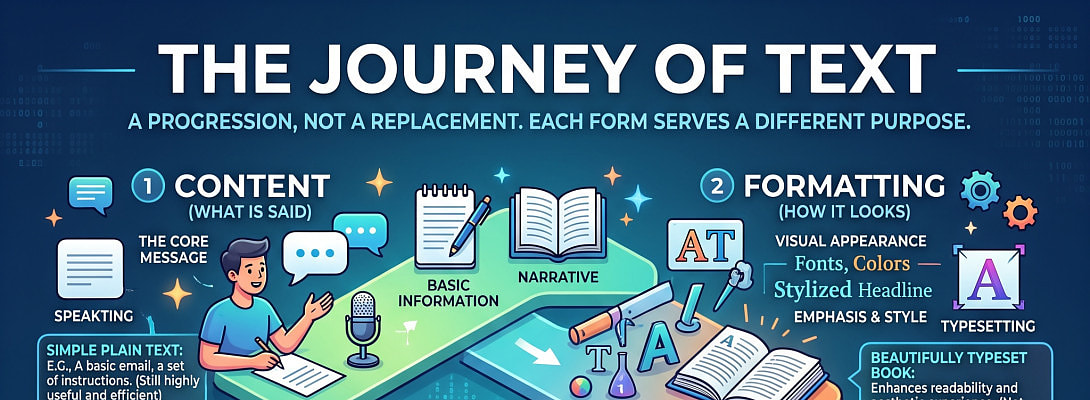
Text Un(t)raveled...
We tend to think of text as words on a page.
Letters become words, words become sentences, sentences become paragraphs.
And somewhere along the way we decide whether something should be bold, italic, large, small, blue, centered, or underlined.
But text has traveled much further than that.
It has learned to carry structure, tell machines what it means, connect one idea to another... and even respond to the person reading it.
Perhaps the most interesting question, then, is not how far text has traveled, but where it has not traveled yet.
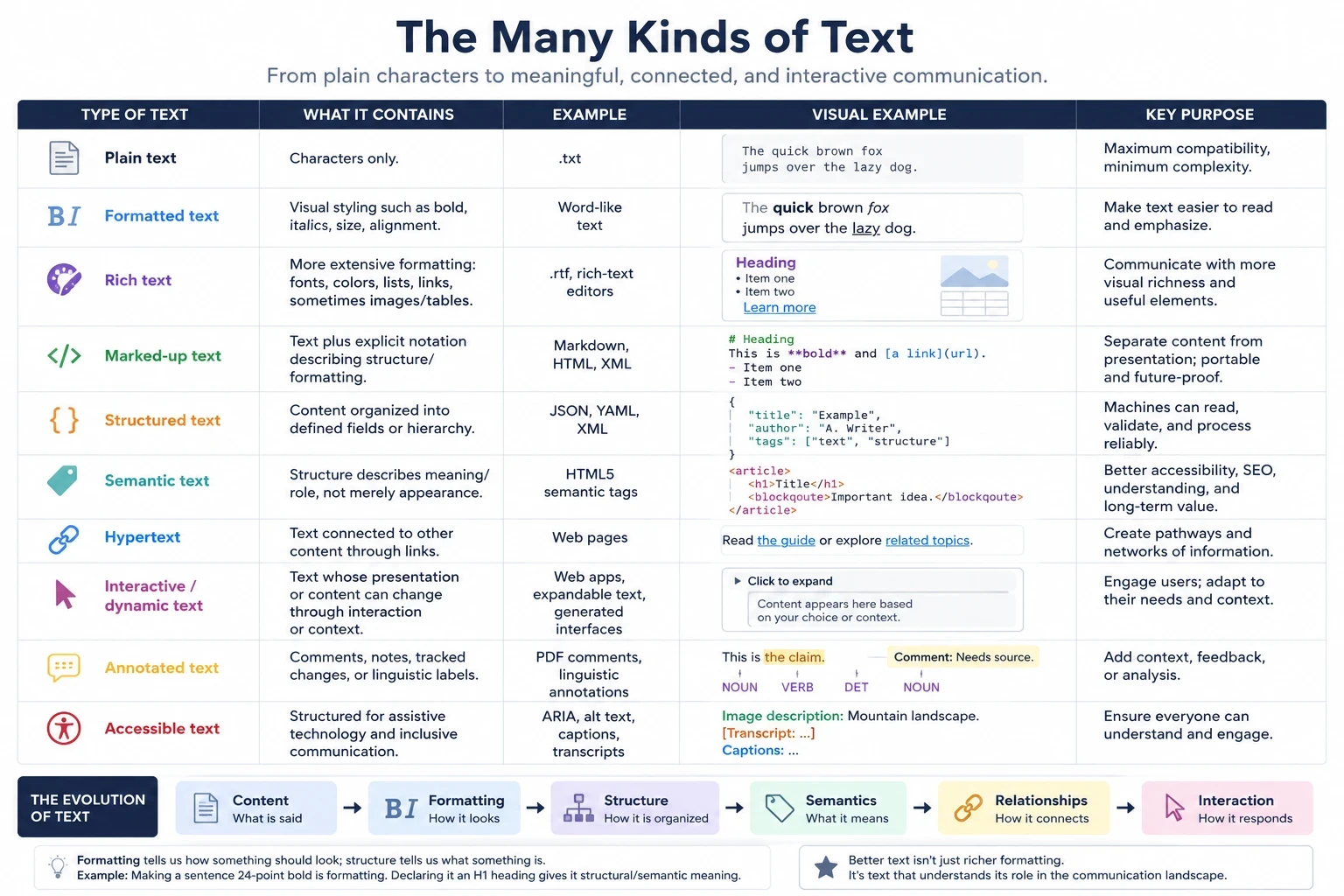
Plain Text = Just the Words
At its simplest, text is a sequence of characters.
A .txt file doesn't need to know that something is a title, a quotation, or an important idea. It simply contains the characters.
That simplicity is also its strength.
Plain text is portable. Almost anything can read it, and it asks very little of the machine opening it.
The meaning is left largely to us.
Formatted Text = How It Looks
Then we started giving text an appearance.
A word could be bold. Another could be italic. A title could be larger than the paragraph beneath it.
Alignment, spacing, typefaces, and emphasis gave writers another vocabulary.
Formatting helps us navigate. It tells the reader: look here, this matters, this is different.
But it also introduces an important distinction.
Making a sentence large and bold does not necessarily make it a heading.
It only makes it look like one.
Rich Text = More Comes Along for the Ride
Rich text expands that visual vocabulary.
Fonts, colors, lists, hyperlinks, tables, images, and other elements can travel with the words.
This makes documents far more expressive.
It can also make them surprisingly troublesome.
Copy a beautifully formatted piece of text from one application and paste it into another, and things sometimes go wrong. 😝 Fonts change. Spacing appears from nowhere. Lists behave strangely. Paragraphs inherit formatting you never intended.
Anyone who has copied content into WordPress and then tried to edit it may have met this particular problem.
The words are innocent.
The invisible formatting traveling with them is often the culprit.
Marked-Up Text = Describes the Text
Another path is to stop hiding those instructions.
Markdown, HTML, and XML add explicit notation around text to describe how it should be interpreted.
Instead of merely making something look bold, we can mark it as important. Instead of visually enlarging a line until it resembles a heading, we can identify it as a heading.
This may sound like a technical distinction.
But something fundamental has changed.
The text has begun to carry information about itself.
Structured Text = Gives Information an Address
Structure goes further.
Formats such as JSON, YAML, and XML organize information into fields and hierarchies.
A piece of information is no longer simply sitting somewhere on a page. It has an address and a relationship to the information around it.
A title is a title.
An author is an author.
A date is a date.
Machines can find these things without having to guess from their appearance.
Text is becoming not only readable, but navigable.
Semantic Text = Says What Something Is
This may be the most important step.
Semantic text describes meaning or role rather than appearance.
Consider a heading.
We could make a sentence 24-point bold and place it above a paragraph. To a human, it probably looks like a heading. Or we can explicitly identify it as a heading.
Those two things may look identical on a screen.
But they are not identical.
The second has meaning built into its structure. Browsers can understand it. Search engines can interpret it. Assistive technologies can navigate it. Software can distinguish it from the paragraph beneath it.
Formatting says, “This is what I should look like.”
Semantics says, “This is what I am.”
Hypertext = Text Discovers Somewhere Else
Ready to put this into action?
Start your free journey today — no credit card required.
Then text learned to travel.
A hyperlink turned a word or phrase into a doorway.
One document could point toward another. A footnote no longer had to remain at the bottom of the page. A reference could lead directly to its source. An unfamiliar idea could open into an explanation.
Reading became less like following a single road and more like exploring a landscape.
The reader could choose where to go next.
That small blue link changed the architecture of communication.
Interactive Text = The Reader Changes the Text
Eventually, text stopped merely pointing somewhere else.
It began responding.
Click to expand. Choose an option. Search. Filter. Ask a question. Reveal an explanation.
In interactive and dynamic systems, what appears can depend on what the reader does, chooses, or needs.
The audience is no longer simply moving through the text.
The text can change around the audience.
Annotated Text = A Conversation Around the Words
There is also text that carries another layer: commentary.
Comments in a document. Suggested edits. Tracked changes. Editorial notes. Linguistic labels. References attached to particular claims.
The original text remains, but another conversation develops around it.
This becomes particularly important when text is collaborative.
Writing is no longer necessarily a finished object passed from writer to reader.
It can become a shared workspace in which meaning is questioned, refined, verified, and negotiated.
Accessible Text = Who Gets to Travel?
There is one more dimension that should not be treated as an afterthought.
Can everyone use the text?
- Captions help people who cannot hear accompanying audio. But they also help someone sitting on a noisy train.
- Alt text can communicate the purpose of an image to someone using a screen reader.
- Proper headings allow assistive technologies to navigate a document rather than forcing someone to move through every line sequentially.
- Transcripts make spoken information searchable and readable.
Accessibility reveals something important about text.
A communication system is not successful simply because information exists.
Someone has to be able to reach it.
Resumed with WA Image Sudio aka DsgnPop :
The Journey of Text
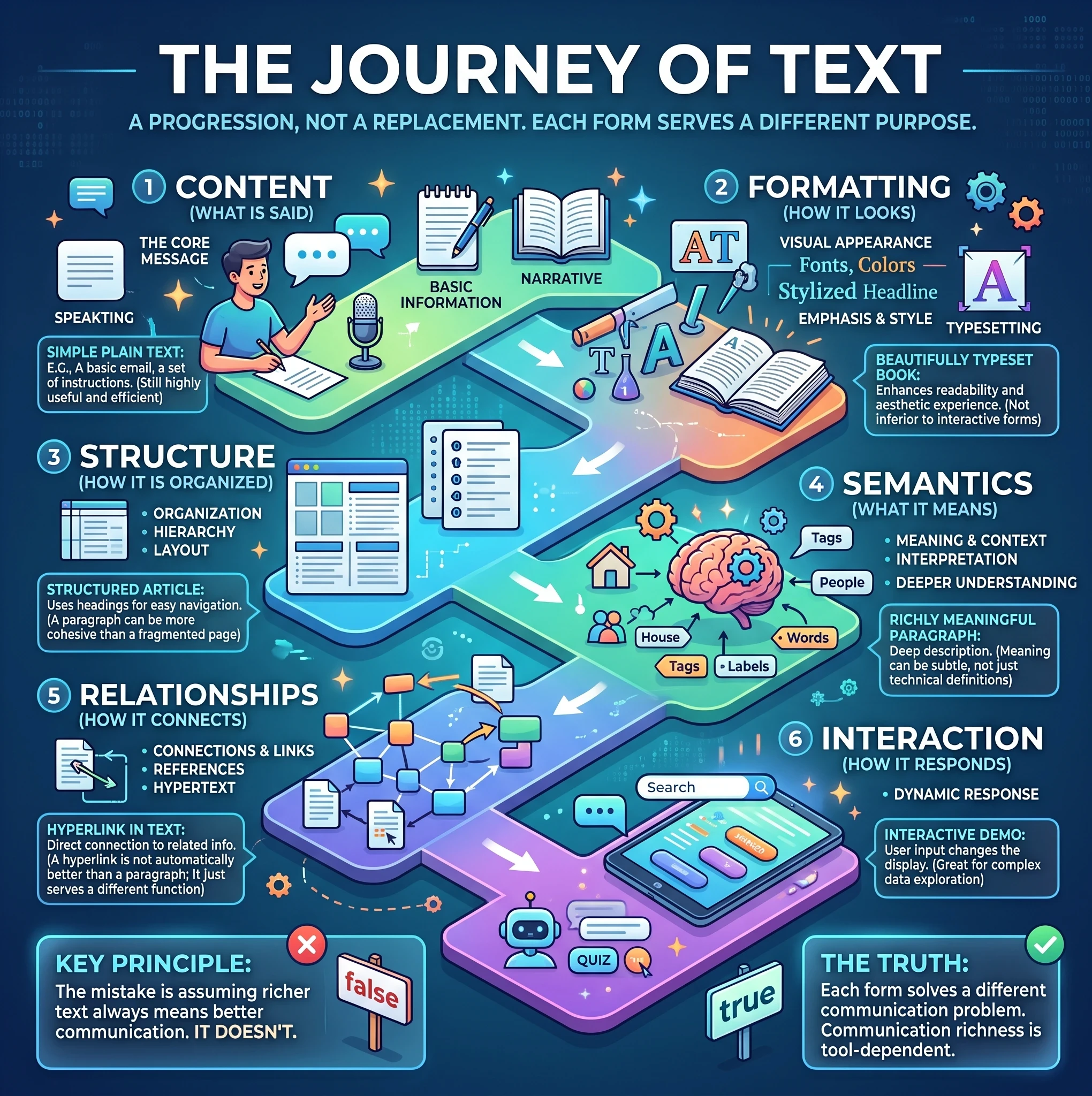
Put these developments beside one another and a larger progression appears.
Content is what is said.
Formatting is how it looks.
Structure is how it is organized.
Semantics is what it means.
Relationships are how it connects.
Interaction is how it responds.
But this is not necessarily a historical sequence.
And each stage does not replace the one before it.
Plain text is still extraordinarily useful. A beautifully typeset book does not become inferior because it is not interactive. A hyperlink is not automatically better than a paragraph.
Each form solves a different communication problem.
The mistake is assuming that making text richer always makes communication better.
It doesn't.
Resumed with WA Image Sudio aka DsgnPop :
What WordPress Teaches Us About Text
WordPress provides a surprisingly practical example.
When writing a blog post, it is tempting to concentrate on appearance.
Make this bigger. Bold that sentence. Change this color. Add some spacing.
But a more durable article begins somewhere else.
With structure.
This is the title.
This is a heading.
This is a paragraph.
This is a list.
This is a quotation.
This is a link.
Once those roles are clear, WordPress can decide how they should look.
That separation matters.
It makes an article easier to edit, easier to restyle, more accessible, and more likely to survive changes in themes, devices, and publishing tools.
For this reason, text destined for WordPress benefits from being written semantically first and decorated later.
Structure before decoration.
And Then Came the Conversation
There is another turn in this journey.
You are reading something that emerged from a conversation between a human and an AI.
That is different from opening a document and reading what was already written.
You can interrupt.
Ask for clarification.
Challenge an idea.
Request another example.
Turn a paragraph into a table.
Turn that table into an image.
And then take the resulting ideas and turn them into a blog post.
That is exactly what happened here.
Text is beginning to behave less like an object and more like an environment.
And that raises questions we have only begun to explore.
- What happens when text knows where it belongs?
- What happens when the same idea can become a paragraph for one person, an explanation for another, audio for someone walking, or a visual for someone who understands by seeing?
- What happens when text can adapt without losing the author's voice?
And who decides how far that adaptation should go?
Text Untraveled
Perhaps the next evolution of text will not be about adding more formatting at all.
We have already learned how to make words bold, colorful, animated, linked, searchable, structured, and interactive.
The more interesting frontier may be whether text can understand its role in a larger communication landscape.
Not merely: How should I look?
But: What am I? Why am I here? What does this person need from me? Where should they go next? And when should I simply get out of the way?
That is the territory still ahead.
Text untraveled.
✨ Fleeky
Thank you for likes, shares and comments
I hope this clarifies a lot... If not, let me know ☺️
Share this insight
This conversation is happening inside the community.
Join free to continue it.The Internet Changed. Now It Is Time to Build Differently.
If this article resonated, the next step is learning how to apply it. Inside Wealthy Affiliate, we break this down into practical steps you can use to build a real online business.
No credit card. Instant access.