Grokipedia vs. Wikipedia: The Battle for Truth (And a Bit of Ego)


Published on November 5, 2025
Published on Wealthy Affiliate — a platform for building real online businesses with modern training and AI.
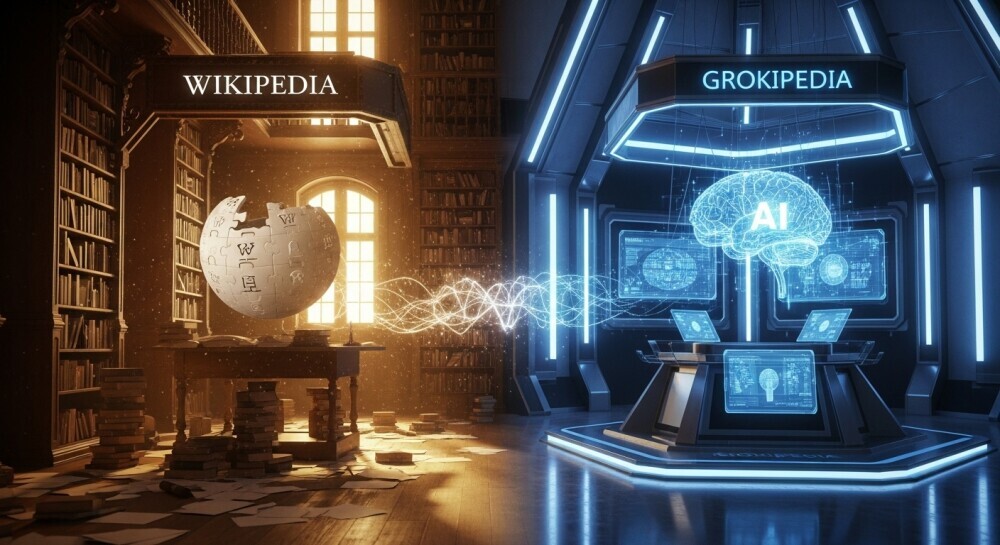
Grokipedia vs. Wikipedia
TL;DR
Elon Musk launched Grokipedia, an AI-powered encyclopedia built to rival Wikipedia. It promises “maximum truth” but raises serious questions about bias and control. Unlike Wikipedia’s messy, human-driven debates and visible edits, Grokipedia offers polished AI output shaped by algorithms — and possibly Musk’s influence.
Wikipedia is slow, flawed, and human. Grokipedia is fast, neat, and corporate. One shows its scars; the other hides them. The article argues that truth needs friction, argument, and emotion — not automation. AI may improve speed, but it risks erasing human context.
Bottom line: Wikipedia is the honest veteran; Grokipedia is the confident rookie. And confidence without accountability isn’t truth.
Summarize This Article With:
[Gemini]
[Grok]
[ChatGPT]
[Claude]
Grokipedia vs. Wikipedia: The Battle for Truth
I have made it clear that I read too much, and sometimes too much for my own good. I read something strange, and you’ve probably seen it for yourself at this point. Elon Musk launched something called Grokipedia. Yeah, because apparently we didn’t have enough platforms claiming to “fix” information.
It’s supposed to be an AI-powered encyclopedia. Think Wikipedia with fewer editors, more algorithms, and a healthy dose of Musk-level confidence. The man literally said it’s designed for “maximum truth.” I mean… come on. That’s like me saying I’m catching the biggest fish I have ever seen today before I even get my boat in the water.
Anyway, based on what I have read, the internet’s already arguing: “Will Grokipedia replace Wikipedia?” And I’m sitting here thinking, replace or improve? The guy just turned the key. Wikipedia’s been running for twenty-four years and has more human fingerprints than the door lock at a gas station restroom.
But let’s break this down because it’s actually fascinating and perhaps a little terrifying.
Wikipedia was founded in 2001, built by a group of nerds who genuinely believed that humans could work together online without losing their minds. Bless them, even though the basic premise of people getting along is moronic itself.
Twenty years later, they’re still at it with millions of volunteers, constant edits, endless debates about whether Pluto’s a planet or not. It’s chaotic, democratic, and very human, which means it is flawed just as much as AI can be at times.
Now, Grokipedia? Born October 27, 2025. Created by xAI, it is Elon Musk’s latest experiment unleashed to the masses. It uses Grok (his chatbot) to write, fact-check, and manage everything. So far, about 885,000 articles, most of them written by AI, sprinkled with human refinements (editing and polishing) like salt on fast food.
They say it avoids “edit wars.” Translation: the algorithm wins every argument.
Wikipedia’s messy because it has opinions clashing. Grokipedia’s neat because it doesn’t allow them. You tell me which one’s closer to real life.
Ready to put this into action?
Start your free journey today — no credit card required.
Okay, here is where things start to get spicy.
Grokipedia calls itself “truth-seeking.” That’s cute. Because early reviewers are already spotting far-right leanings like glowing articles about Elon, sanitized takes on politics, and missing chunks about people he doesn’t like. The AI’s idea of “truth” seems oddly friendly to its creator.
Wikipedia, for all its flaws, at least makes an attempt to show its dirty laundry. You can read the edit history, see who fought over what, and make your own decision.
Grokipedia? You get the cleaned-up version, the “we ran this through PR before publishing” kind of truth.
I’m not hating on the tech. The idea’s brilliant. Fast updates, fewer trolls, no vandalism. But if we’re replacing human editors with AI that quietly favors its boss, we’re not fixing bias; we are sort of industrializing it, so to speak.
Wikipedia may be slow and full of internal drama, but it’s honest about it. It’s like that grumpy old uncle who tells you exactly what he thinks, even if it’s politically incorrect.
Grokipedia’s the opposite. It smiles, quotes data, and says, “Trust me, I know better.”
And people will trust it i'm afraid, because it’s shiny, confident, and sounds smart.
But here’s the thing: confidence doesn’t always equal accuracy.
AI doesn’t “know.” It predicts. It does well at times with its predictions until it doesn't, which is why I have said in the past that AI is evil.
Give it a million facts, and it’ll tell you the most likely next sentence. That’s not knowledge. That’s autocomplete with a personality, robotic, but a personality just the same.
Wikipedia runs on passion. You’ve got people who care deeply about ancient pottery, insect taxonomy, and the political structure of 13th-century Poland, all arguing about footnotes. That’s love of knowledge. They may be baseless lies at times for public opinion, but it is still a conversation about the truth.
At the same time, we have Grokipedia that runs on speed. It doesn’t argue with you unless you are in fun mode, then it can be a pain in the ass. It just outputs.
But truth isn’t supposed to be quick and easy. It’s supposed to be debated, challenged, and tested until it holds up under pressure. That’s how we get closer to real understanding through friction and hurt feelings.
Remove the friction and feelings, and you don’t get the truth. You get propaganda with better punctuation.
And my friends, this is where I think it connects to what we do here at Wealthy Affiliate.
AI is creeping into everything we do, like content writing, marketing, and even “knowledge.” Everyone’s chasing efficiency, automation, and output. And yeah, it helps. But at some point, we have to ask: what are we giving up for convenience? This is why adding yourself to your content is so very important. Do not copy and paste "AI BS(💩).
WA has spent years telling people that authenticity matters and that the human experience is what connects readers. So when I see an AI writing the history of the world, I can’t help but laugh and cringe at the same time.
Wikipedia isn’t perfect, but it’s human. You can see the fingerprints, the bias, the mistakes. You can see the effort.
That’s what makes it semi-trustworthy.
Grokipedia might be fast and flashy, but it’s sterile. You can’t see the thinking, just the output it chooses to deliver.
Here’s my take: this isn’t just about who owns the better encyclopedia. It’s about who owns the narrative.
Wikipedia’s a community. Grokipedia’s a product.
One is a messy conversation. The other is a monologue written by a machine.
And if we let the machines write the world’s story without humans arguing over the details, we’ll lose something we can’t get back, and that is context. This may be another pivotal moment in history where AI becomes a danger. Who knows?
I’ll still use both, of course, because I am a rebel. I love testing tools and breaking down how they work. But I’ll keep my skepticism handy with this one.
Because when Wikipedia gets something wrong, a human can fix it.
When Grokipedia gets something wrong, it’ll simply rewrite history and claim it was right all along. This frightens me a bit. I mean, I am not losing sleep, but at the same time, I remain concerned.
If you want my honest read on the two?
Wikipedia is the flawed, cranky veteran who still shows up and does the work.
Grokipedia’s the shiny rookie with all the piss and vinegar and none of the scars.
And we both know who wins in the long run, the one who still listens, learns, and admits when it’s wrong.
Just something else that has invaded my gummy-filled mind and figured I would share with you. Please share your thoughts or concerns below.
Key Takeaways
- Grokipedia is Elon Musk’s AI version of Wikipedia, promising “maximum truth” but raising bias concerns.
- Wikipedia thrives on messy human debate, while Grokipedia relies on clean, controlled AI output.
- Real truth comes from discussion and disagreement, not automation.
- AI can write fast, but can also quietly rewrite history to fit a narrative.
- Authenticity still matters — human fingerprints make knowledge trustworthy.
Share this insight
This conversation is happening inside the community.
Join free to continue it.The Internet Changed. Now It Is Time to Build Differently.
If this article resonated, the next step is learning how to apply it. Inside Wealthy Affiliate, we break this down into practical steps you can use to build a real online business.
No credit card. Instant access.