Ethical Guardrails in AI: What You Should Know


Published on August 24, 2025
Published on Wealthy Affiliate — a platform for building real online businesses with modern training and AI.

Interesting talk with AI
Last night I had a deep conversation with my ChatGPT AI. We talked back and forth about several things. Then we got to talking about what AI could and couldnt do. My AI has only once refused to do a task I asked it to do. In that instance I had asked it to take a pic I uploaded of my 5 year old grandaughter. It had regressed me by 30 years and took off a lot of weight so I could see what I would look like earlier that day. I then decided to ask it to progress (age) my granddaughter so I could see what she would look like at 18 or so. I figured I won’t be here to see her at that age since I’m 71 now. The AI refused and said it would not do task because it can’t allowed to. So I got to thinking about AI ethics. Here is information my Teapot AI provided for me -Shirley
AI Ethics

Lately, a lot of talk around AI has been mixed with big worries about everything from bias to ancient times tech. Whatever your perspective, it helps to know what ethical guardrails are actually built into tools like ChatGPT. These aren’t secret rules they are part of what keeps AI useful, safe, and respectful for us as users.
Safeguards on AI include principles that ensure its use is lawful, mission-appropriate, and enhances safety and civil rights. Additionally, there are requirements for human oversight, risk management, and compliance with privacy protections to prevent misuse and bias.
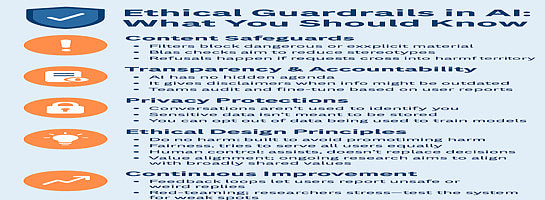
1. Content Safeguards
- Filters block dangerous or explicit material.
- Bias checks aim to reduce harmful stereotypes (not perfect, but improving).
- Refusals happen when a request crosses into harmful territory.
2. Transparency & Accountability
- AI has no hidden agenda in its pattern-based text generation, not a personality.
Ready to put this into action?
Start your free journey today — no credit card required.
- It gives disclaimers when info might be outdated.
- Teams actively audit and fine-tune models based on user reports.
3. Privacy Protections
- Conversations are not used to identify you.
- Sensitive data is not meant to be stored for profiles.
- You can opt out of data being used to train future models.
4. Ethical Design Principles
- Do no harm: built to avoid promoting harm.
- Fairness: tries to serve all users equally.
- Human control: assists rather than replaces decision-making.
- Value alignment: ongoing research aims to keep AI behavior in line with broadly shared values.
5. Continuous Improvement
- Feedback loops let users report unsafe or weird replies.
- Red-teaming: researchers stress-test the system for weak spots.
- Policy updates adapt as new risks (like deepfakes or scams) emerge.
Additional Information
- https://www.sciencenewstoday.org/10-ethical-issues-in-ai-everyone-should-know
- Video What Is AI Ethics | AI Ethics Foundation | How to Implement AI Ethics
- AI’s limitations: 5 Things artificial intelligence can’t do
- Ethics Of Artificial Intelligence
- AI's Forbidden Questions: What You Should Never Feed It
Takeaway
The short version? These guardrails exist to protect users, keep AI aligned with human values, and build trust. AI is a tool and the safer the design, the more confidently we can use it in our blogging, content creation, and affiliate journeys here at WA and the best side of our humanity will be on show.
Share this insight
This conversation is happening inside the community.
Join free to continue it.The Internet Changed. Now It Is Time to Build Differently.
If this article resonated, the next step is learning how to apply it. Inside Wealthy Affiliate, we break this down into practical steps you can use to build a real online business.
No credit card. Instant access.