The Trailmaker of Hollowbrook - A folktale of Turning Wandering Feet into Welcome Home


Published on September 17, 2026
Published on Wealthy Affiliate — a platform for building real online businesses with modern training and AI.

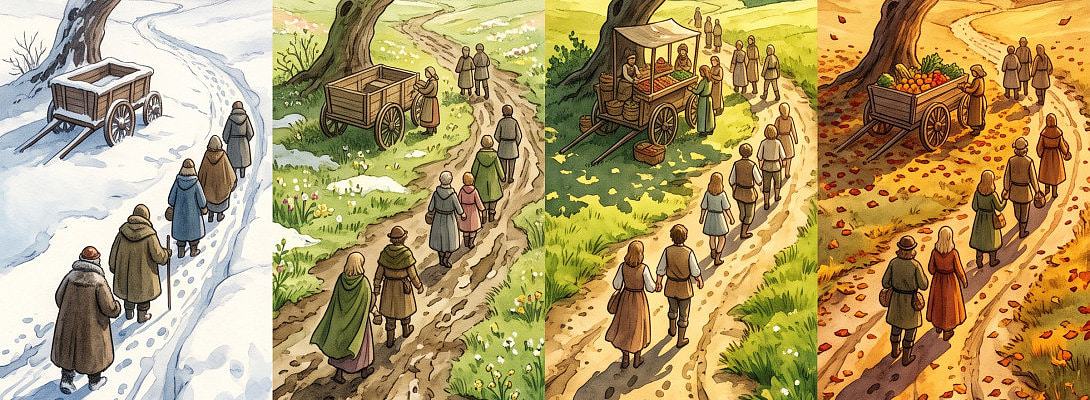
In the valley of Hollowbrook, where three roads met beside a crooked old oak, there lived a young trader named Tobin Ashwell. Tobin had inherited his father's market stall, a rickety wooden cart stacked with dried herbs, carved trinkets, and jars of honey, and he set it up each morning at the crossroads, certain that if enough travelers passed by, some of them would surely buy something.
Some days, they did. A merchant would stop, admire a carving, and pay in silver. Other days, dozens of travelers streamed past without a glance, and Tobin's cart sat as untouched as a forgotten well.
"It's the roads," Tobin muttered to himself one evening, kicking a stone into the dust. "Some days they bring good travelers, some days they don't."
An old woman sitting beneath the crooked oak, the kind of old woman every good folktale requires, wrapped in a shawl the color of river moss, chuckled without looking up from her knitting.
"It is not the roads, boy," she said. "It is your cart."
Her name was Maren the Trailmaker, and long before Tobin was born, she had been famous throughout the valley for a peculiar gift: she could take any lost traveler and guide them, without fail, to exactly where they needed to go. Villagers said she could read a wanderer's face the way a shepherd reads clouds before rain.
Tobin, more curious than proud, sat down beside her. "Then teach me, Old Maren. Teach me why some days I sell everything, and other days I sell nothing at all."
And so, over the seasons that followed, Maren taught him, not through lectures, but through a series of small, strange lessons at the crossroads of Hollowbrook.
Every Traveler Needs a Path, Not a Pile
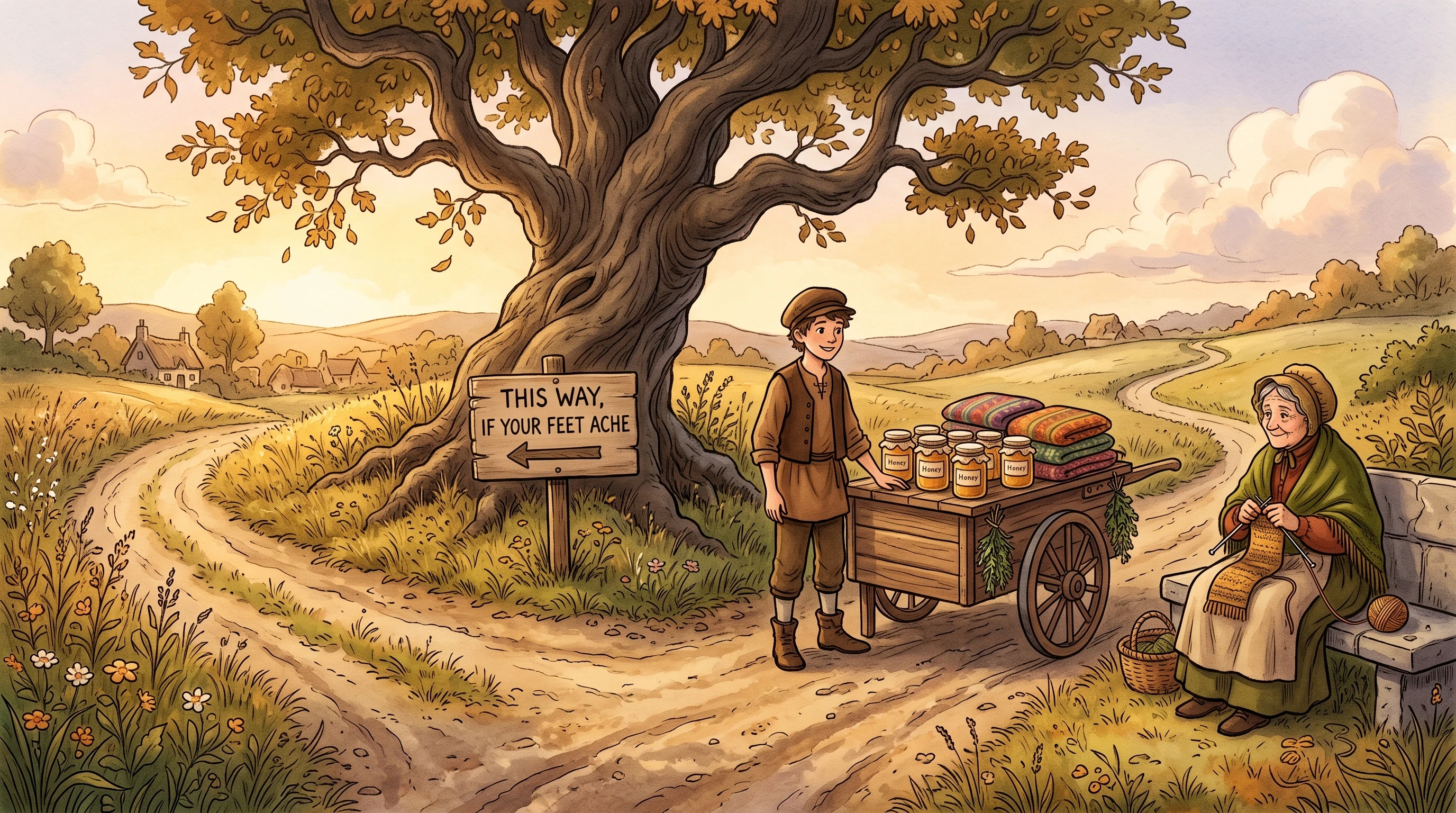
The next morning, Maren examined Tobin's cart and shook her head. Everything was crammed together, herbs beside trinkets beside honey jars beside old boots he'd forgotten to sell last winter.
"When a traveler stops here," Maren said, "what do they see?"
"My goods," Tobin said proudly.
"No," said Maren. "They see a pile. A pile is not a path. A path says: here is where you are, here is where you're going, and here is the bridge between."
She rearranged his cart into a line: first, a small carved sign reading "Tired feet? Sore back?" then, beside it, a neatly folded traveler's cushion, then, at the very end, a little wooden bowl that said "Take one, rest a while."
"Now," Maren said, "you are not selling a cushion. You are answering a question the traveler was already asking."
That day, three tired travelers stopped, nodded at the sign, and bought the cushions without Tobin saying a single word.
Never Leave a Wanderer Standing Confused
The following week, a merchant named Old Cobb stopped at Tobin's cart, looked at everything, sighed, and walked away empty-handed.
"Did you see that?" Tobin groaned. "He looked at everything and left!"
Maren nodded slowly. "Because you showed him everything and told him nothing. A traveler who doesn't know what to do next will always choose to do nothing at all."
"So what do I say?"
"Something simple," Maren said. "'If your boots are worn, start here.' A single sentence can turn a wandering eye into a walking foot."
Tobin painted a small sign that read: "New in town? Start with the honey, it cures a dusty throat." The very next traveler read it, laughed, and bought two jars.
One Cart, One Purpose
Ready to put this into action?
Start your free journey today — no credit card required.
Emboldened, Tobin tried to do even more. He added a fortune-telling corner, a shoe-repair bench, a small puppet show, and a pile of "miscellaneous curiosities," all at once, all on the same cart.
Travelers stopped, stared at the chaos, scratched their heads, and moved on.
"You have built a marketplace," Maren said, sighing, "when all you needed was a doorway. A doorway leads to one room. A marketplace leads nowhere, because it leads everywhere."
Tobin, humbled, tore down the puppet show and the fortune corner. He kept just one purpose each week: this week, tired feet; next week, hungry bellies. One problem. One answer. One cart.
Sales doubled.
Point, Don't Push
There was a boy across the crossroads, a rival trader named Fennick, who shouted at every passerby, grabbing sleeves, promising miracles from his tonics. Travelers scattered from him like startled birds.
"Why does no one buy from Fennick," Tobin asked, "even though he tries the hardest?"
"Because he pushes," Maren said. "Travelers do not want to be pushed. They want to be pointed. A pointed finger says, 'this way, if you wish.' A pushing hand says, 'you have no choice.'"
So instead of shouting, Tobin simply placed small arrows of painted stone leading up to his cart, each one gently labeled: "This way, if your feet ache." No shouting. No grabbing. Just quiet, honest direction, and travelers followed it exactly because they were never forced to.
Trust Is Built Over Many Crossings
Not every traveler bought on the first day. Many passed through Hollowbrook again and again, merchants who traveled the same road every season, herders bringing sheep to market twice a year, pilgrims returning from the northern hills.
Tobin noticed something: the ones who bought the most were not strangers. They were the travelers who had passed his cart five, six, seven times before, watching him, quietly, long before they ever reached for their coin purse.
"They are not judging your cart in one glance," Maren explained. "They are watching your cart across many seasons. If your honey is sweet every single time, if your signs are always honest, if your cart is always where you say it will be, then trust grows the way moss grows on stone. Slowly. Then suddenly, it covers everything."
Tobin began setting up his cart at the same hour, in the same spot, every single day, rain or shine, crowd or none. Even on empty days, he stayed, restocked, and smiled at whoever passed.
Watch the Footprints
One evening, Maren pointed to the dust in front of Tobin's cart. "What do you see?"
"Footprints," Tobin said.
"Where are they thickest?"
Tobin looked closer. The dust was worn smooth in front of the honey jars and the cushion sign, but barely touched in front of the boots he still hadn't sold.
"Then stop guessing what travelers want," Maren said, "and follow the footprints of what they already love. Do more of what wears the dust smooth. Do less of what gathers cobwebs."
Tobin sold the old boots to a passing cobbler for scrap leather, and doubled his honey stock instead. The footprints only grew deeper.
A Simple Cart Beats a Complicated Wagon
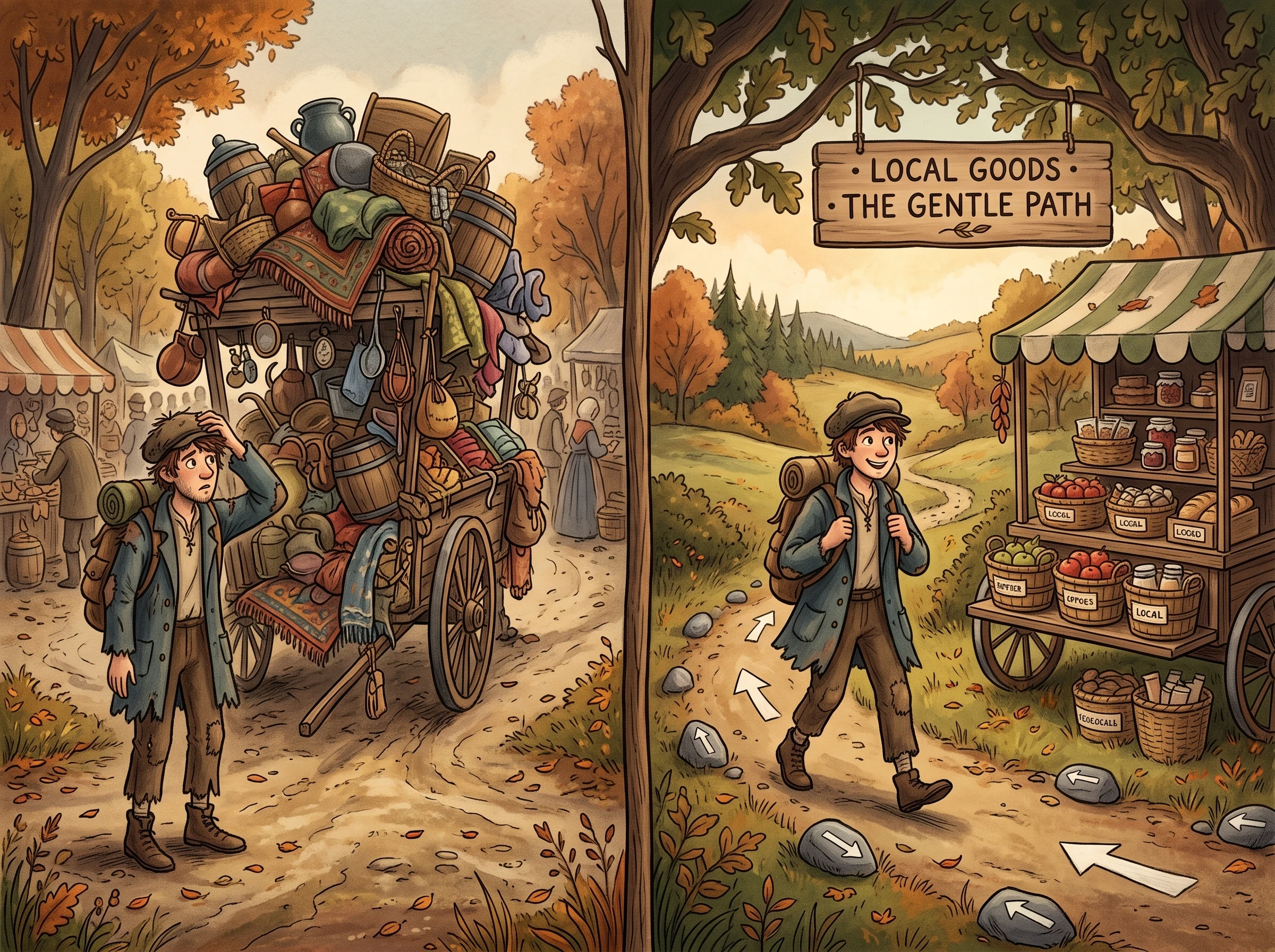
A traveling merchant once rolled through Hollowbrook with an enormous wagon, bells, mirrors, sixteen different goods, three hired barkers shouting over one another. It looked magnificent. It sold almost nothing, because no traveler could tell what the wagon was even for.
Tobin's little cart, by comparison, looked almost embarrassingly plain: one sign, one path, one purpose.
But plain and clear beat magnificent and confusing, every single time.
"You do not need a wagon," Maren told him. "You need a cart that travelers understand in three heartbeats. Grow it later. Start simple now."
The Crossroads Rewards the Patient
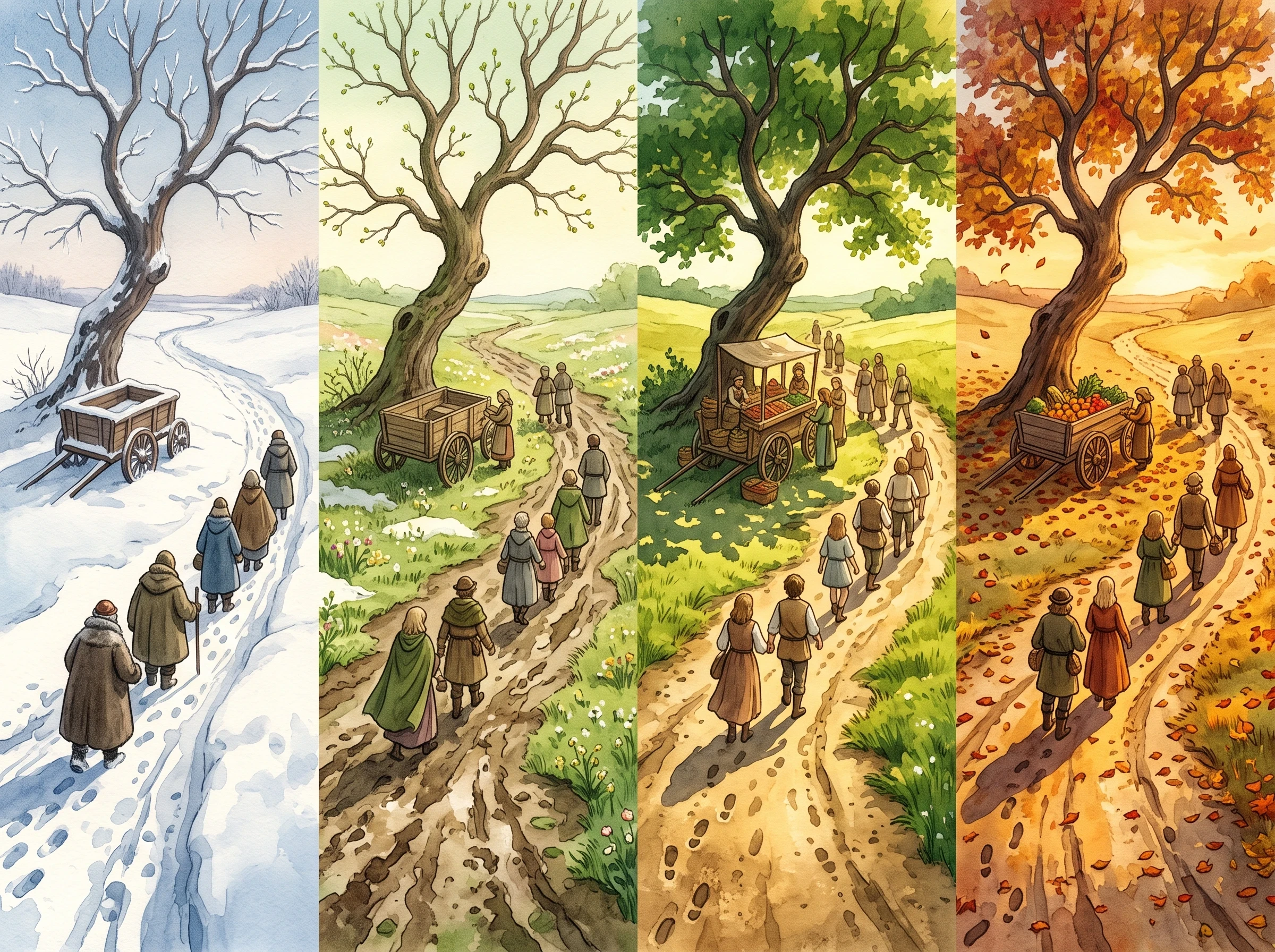
There came a long, hard winter when almost no one passed through Hollowbrook at all. Tobin's coin purse grew thin, and he wanted, more than once, to abandon the crossroads entirely.
"It isn't working," he told Maren one frozen evening. "Nothing's changed in months."
Old Maren wrapped her shawl tighter and pointed to the crooked oak beside them, the very one that had stood at that crossroads for two hundred years.
"That tree did not become mighty in one season," she said. "It grew one ring at a time, through winters exactly like this one. Your cart is the same. The system you're building isn't seen in a day. It's seen in the rings you leave behind, season after season."
Tobin stayed. He kept his sign painted fresh, his path clear, his honey sweet. And when spring finally came, the travelers returned to a crossroads that felt, to them, like coming home, because nothing about it had wavered while they were gone.
The Trailmaker's Legacy
Years later, Tobin Ashwell became known throughout the valley, not as the boy with the lucky cart, but as "the Trailmaker of Hollowbrook," the honor Old Maren herself had once carried. Young traders came from neighboring villages just to watch how his crossroads worked: one clear sign, one clear path, one honest purpose, repeated faithfully, season after season, until the whole valley trusted the road that led to his cart before they even arrived.
And when they asked him his secret, Tobin always gave the same answer Old Maren once gave him:
"I did not build a pile. I built a path. And a path, walked faithfully long enough, becomes a road that travelers will choose for the rest of their lives."
Share this insight
This conversation is happening inside the community.
Join free to continue it.The Internet Changed. Now It Is Time to Build Differently.
If this article resonated, the next step is learning how to apply it. Inside Wealthy Affiliate, we break this down into practical steps you can use to build a real online business.
No credit card. Instant access.