You're Not Getting Traffic Because You're Solving the Wrong Problem


Published on June 5, 2026
Published on Wealthy Affiliate — a platform for building real online businesses with modern training and AI.


How a 300-year-old math trick exposed the real reason my niche blog was stalling
I did everything right.
Better headlines. Targeted keywords. Consistent publishing. Internal links. Social media sharing. I even optimized my page load speed — something I had to look up how to do.
Six months in, I had 47 articles, a clean website, and almost no traffic.
Here is what took me far too long to accept: the problem was never the tactics. I had become extremely accurate at providing completely accurate answers to the wrong questions.
When I asked AI, "How do I get more traffic?" it answered honestly and well. The list it handed me was textbook-perfect. I followed every suggestion perfectly. But the traffic never came. I finally stopped to ask what my solution was supposed to be built on.
So I got to thinking. What do "Boomers do best?"
We are wired to fix things with gerry-rigged solutions. Or is it thinking outside of the box? I have 30-plus years of professional experience. Real skills. Genuine things to offer people. The problem was never what I knew. The problem was that I had never clearly defined who I was writing for, or what specific, painful problem I was actually solving.
Once I figured that out, everything changed. Not slowly. Fast. Three years in, I now have four functioning websites, and a fifth business started on everything that I have learned.
This is what no one tells you about using AI for blogging.
The Question That Sounds Right But Isn't

Johann Bernoulli, a Swiss mathematician working in 1697, ran into an ugly problem. The expression x^x — a number raised to its own power — was nearly impossible to work with directly.
His solution was not to try harder at the same approach. It was to rewrite the problem.
By transforming x^x into e^(x ln x), he converted an intractable mess into a standard, solvable equation. The problem did not disappear. Nobody cheated. But by changing the form of the problem, it became workable.
This is the exact move most bloggers never make.
When a new blogger asks, "How do I get more traffic?" they are staring at their own version of x^x — an ugly, surface-level problem that resists any direct solution.
The rewrite? "Who exactly am I helping, and what specific problem am I solving for them?"
Traffic is an outcome. Reader clarity is the foundation.
Ready to put this into action?
Start your free journey today — no credit card required.
No amount of SEO optimization can fix vague content aimed at a vague audience. If your niche is unclear, more traffic only amplifies the problem — more people arriving to find something that does not quite speak to them.
AI Accelerates Whatever You Feed It
Here is the Dullahan's truth: AI does not care if your strategy is right. It cares if your prompt is clear.
Feed it a weak question, and it will produce a polished, well-organized answer — one that takes you further down the wrong road faster than you could have managed on your own.
Compare these two prompts:
Weak: "Write a blog post about affiliate marketing."
Strong: "My reader is 61, worried about retirement income, skeptical of online business, and easily overwhelmed by technology. Give me five article angles that explain affiliate marketing as a low-cost, low-risk income path — without hype or jargon."
Both prompts get a response. But only one gets an article that a real human being will stop scrolling to read.
The second blogger did not let the AI think strategically. They did that work themselves first, then handed AI a clear problem to execute.
That is the difference between producing content and building a business. Publishing faster is not the same as building better. If your underlying strategy is weak, AI helps you move in the wrong direction faster — and build a larger monument to a mismatched niche.
Three Questions You're Probably Asking Wrong
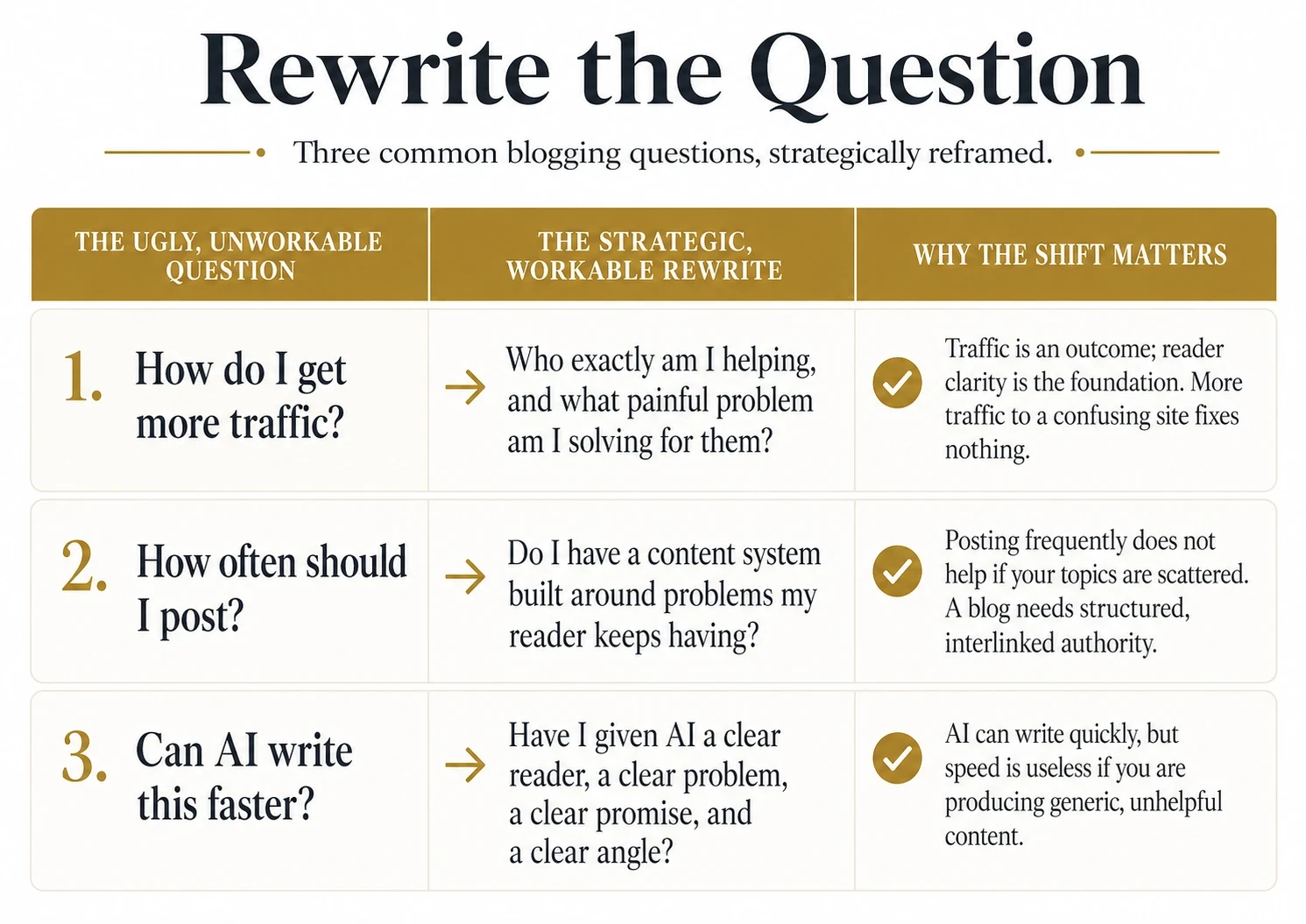
Most bloggers plateau because they keep asking outcome-focused questions instead of reader-centered ones. Here is the rewrite for the three most common ones:
"How do I get more traffic?" → Who exactly am I helping, and what urgent problem am I solving for them?
"How often should I post?" → Do I have a content system built around problems my reader keeps having?
"Can AI write this faster?" → Have I given AI a clear reader, a clear problem, a clear promise, and a clear angle?
Each rewrite shifts the focus from output to strategy — from what you are producing to why it will matter to someone specific.
Five Minutes Before Your Next Post
Before you open your AI tool for the next article, try this instead. No drafts. No keyword tools. Just five minutes and three honest questions:
- What is the surface-level problem my reader is searching for?
- What is the deeper, emotional problem hiding underneath it?
- Can I rewrite this topic into a sharper, more specific form?
"How to start a blog" becomes "How to start a blog when you are 60 and cannot afford another expensive mistake."
That rewrite has a real person in it. It has real fear. It has a reason to keep reading.
When you feed that into AI, what comes back is something genuinely worth publishing.
The Lesson I Wish I Had Learned Sooner
I spent more months than I care to admit publishing in the wrong direction at full speed.
The shift was not a new tool or a new tactic. It was a single question I had been avoiding: Am I solving the right problem — or just getting faster at solving the wrong one?
If your blog feels like it is stalling despite real effort, consider that the issue might not be your execution. It might be your question.
What problem are you actually trying to solve? And is it the right one?
I would love to know what comes up for you when you sit with that. Drop it in the comments — or highlight the line that hit closest to home.
Share this insight
This conversation is happening inside the community.
Join free to continue it.The Internet Changed. Now It Is Time to Build Differently.
If this article resonated, the next step is learning how to apply it. Inside Wealthy Affiliate, we break this down into practical steps you can use to build a real online business.
No credit card. Instant access.