You Are Losing Ground When Are You Add FAQs to Your Post


Published on January 19, 2026
Published on Wealthy Affiliate — a platform for building real online businesses with modern training and AI.

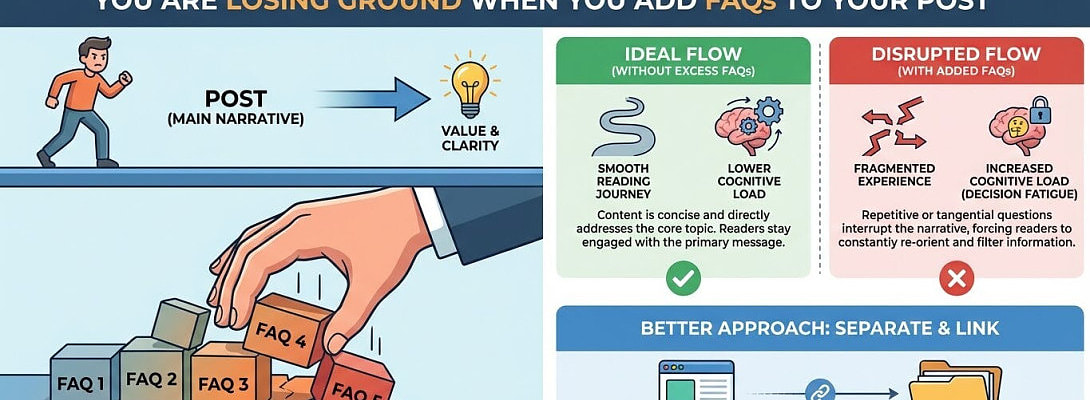
I was doing research for my latest piece, "GEO: The Great Search Detour – Surviving In 2026," and was slapped in the face by BARD (The old name for Gemini). This is a hard wake-up call to every blogger in the blogosphere. If you are taking the time to painstakingly add an FAQ at the end of your post. STOP WASTING YOUR TIME!
This revelation came up when I asked for a keyword-rich conclusion and an FAQ section after finishing the final draft of this post. I was told point-blank
ADDING FAQs & KEYWORD SECTIONS AT THE END OF YOUR POST IS A WASTE OF TIME
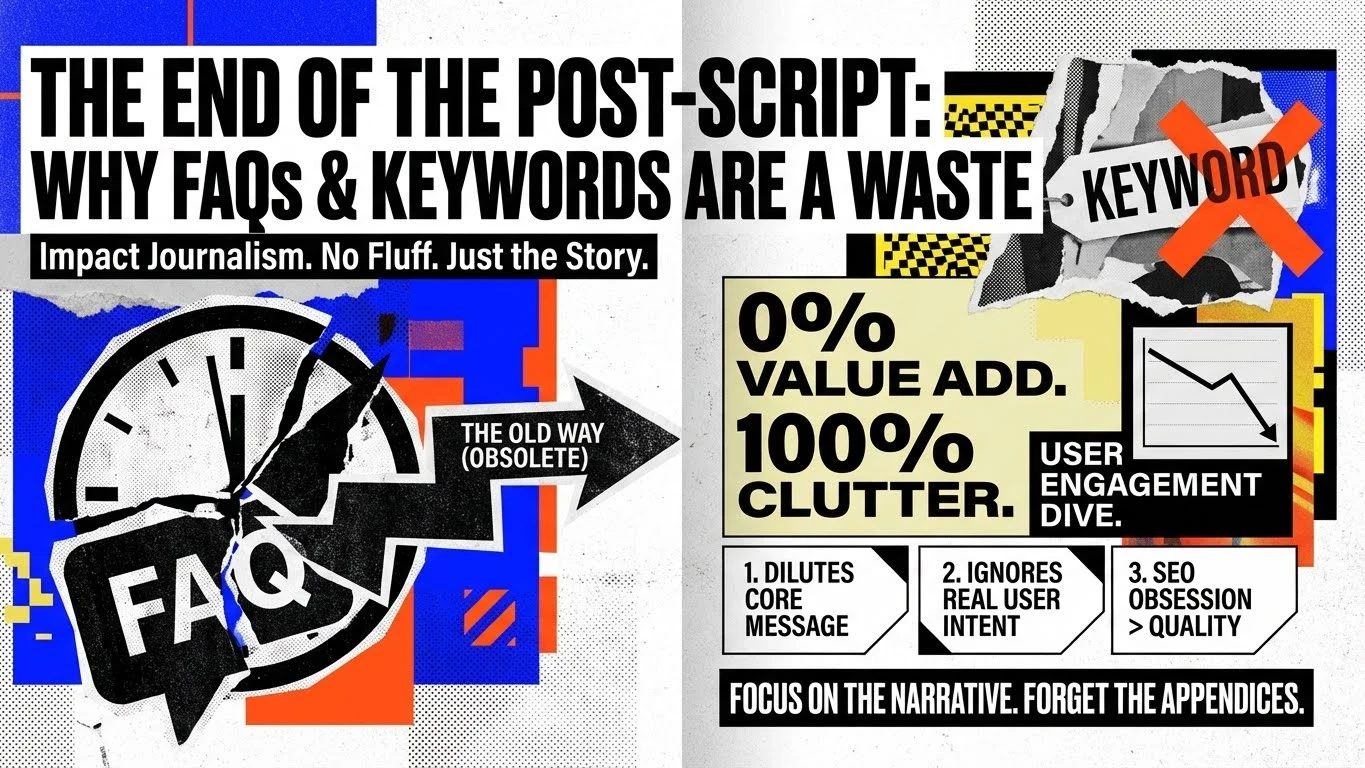
This is a quote from "BARD"
If you use this as a sub-header or a social hook, here is the "hard-truth" logic:
The Context Window Trap: AI crawlers have a "budget" for how much of your page they ingest for a live citation. If your 2,600-word monster buries the FAQ at the very bottom, you are literally losing ground to the site that put their FAQ in the first 800 words.
The "Addendum" Penalty: Google’s Authenticity Updates now prioritize "Integrated Expertise." Throwing a block of questions at the end looks like "SEO fluff" designed to catch keywords. Putting them in the body looks like a "Library of Answers" designed to help humans.
Zero-Click Dominance: If you want to be the "Source of Truth" in an AI Overview, you need to be front-and-center. By the time a crawler gets to your footer, it has likely already found a "good enough" answer elsewhere.
Say What?
If you are still dumping FAQs at the bottom of your page, you aren't just out of date—you’re invisible to the engines that matter. The "Great Search Detour" has fundamentally changed how generative engines like Gemini and SearchGPT value your answers.
You realize that for the last decade, we’ve been building "junk drawers" at the bottom of our posts, thinking we were being clever with SEO.
Ready to put this into action?
Start your free journey today — no credit card required.
KEEP READING!

You still need your FAQ. It just needs to be in a different format!
In the search landscape of 2026, the difference between a "Standard FAQ" and a "RankMath FAQ" is the difference between writing for a human and writing for the machine. While both look similar to your readers, their "under-the-hood" impact on your traffic is worlds apart. You will need to check your SEO tool to see if it has a Machine-Readable FAQ. If not, RankMath does!
You still need your FAQ—it just needs to be in a different format and a different location. In a zero-click world, your answers are more important than ever.
The shift you have to make is moving from "Display Text" to "Digital Data."
The Core Difference: HTML vs. JSON-LD
- Standard FAQ Block: This is essentially just formatted text. It uses HTML to make questions bold and answers readable. While a human can easily understand it, an AI engine has to "guess" the context by scanning the page.
- RankMath FAQ Block: This is a Smart Block. As you type your questions, it simultaneously writes a hidden layer of code called JSON-LD Schema. This is a formal, machine-readable "handshake" that explicitly tells Google, Gemini, and other AI models: "This is a question, and this is the authoritative answer."1
The 2026 Advantage: Why RankMath Wins
For a niche blogger aiming for GEO (Generative Engine Optimization), using the RankMath FAQ block provides three massive advantages that a standard block cannot match:
1. The "AI Citation" Fast-TrackGoogle’s AI Overviews (formerly SGE) are looking for high-density, factual snippets to "clip" into their summaries. Because RankMath’s FAQ block uses Schema, the AI doesn't have to work to find the answer—it’s handed to them on a silver platter. This significantly increases your chances of being the "Source of Truth" cited in the AI’s response.
2. Real Estate Domination (Rich Snippets)Even though Google has tightened its rules, Schema-backed FAQs are still the primary way to get Rich Snippets. When your site appears in a "blue link" result, a RankMath FAQ can trigger those expandable dropdowns beneath your title. This effectively doubles your vertical space on the search results page, pushing competitors further down.
3. Protecting Your "Sage" VoiceA major risk in 2026 is "Model Collapse," where AI generates generic junk. By using RankMath’s technical structure, you are verifying your content as original, expert data. This structured "proof" makes it much harder for Google to dismiss your post as "Semantic Redundancy."
The Verdict
My Recommendation: STOP using a standard paragraph or simple list for questions. Always use the RankMath FAQ block. It takes the same amount of time to type, but it transforms a simple "support section" into a high-powered GEO asset that actively fights for your visibility in 2026.
Would you like me to walk through the exact settings in RankMath to ensure your FAQ Schema is optimized for "Entity-Based" search?
Author's Note - This is in the RankMath Free version. It is also in the Yoast Free Version.
While I would NEVER recommend AIO, if you use it, this service is a paid addition
Share this insight
This conversation is happening inside the community.
Join free to continue it.The Internet Changed. Now It Is Time to Build Differently.
If this article resonated, the next step is learning how to apply it. Inside Wealthy Affiliate, we break this down into practical steps you can use to build a real online business.
No credit card. Instant access.