The AI Slop Curve.


Published on April 23, 2026
Published on Wealthy Affiliate — a platform for building real online businesses with modern training and AI.

Every technology revolution looks like a disaster before it looks like progress. Right now, we're in the ugly part.
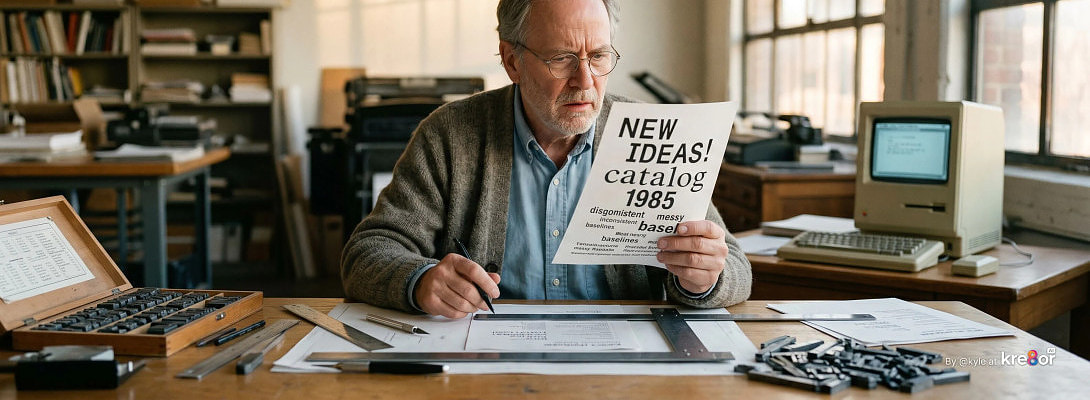
Picture a design studio in 1985.
Phil the typographer is at his drafting table, muttering about a catalog his nephew made on something called a "Macintosh." The letters don't sit on the baseline. Three fonts on one page. Comic Sans, even though that hasn't been invented yet because the universe is still being merciful.
Phil has spent twenty years learning to set type by hand. He knows that "case" comes from the wooden drawers that held the metal letters. He can kern a paragraph in his sleep. He looks at his nephew's catalog, and with the quiet certainty of a prophet at the end of the world, he says:
"This is going to ruin everything."
He's not entirely wrong.
He's also not even close to right.
Here's what Phil couldn't see...and what I feel almost everyone watching AI right now probably can't see either:
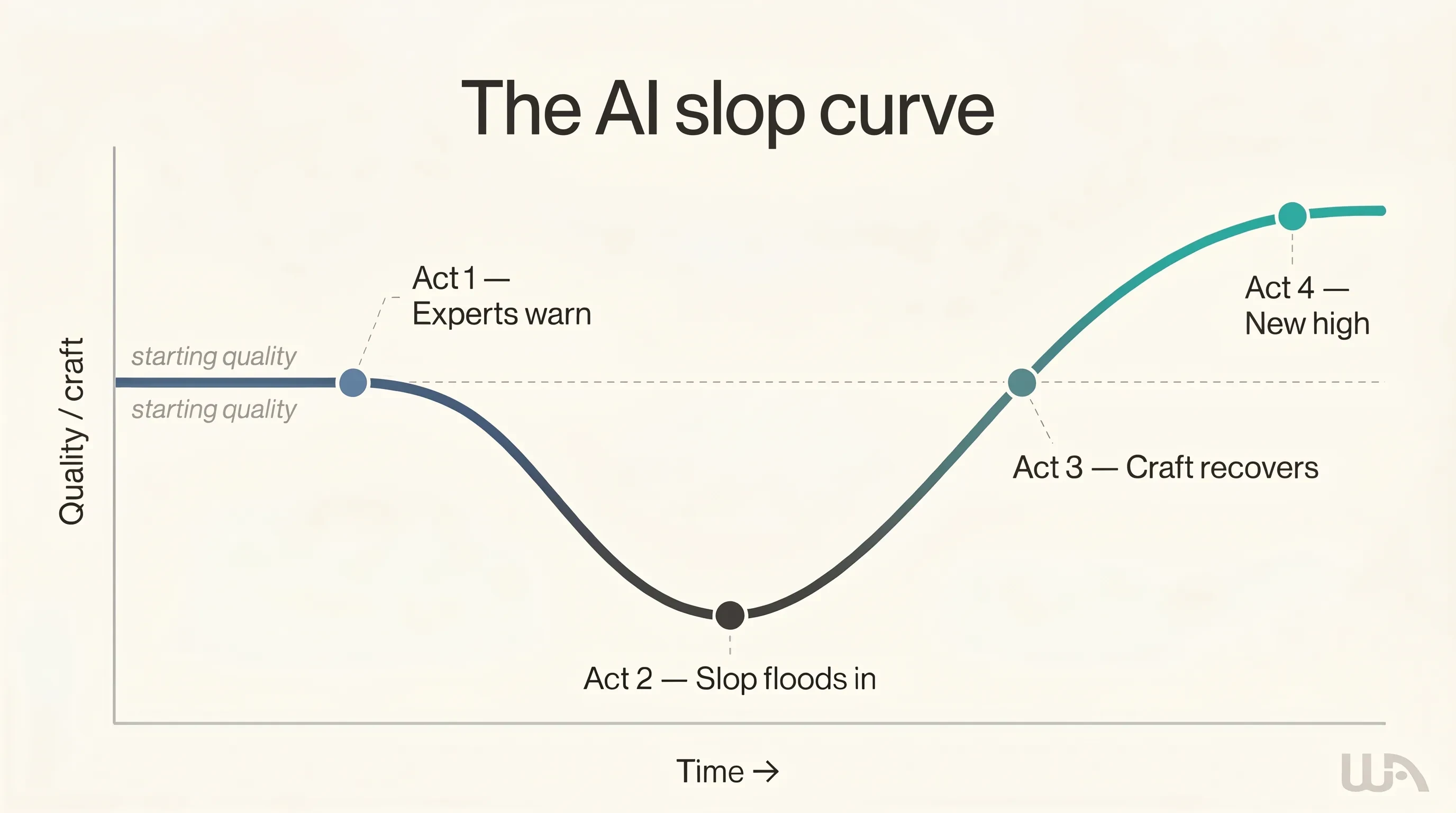
Quality always drops before it rises. Every. Single. Time. The shape is so reliable you could set your watch by it. Four acts, in order, no skipping.
Act 1: The experts warn
Every revolution starts with a guild meeting.
Typographers in 1985. Photographers in 2008, when phones suddenly had cameras that were "good enough." Doctors in 2015, the year we all started Googling our symptoms at 2 a.m. Writers, illustrators, and coders right now.
The warnings are sincere. They're also, narrowly, correct. Uncle Jerry's phone photos really do look bad. WebMD really will convince you that a mild headache is a brain tumor. AI really does produce some genuinely terrible copy.
Ready to put this into action?
Start your free journey today — no credit card required.
But consumers don't go to guild meetings. They never have.
Act 2: The slop floods in
This is where we are.
This is also the scary part, because if you only looked at the world at the bottom of the curve, you'd conclude the experts were right all along. Average quality genuinely drops when tools get accessible. Three fonts on one page. A billion mediocre wedding photos. LinkedIn posts that open with "In today's fast-paced world…" Everything does look a little broken.
Here's the tell, though. The thing almost nobody wants to admit out loud: the copywriter who'd never let AI write a word of her prose is perfectly happy to let it retouch her photos. Format her spreadsheets. Catch her typos. She runs spellcheck instead of hiring an editor.
So do I. So do you.
We're all artisans in one lane and impatient consumers in twenty others. The consumer in us always wants the best available tool, and doesn't much care whose job it threatens.
Act 3: Craft recovers
Some people figure it out.
They stop fighting the tool and start using it in ways its inventors didn't anticipate. The bad stuff doesn't vanish by any means. Comic Sans is immortal, and some AI-generated blog post with seven em-dashes in one paragraph (and some passive aggressive emojis) is probably being published as you read this. But great new work starts appearing alongside the slop.
The average stays low. The best gets better.
Act 4: The new high
Then the ceiling moves.
Today's professional photographers do things that would've required a film crew, a darkroom, and a small fortune in 2005. Patients walk into doctor's offices having read ten studies instead of zero, and sometimes they catch things the doctor misses. Type is more expressive, more varied, and more playful than it was when Phil's grandfather was alive.
The typographers who stuck it out didn't lose their craft. They just stopped being the only people who had access to it, and in exchange, they got tools their predecessors couldn't have imagined.
One honest caveat, because I don't want to oversell this.
Not every transition ends at a higher peak. Factory farming really did damage flavor. Frozen dinners really did replace dinner (and are gross at the very best of times). Mass production really did kill a thousand artisan trades, and we're still reckoning with some of those losses a century later. Sometimes the trough is the ending.
But usually it isn't. Usually, given enough time, taste finds its footing and the curve keeps climbing.
So if you're frustrated by AI slop right now (and there is plenty to be frustrated by) remember where you are on the graph. The anger is part of Act 1. It's the guild meeting. It's Phil at his drafting table.
The only complaint that actually bends the curve is the work itself.
Make something good. Then make something better.
Share this insight
This conversation is happening inside the community.
Join free to continue it.The Internet Changed. Now It Is Time to Build Differently.
If this article resonated, the next step is learning how to apply it. Inside Wealthy Affiliate, we break this down into practical steps you can use to build a real online business.
No credit card. Instant access.