From AltaVista to AI: How Browsers Changed the Affiliate Game


Published on October 21, 2025
Published on Wealthy Affiliate — a platform for building real online businesses with modern training and AI.

I still remember the first time I opened AltaVista. It wasn’t even about making money online back then. It was curiosity. I’d sit at the family computer, dial-up screeching through the speakers, waiting for that moment when the screen finally loaded something other than a loading bar. The search box felt like a portal to another world.
But that dial up sound??? Man, that was something else:
https://youtu.be/gsNaR6FRuO0?si=x-gSifUOVnXWQA6L
Anyway, I’d type things like “how to build a free website” or “Myspace layouts,” and within minutes, I’d be knee-deep in early internet chaos. Bright backgrounds. Blinking text. Broken images. And yet, it felt alive. If you were an online creator back then, you weren’t building for SEO. You were building for survival.
Now, we open ChatGPT or Gemini and ask it to write the content, research the keywords, and format the HTML all before lunch. Things have changed. But for affiliate marketers, the shift from search engines like AltaVista to AI browsers isn’t just nostalgic—it’s strategic.
The Early Days of Browsing and Search
Before Google took over, we had a playground of search engines that felt like mini-universes.
- AltaVista: The pioneer of real search indexing. It didn’t always give you what you wanted, but it gave you something.
- Lycos: Famous for its simplicity and “search the web” feel before algorithms ruled everything.
- Ask Jeeves: You literally typed in questions, and a digital butler “answered” them.
- Yahoo!: The portal of all portals. If you didn’t have a Yahoo email, you weren’t on the internet.
- AOL.com: The sound of dial-up still rings in my head. That “You’ve Got Mail” moment was real.
As affiliate marketers back then, we would have been mailing physical order forms, running banner ads, or posting links in forums. There was no real analytics dashboard. Just hope and patience.
The Browsers That Started It All
When the web first opened up, a few browsers shaped everything that followed:
- Netscape Navigator: The first major browser. It made surfing the web a real experience.
- Internet Explorer: Microsoft’s answer to everything. It dominated for over a decade.
- Mosaic: The very first to mix text and images on one page. The start of the modern internet.
- AOL Explorer: If you had dial-up, this was probably your window to the world.
- Opera: A browser that felt ahead of its time, with features like pop-up blocking and tabs before anyone else.
Then came Firefox, born from Netscape’s ashes, and Safari, Apple’s clean, controlled ecosystem. But the big shift came in 2008 when Google Chrome entered the scene.
Chrome didn’t just browse the web—it defined it. It made extensions normal, developer tools accessible, and speed the new standard. Today, many of us build affiliate sites with Chrome’s inspector open in one tab and WordPress in another. It became part of our process.
Today’s Browser Lineup for Affiliates
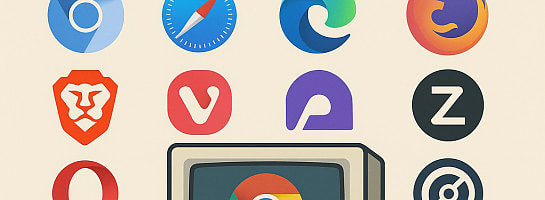
Every affiliate marketer has their favorite browser, and for good reason. Here’s a look at what’s out there today and why each has a place in our workflow.
Google Chrome
Ready to put this into action?
Start your free journey today — no credit card required.
Fast, familiar, and filled with tools. Chrome is where most of the web happens.
For affiliate marketers, it’s ideal because every SEO plugin, keyword extension, and analytics tool seems to run best here.
Microsoft Edge
This is my personal pick. Edge has come a long way from Internet Explorer.
It’s built on the same Chromium base as Chrome, but it’s lighter on resources and integrates with Bing Webmaster Tools and AI copilots directly in the sidebar. I often write content in one tab, run quick keyword checks in another, and even use Bing’s AI features to summarize data mid-task.
Safari
Apple users swear by it. If your audience is on mobile or Mac, testing in Safari is essential. It also gives you insight into how affiliate links behave in privacy-heavy environments—something worth knowing before you lose conversions.
Firefox
Still a privacy favorite. For affiliates concerned about tracking, cookie behavior, or ad-block interference, Firefox offers a testing ground that keeps you honest about how your links perform.
Opera
While not as popular, Opera remains interesting. It has a built-in VPN and ad-blocker, so it’s a perfect browser to test whether your landing pages survive those privacy filters.
Brave
Privacy-first and built on Chromium. Many modern users prefer it because it blocks trackers automatically. If your affiliate program relies on cookies, this browser shows you how much you’re losing to privacy trends.
Arc Browser
The new kid on the block. It turns your browser into a workspace, letting you organize multiple affiliate dashboards and content tools visually. It’s experimental, but it hints at what browsing may become—a control center, not a window.
AI is Becoming a Browser
Here’s where things really get interesting.
AI tools like ChatGPT, Perplexity, and Anthropic’s Claude aren’t just assistants anymore. They are the browsers now. You ask a question, and they pull results, summarize, and recommend links. The traditional “search results page” is being replaced by conversation.
For affiliate marketers, that means two things.
First, our content needs to be readable by AI. Structured data, schema markup, and strong EEAT signals aren’t just for Google anymore. They help AI engines understand what your site is about and when to recommend it.
Second, we might start optimizing for AI discovery rather than pure search. Imagine future affiliate tracking links that integrate directly into AI chat interfaces—less clicking, more conversational recommendations.
Should we resist that? I don’t think so. We’ve adapted from printed classifieds to blogs, from banner ads to SEO, from Facebook to TikTok. Each change looked uncertain until someone figured out how to use it. This one’s no different.
Looking Back—and Forward
Sometimes I think about what affiliate marketing would have been like in the AltaVista days. No social media. No real analytics. Just web rings, directory submissions, and patience.
Today, I can launch a campaign, track conversions in real-time, test user experience in five browsers, and use AI to help write my headlines—all in an afternoon.
That’s the evolution. From dial-up to fiber, from Myspace pages to AI chat windows.
From wondering if anyone saw your link on AltaVista to knowing exactly who clicked it on Chrome.
So the question isn’t whether AI browsers will replace the old ways. The question is whether we’ll be ready when they do.
Share this insight
This conversation is happening inside the community.
Join free to continue it.The Internet Changed. Now It Is Time to Build Differently.
If this article resonated, the next step is learning how to apply it. Inside Wealthy Affiliate, we break this down into practical steps you can use to build a real online business.
No credit card. Instant access.