Why Most People Quit Affiliate Marketing Too Early


Published on March 22, 2026
Published on Wealthy Affiliate — a platform for building real online businesses with modern training and AI.

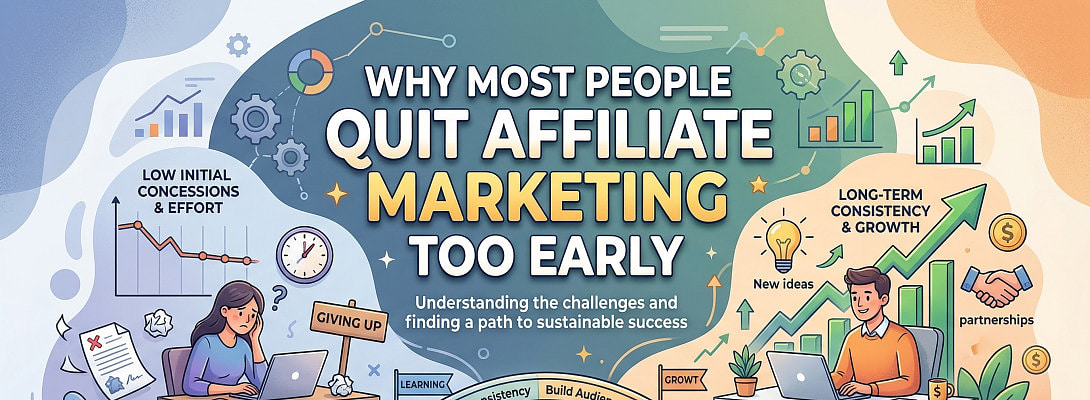
Most beginners quit affiliate marketing too early because they expect instant results, fail to understand the process, and focus too much on income rather than building trust and authority. Early efforts often go unnoticed, clicks are slow to appear, and audiences take time to find and value your content. By understanding these early challenges and focusing on consistent, actionable steps, you can avoid quitting prematurely and set a foundation for long-term affiliate success.
What Every Beginner Needs to See
Affiliate marketing is frequently misrepresented as a “get-rich-quick” system. Many beginners start with the idea that posting a few links will immediately generate income. When results don’t appear, discouragement sets in. It is important to understand that success in affiliate marketing is gradual and based on consistent effort, not luck. Early content often receives few clicks because trust has not yet been built and search engines are still indexing your work.
Research from Forbes (2025) shows that over 65% of affiliate marketers quit within the first three months, not because they lack effort, but because they misinterpret early silence as failure. The reality is that online content takes time to reach your audience, and conversions occur only after trust and value are established.
As a beginner, focusing on small progress indicators such as page views, engagement, and feedback is crucial. Every article, social post, or email is an investment in your long-term visibility. Understanding this principle early helps prevent discouragement and allows you to focus on the process instead of chasing immediate financial results.
Common Reasons Beginners Quit Too Early
Affiliate marketing can feel overwhelming for beginners. Most quit because they misread early results, misunderstand the process, or get frustrated when effort doesn’t immediately pay off. The truth is that success requires time, consistency, and trust-building, yet these crucial elements are often invisible in the early stages. Understanding why beginners fail allows you to anticipate these challenges and take deliberate actions that keep you moving forward instead of quitting.
1. Quitting Too Soon Because Nothing Seems to Happen
Many beginners give up after only a few posts because the early results seem negligible. This is a natural reaction, but it overlooks the fact that affiliate marketing requires a discovery period. During this time, search engines index your content, audiences begin to notice your work, and engagement starts to accumulate slowly. Without patience, early efforts appear invisible, creating the false impression of failure.
It is important to recognize that early effort is building a foundation. Each article you publish contributes to future visibility, authority, and traffic. According to Ahrefs (2024), most articles take 3–6 months to rank consistently even for long-tail keywords. Beginners who quit in this period are leaving potential traffic and income on the table.
Instead of focusing on immediate clicks or income, measure progress using small engagement metrics. Observing these early indicators allows you to refine your messaging and better understand your audience before expecting financial results.
How to navigate this early phase:
- Commit to a consistent publishing schedule that signals reliability to both search engines and your audience.
- Monitor minor engagement metrics like time on page, scroll depth, or social shares instead of obsessing over clicks.
- Treat the first few months as a learning laboratory, testing titles, content length, and CTA placement.
- Focus on quality content creation rather than immediate monetization.
- Track trends in your content performance to adjust future topics and formats effectively.
2. Misinterpreting Early Silence as Failure
Early silence is often mistaken for incompetence or bad content. Beginners assume that if nobody is clicking or commenting, their work is worthless. In reality, early silence is a natural phase in audience discovery. Search engines take time to index content, audiences need repeated exposure, and trust is built gradually.
Understanding this process is critical. The Content Marketing Institute (2025) shows that many top-performing articles receive little engagement in their first few months, yet eventually become consistent traffic sources. Quitting before this window closes means missing the exact period when content begins to compound in value.
The key is to focus on incremental indicators of progress. Observing small signals of interest—like impressions, shares, or brief feedback—can inform you that your content is gaining traction. These subtle metrics are early proof that your work is being noticed, even if clicks and conversions are not yet visible.
How to handle early silence:
- Concentrate on content quality and consistency rather than judging results too quickly.
- Look for subtle indicators like shares, time on page, and early comments to measure early traction.
- Experiment with headings, visuals, and CTA placement based on data, not guesswork.
- View the initial phase as a training period for learning your audience and refining messaging.
- Avoid comparing early results to others’ success, as every niche and content path varies.
3. Building Trust Takes Time
Clicks and conversions do not occur immediately because your audience must first trust you. Trust is built through consistent value delivery, accuracy, and reliability. Beginners often fail by pushing affiliate links too early, without establishing credibility, which results in low engagement and missed opportunities.
Trust takes repeated exposure to your insights and practical guidance. The Edelman Trust Barometer (2025) shows that credibility, transparency, and reliability are crucial for influencing purchasing decisions online. Without these elements, even well-placed affiliate links may be ignored.
Beginners must approach content creation as a trust-building exercise. Focus on solving real problems, providing actionable guidance, and maintaining a consistent voice. Over time, readers recognize your authority and are more likely to engage with your recommendations.
How to build trust effectively:
- Deliver content that addresses real problems and provides solutions your audience can implement immediately.
- Avoid aggressive promotion at the start; emphasize helpful guidance over selling.
- Keep a consistent tone, style, and messaging across all platforms to build recognition.
- Disclose affiliations transparently to maintain credibility.
- Ensure repeated exposure to your insights before expecting readers to click affiliate links.
4. Expecting Quick Wins Before the System Has Time to Work
Many beginners fail because they assume affiliate marketing will deliver immediate financial results. This impatience often leads to frustration and quitting, even though the system is designed to compound value gradually. Your content needs time to reach search engines, social platforms, and your target audience before results start to appear consistently.
Affiliate marketing success depends on repeated exposure and incremental trust-building. According to Backlinko (2025), content often requires several weeks to months before it begins generating noticeable clicks. Early financial results are not an accurate measure of your potential success, and quitting prematurely prevents the system from working for you.
Instead of chasing instant income, focus on metrics that indicate growth and learning. Analyze impressions, engagement, and audience feedback to understand how your content resonates. By prioritizing long-term consistency over short-term gain, you set yourself up for reliable traffic, trust, and affiliate conversions.
How to give the system time to work:
- Track micro-progress indicators like page views, social shares, and comments rather than immediate revenue.
- Plan a content calendar that spreads topics over weeks and months to ensure consistent exposure.
- Avoid over-promoting early; focus on providing value first, monetization second.
- Reassess strategies periodically using analytics to see what resonates and adjust without abandoning efforts.
- Recognize that affiliate marketing compounds over time, and early patience is critical for long-term success.
5. Focusing Only on Income Instead of Value
Many beginners prioritize quick earnings over building real value for their audience. This mindset often results in generic content, aggressive promotion, and low engagement. Without offering practical solutions and insights, your audience will not trust your recommendations or click your links.
Successful affiliate marketers understand that value drives conversions, not hype. Research from HubSpot (2024) highlights that audiences engage 60% more with content that educates or solves problems than with purely promotional material. By focusing on value first, income naturally follows.
Your approach should be audience-first. Provide actionable guidance, solve problems your readers face, and demonstrate expertise. The more value you deliver consistently, the more likely your audience will return, share your content, and trust your affiliate recommendations.
How to focus on value instead of income:
- Identify specific problems your audience faces and create content directly addressing them.
- Include step-by-step guidance or practical tips that readers can apply immediately.
- Avoid overwhelming readers with affiliate links in early content; let trust develop first.
- Monitor engagement to see which value-focused topics generate attention and expand them.
- Balance monetization with education, ensuring content delivers clear solutions before suggesting products.
6. Giving Up When Traffic Is Slow
Beginners often equate slow traffic with failure. Early-stage affiliate websites rarely attract high volumes of visitors, but this does not indicate lack of potential. Traffic builds gradually as search engines index content, social shares accumulate, and your authority grows.
It is essential to understand that slow traffic is normal in the early months. According to Ahrefs (2025), more than 70% of websites receive minimal traffic during the first 3–6 months. Patience and consistent effort allow you to refine content, target the right keywords, and improve audience engagement before expecting large-scale traffic.
Ready to put this into action?
Start your free journey today — no credit card required.
Instead of quitting, focus on strategies to incrementally increase visibility. Track small gains, optimize existing content, and maintain publishing consistency. Slow traffic is an opportunity to experiment, learn your audience, and set up systems that pay off exponentially over time.
How to handle slow traffic effectively:
- Analyze which content topics are attracting the most attention and create similar posts.
- Use internal linking to guide visitors through multiple related articles.
- Promote content on social media, forums, and niche communities to gain early engagement.
- Collect feedback from early readers to understand what resonates and adjust accordingly.
- View slow traffic as a learning and optimization phase, not a sign of failure.
7. Overcomplicating the Process
Beginners often quit because they believe affiliate marketing is overly complex. They assume success requires sophisticated tools, advanced SEO, or professional-level design before they even start. This misconception creates unnecessary stress and stalls progress, even though simple, consistent actions often yield better results than complicated strategies attempted too early.
Affiliate marketing works best when you focus on mastering fundamentals first. Delivering helpful content, understanding your audience, and promoting relevant products in a straightforward manner often outperforms convoluted approaches. According to Neil Patel Insights (2025), beginners who simplify their strategy see higher completion rates for content creation and better long-term engagement than those who overcomplicate early efforts.
By stripping the process down to essentials, you can focus on actions that matter: creating problem-solving content, tracking results, and optimizing incrementally. Complexity can be added later, once foundational systems are in place.
How to simplify the process:
- Start with one niche and focus on delivering consistent, valuable content within it.
- Avoid investing in multiple paid tools at the start; use free resources and beginner-friendly platforms.
- Break down your content creation into clear steps such as research, writing, publishing, and promotion.
- Focus on one traffic channel at a time instead of attempting to master all channels simultaneously.
- Reassess and expand your strategy only after consistent results in foundational actions.
8. Ignoring Feedback from Early Audience
Many beginners fail to notice or act on feedback from their initial readers. Comments, social shares, and engagement metrics are early signals of what your audience values. Ignoring them leads to misaligned content, low engagement, and eventual discouragement.
Understanding your audience’s preferences allows you to adjust your content, messaging, and promotion effectively. The Content Marketing Institute (2024) emphasizes that adaptive content strategies informed by audience feedback consistently outperform rigid plans. Ignoring feedback in the early stages prevents you from learning the nuances of your niche and building long-term credibility.
To succeed, you must treat every interaction as an opportunity to learn. Small insights from early readers often provide guidance for refining future posts, adjusting link placements, and improving overall engagement.
How to leverage audience feedback:
- Monitor comments and questions to understand common problems and interests.
- Use analytics tools to track which content gets the most attention or shares.
- Adjust future content topics based on reader engagement trends.
- Encourage interaction through questions or polls to gain clearer insights.
- Treat feedback as a practical roadmap for continuous improvement.
9. Neglecting Consistency
Consistency is a critical factor that beginners often underestimate. Posting sporadically or taking long breaks causes audiences to lose interest and search engines to deprioritize content. Beginners sometimes assume that one or two posts are sufficient, not realizing that authority and engagement are built over time through repeated effort.
Consistency is not just about publishing frequency—it also involves maintaining quality, voice, and style. The HubSpot Research (2025) shows that creators who publish consistently see 3x higher audience retention than those with irregular schedules. In affiliate marketing, steady output builds trust and signals commitment, which increases the likelihood of clicks and conversions.
Establishing a rhythm allows you to refine your process, understand audience patterns, and track performance trends. This predictability not only attracts readers but also helps you remain motivated by measuring tangible progress over time.
How to maintain consistency:
- Create a content calendar with realistic publishing goals that you can sustain.
- Batch-produce content when possible to avoid gaps during busy periods.
- Maintain consistent formatting and tone so readers recognize your brand easily.
- Track deadlines and progress with simple tools like spreadsheets or project apps.
Commit to publishing at a steady pace, even if early results seem slow, because consistency compounds into long-term growth.
10. Comparing Yourself to Others
Beginners often quit because they constantly compare their progress to others in the affiliate marketing space. This comparison creates discouragement, self-doubt, and a sense of inadequacy, even though every marketer’s journey is unique. Metrics like traffic, conversions, and income vary widely depending on niche, audience, and timing.
Comparisons are misleading because beginners rarely see the full context behind another marketer’s success. According to Neil Patel Insights (2025), what appears as instant success online often results from months or years of prior effort, testing, and optimization. Comparing yourself to someone else’s peak milestones without acknowledging their foundational work sets unrealistic expectations and fuels premature quitting.
Instead of comparing, focus on tracking your personal progress. Celebrate small wins, learn from setbacks, and refine strategies based on your audience and results. Internal benchmarks provide a realistic view of growth, motivation, and areas for improvement, ensuring you stay on track without unnecessary discouragement.
How to stop comparing and focus on your journey:
- Track your own performance metrics rather than obsessing over others’ stats.
- Set incremental, achievable goals that reflect your stage of growth.
- Reflect on progress regularly to acknowledge improvement and learning.
- Treat other marketers’ successes as inspiration, not a standard for immediate comparison.
- Focus on building systems and habits that compound results over time instead of chasing quick wins.
11. Neglecting Skill Development
Many beginners assume they can succeed without actively developing marketing, writing, or research skills. Affiliate marketing requires a combination of content creation, SEO, audience engagement, and basic analytics. Neglecting skill development results in stagnation, low-quality content, and early frustration.
Investing in skill-building gives you a competitive edge and confidence. According to Backlinko (2025), marketers who consistently learn and apply new techniques experience higher traffic, engagement, and conversions than those who rely solely on intuition. Focusing on developing skills ensures your content continues to improve, your marketing becomes more precise, and your results become repeatable.
Skill development should be practical and ongoing. Learning while implementing allows you to immediately apply insights, test results, and refine strategies in real time, accelerating your growth and preventing discouragement caused by lack of competence.
How to develop essential skills for affiliate marketing:
- Dedicate time weekly to learn SEO, copywriting, and analytics basics.
- Practice content creation regularly to refine writing style and clarity.
- Study case studies from successful affiliate marketers to understand applied techniques.
- Experiment with new tactics in small, controlled ways to see what works for your audience.
- Treat every post and campaign as an opportunity to learn and improve your skill set.
12. Quitting Before Systems Are in Place
Beginners frequently stop too early because they haven’t built repeatable systems for content, promotion, and tracking. Without structured systems, growth is inconsistent, results appear random, and motivation suffers.
A systematic approach allows you to predict results, optimize efficiently, and scale operations. According to HubSpot Research (2024), marketers with clear processes for content creation, scheduling, and analytics are 2–3x more likely to achieve long-term success. Systems provide clarity, reduce decision fatigue, and ensure that effort consistently translates into measurable results.
Building systems early also protects you from burnout. When routines, templates, and workflows are in place, you can focus on quality execution instead of constantly reinventing the process. This stability is a critical factor in preventing early quitting.
How to build systems that sustain success:
- Develop a content production workflow including research, drafting, editing, and publishing.
- Set up tracking tools and dashboards to monitor traffic, engagement, and affiliate conversions.
- Create promotion routines for social media, forums, and email outreach.
- Use templates and checklists to streamline repetitive tasks without losing quality.
- Periodically review and adjust systems to ensure they scale with your growth and evolving goals.
13. Ignoring Audience Building
Beginners often focus only on content or products without actively building a loyal audience. Without a dedicated readership, engagement remains low, affiliate clicks are scarce, and motivation drops. An audience is not just traffic—it’s a community of people who trust you, value your content, and are likely to act on your recommendations.
Focusing on audience building ensures that your efforts compound over time. According to HubSpot (2025), marketers who prioritize audience engagement see 4x higher click-through rates than those who focus purely on content output. By cultivating relationships through comments, email, and social channels, you create a network that amplifies your content naturally.
The key is to treat audience growth as an integral part of your strategy, not an optional side project. Engaging your readers, answering questions, and providing consistent value builds credibility, keeps people coming back, and dramatically increases your long-term affiliate revenue potential.
How to build and nurture your audience:
- Respond to comments and emails promptly to show readers they’re valued.
- Use lead magnets like free guides or checklists to capture email subscribers.
- Engage in relevant online communities where your target audience spends time.
- Share behind-the-scenes content or personal insights to humanize your brand.
- Track engagement metrics to understand what resonates and refine content accordingly.
14. Avoiding Continuous Learning
Many beginners assume affiliate marketing is static and stop learning after publishing a few posts. This mindset limits growth, reduces adaptability, and creates stagnation. The digital marketing landscape evolves rapidly, and strategies that worked yesterday may not perform today.
Continuous learning is essential to stay competitive. According to Backlinko (2025), top affiliate marketers regularly test new approaches, adopt emerging tools, and study audience behavior to refine tactics. Ignoring learning leads to missed opportunities, poor content performance, and early burnout.
Approach learning as a practical, applied activity. Every article, campaign, or traffic test can teach you something new. By treating every effort as a learning opportunity, you not only improve your skills but also build confidence in your ability to adapt and scale over time.
How to embrace continuous learning:
- Dedicate weekly time to study SEO, copywriting, analytics, and new marketing trends.
- Analyze successful campaigns in your niche to identify applicable strategies.
- Test new approaches in small, controlled ways to see what resonates with your audience.
- Attend webinars, workshops, or online courses to expand your knowledge base.
- Document insights and lessons learned to refine processes and accelerate growth.
15. Failing to Track and Adjust
Beginners often create content without tracking performance metrics or adjusting strategies. Without understanding what works, effort becomes wasted, frustration builds, and quitting seems like the easiest solution. Success in affiliate marketing depends on informed decisions, not guesswork.
Tracking provides actionable insights. According to Ahrefs (2025), marketers who consistently analyze traffic, engagement, and conversion data are far more likely to optimize effectively and achieve long-term growth. Metrics reveal which topics, formats, and promotion channels generate results, allowing you to focus on what truly matters.
Adjusting based on data ensures your efforts are efficient and outcome-driven. By iteratively refining your content, promotion, and approach, you increase the likelihood of success, maintain motivation, and reduce the risk of quitting prematurely.
How to track and adjust effectively:
- Set up analytics dashboards to monitor traffic, clicks, and engagement regularly.
- Identify top-performing content and replicate strategies across similar topics.
- Track affiliate conversions to understand which recommendations resonate most with your audience.
- Adjust underperforming content by updating, optimizing, or repurposing it.
- Use insights to inform future content and promotion decisions, creating a continuous improvement cycle.
Conclusion
Most beginners quit affiliate marketing too early because they expect quick results, ignore their audience, do not track their progress, or fail to develop the right skills. Understanding these common mistakes helps you avoid them and stay on course.
Focusing on practical strategies helps you improve your skills, create simple systems that work, and stay consistent without feeling overwhelmed. Every small step you take adds up, bringing you closer to real results over time.
Affiliate marketing takes patience, steady effort, and learning from what works and what does not. Following these steps keeps you on track and gives you a clear path to success, even when others quit too soon.
Share this insight
This conversation is happening inside the community.
Join free to continue it.The Internet Changed. Now It Is Time to Build Differently.
If this article resonated, the next step is learning how to apply it. Inside Wealthy Affiliate, we break this down into practical steps you can use to build a real online business.
No credit card. Instant access.