How to Turn One Post Into Multiple Traffic Sources


Published on March 23, 2026
Published on Wealthy Affiliate — a platform for building real online businesses with modern training and AI.

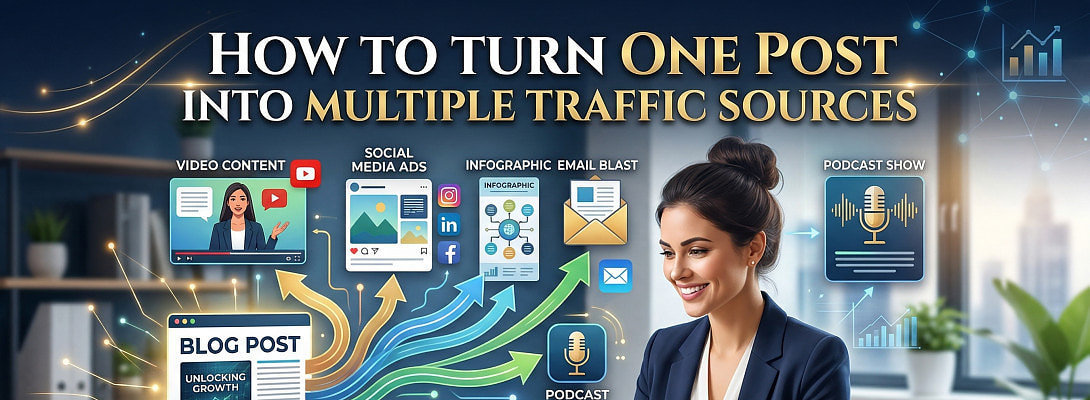
You can turn one post into multiple traffic sources when you break it into smaller content pieces, adapt each piece for different platforms, and publish them in formats that match how people consume content on those platforms. A single well-written post can generate traffic from search engines, social media, video platforms, email, and online communities when you reuse the same idea in different ways that fit each channel.
Creating content takes time, yet many beginners rely on a single blog post and expect it to bring traffic on its own. This limits growth. According to Content Marketing Institute (2025), marketers who repurpose content effectively generate up to 60% more traffic compared to those who publish once and move on. The difference is not effort alone; it is how content gets distributed and reused across platforms.
The opportunity is clear. Research from HubSpot (2025) shows that brands using multiple content channels see 3 times more engagement than those relying on a single source. When you understand how to extend the life of one post, you stop creating content endlessly and start building a system where one idea works for you in many places at once.
What You Must Understand Before You Start
Content is not limited to one format. A blog post is only the starting point. Each idea inside that post can become a video, a short clip, a question, or a social post. According to Neil Patel Digital (2025), repurposed content can drive up to 75% of total traffic when used across multiple platforms. This works because people consume content differently. Some prefer reading, others prefer watching or scrolling short posts.
When you match your content to different consumption styles, you increase reach without creating new ideas from scratch. The goal is simple. Extract value from one post, convert it into multiple formats, and place each format where your audience already spends time.
How to Turn One Post Into Multiple Traffic Sources
One strong post contains many ideas, and each idea can attract a different type of audience. The steps below show how to expand one piece of content into multiple traffic streams that work together to grow your reach and increase clicks.
Step 1: Break Your Post Into Multiple Standalone Ideas
A single post usually contains several key points, but most beginners treat it as one piece instead of a collection of ideas. Each section, tip, or insight inside your post can stand on its own and attract attention independently. According to Backlinko (2025), content that focuses on a single idea performs up to 40% better in engagement than content that tries to cover too much at once.
When you extract individual ideas, you create more opportunities for visibility. A long article may only rank for a few keywords, but smaller pieces can target different searches, questions, and interests. This approach increases your chances of reaching people at different stages of their journey. Some are just discovering the topic, while others are ready to take action.
This process also improves clarity. Each piece becomes sharper and easier to understand. Instead of overwhelming your audience with too much information at once, you present one idea at a time. This keeps attention high and makes your content more shareable across platforms.
Key Actions to Implement This Strategy:
- Identify each main point or subheading in your post and treat it as a separate content idea
- Turn each idea into a short, focused message that solves one problem
- Remove unnecessary details so each piece remains clear and easy to understand
- Match each idea to a specific audience need or question
- Save these extracted ideas in a content list for future use
- Focus on clarity and usefulness to improve engagement on each platform
Step 2: Turn Key Points Into Short-Form Social Content
Short-form content drives fast engagement, especially on platforms like TikTok, Instagram, and X. According to Sprout Social (2025), short-form posts generate 2.5 times more engagement than long-form content on social media. This makes them one of the fastest ways to turn your blog content into traffic.
Each key point from your post can become a short video, caption, or quick tip. These pieces should focus on delivering one clear message in a simple way. People scroll quickly, so your content must capture attention and deliver value within seconds. When your short content connects with viewers, they become curious and want more information, which leads them back to your main post or affiliate link.
Consistency matters here. Posting regularly keeps your content visible and builds familiarity with your audience. Research from HubSpot (2025) shows that brands posting consistently on social media see up to 70% higher engagement rates than those posting occasionally. Short content acts as a bridge that brings people from social platforms to your main content.
Key Actions to Implement This Strategy:
- Convert each key point into a short video or simple text post
- Keep each piece focused on one clear message
- Use simple language that is easy to understand quickly
- Post consistently across your chosen platforms
- Add a clear direction that leads viewers to your main content
- Observe which posts get the most engagement and create similar ones
Step 3: Turn Your Post Into Searchable Content on Multiple Platforms
Search traffic does not only come from Google. Platforms like YouTube, Pinterest, and even TikTok now function as search engines. According to DataReportal (2025), over 40% of Gen Z users use TikTok or Instagram to search for information instead of traditional search engines. This creates an opportunity to expand your reach beyond one platform.
Your original post can be adapted into formats that rank on different platforms. A blog post can become a YouTube video, a Pinterest pin, or a series of searchable posts. Each platform has its own way of ranking content, but the goal remains the same. You want your content to appear when someone searches for a solution.
This approach multiplies your visibility without requiring new ideas. One topic can rank on Google, appear on YouTube, and show up on social search feeds at the same time. According to Ahrefs (2025), content that appears on multiple platforms increases total traffic potential by over 200% compared to single-platform content.
Key Actions to Implement This Strategy:
- Turn your post into a YouTube video targeting the same topic
- Create Pinterest pins that highlight key ideas from your post
- Use keywords naturally in titles, captions, and descriptions
- Focus on search intent when adapting your content
- Publish your content across platforms where your audience searches
- Track which platforms bring the most traffic and prioritize them
Step 4: Create Video Content From Your Ideas
Video gives your content a wider reach because many people prefer watching instead of reading. According to Wyzowl (2025), 91% of users prefer video content when learning about a topic. This means a large group of your potential audience may never read your blog post, but they will watch a clear, helpful video that explains the same idea.
Your post already contains everything you need to create video content. Each section can serve as a script. Each key point can become a short explanation. You do not need new ideas. You only need to present the same message in a format that fits how people consume video. This allows you to reach platforms like YouTube, TikTok, and Instagram without starting from zero each time.
Video also builds trust faster. People connect more easily when they hear a voice explaining something clearly or see someone walk through a simple solution. According to HubSpot (2025), video content generates up to 2 times higher engagement than text-based content. When viewers understand your message quickly, they are more likely to follow your link, read your full post, or take action on your recommendations.
Ready to put this into action?
Start your free journey today — no credit card required.
Key Actions to Implement This Strategy:
- Turn each section of your post into a short, clear video script
- Focus each video on one idea to keep it simple and easy to follow
- Use straightforward language so viewers understand quickly
- Record short videos for social platforms and longer ones for YouTube
- Add captions to improve watch time and accessibility
- Direct viewers naturally to your main content or link
- Stay consistent with video posting to build trust and visibility
Step 5: Use Email to Bring Readers Back
Email gives you control over your traffic because you can reach your audience directly without relying on algorithms. According to Campaign Monitor (2025), email marketing delivers an average return of $36 for every $1 spent, making it one of the most reliable channels for consistent traffic. Many beginners ignore this, yet it remains one of the strongest ways to keep people engaged with your content over time.
Your post can easily provide content for multiple emails. Each key idea can be written as a short message that focuses on one clear insight. Instead of sending one long email, you can send a series of focused emails that guide readers step by step. This approach keeps your audience interested and gives them a reason to return to your content repeatedly.
Email also strengthens trust when used correctly. When your messages consistently provide useful and clear information, readers begin to rely on you. According to HubSpot (2025), value-driven emails can increase click-through rates by up to 50%. This makes email a powerful way to bring readers back to your post and encourage them to explore your recommendations.
Key Actions to Implement This Strategy:
- Break your post into smaller topics that can be sent as individual emails
- Write short, clear emails that focus on one idea at a time
- Include a natural link directing readers to your full content
- Maintain a consistent sending schedule to stay visible
- Use simple subject lines that reflect the benefit inside the email
- Keep your tone direct and personal to build connection
- Track open rates and clicks to improve future emails
Step 6: Answer Questions to Attract Targeted Traffic
People search for answers every day, often in the form of direct questions. Platforms like Quora, Reddit, and even search engines highlight clear, helpful answers. According to Ahrefs (2025), a large share of online searches are question-based, which creates a strong opportunity to position your content where people actively look for solutions.
Your post already contains answers. Each section can respond to a specific question your audience is asking. Instead of creating new content, you extract the relevant part and present it as a direct, easy-to-understand answer. This allows you to appear in places where users are already searching for help, increasing your chances of getting clicks from people who are ready to take action.
This method works well because it targets intent. Someone asking a question already wants a solution. When you provide a clear answer and guide them to your full content, you attract visitors who are more likely to engage. According to HubSpot (2025), users who search with specific intent are more likely to take action than those casually browsing content.
Key Actions to Implement This Strategy:
- Identify common questions related to your topic
- Extract answers directly from your post content
- Write clear and simple responses that solve the problem
- Add a natural reference to your full post for more details
- Focus on platforms where users actively ask questions
- Stay consistent in answering to build trust and visibility
- Track which questions bring the most traffic and refine your approach
Step 7: Create Visual Content People Save and Share
Visual content has unmatched power on the internet. Posts that include compelling images, infographics, or short videos are more likely to grab attention, explain ideas quickly, and leave a lasting impression. According to HubSpot (2025), social media posts with visuals receive up to 94% more views than text-only posts. When you create content people naturally want to save or share, you multiply your traffic because your post reaches networks beyond your immediate audience. This is particularly effective for evergreen content that solves recurring problems or provides clear step-by-step guidance.
Designing visual content requires understanding what your audience finds engaging. Infographics can simplify complex topics, screenshots or slides can demonstrate practical steps, and short, shareable videos can convey actionable insights faster than text alone. Research from Venngage (2025) shows that infographics are liked and shared on social media three times more than other content types. When people save your visuals for later reference, they become repeat visitors to your blog, website, or affiliate page, and sharing exposes your content to entirely new audiences without additional effort.
Visuals also increase comprehension and retention. The Social Science Research Network (2025) highlights that humans remember 65% of visual information compared to just 10% of text. By adding visuals that reinforce your key points, you ensure readers understand and value your content, which strengthens trust and encourages further engagement. Done strategically, this transforms a single post into a hub of shareable, repeatable traffic.
Key Actions to Implement This Strategy
- Convert key points into infographics that summarize your content clearly
- Create short, actionable video snippets highlighting steps or tips
- Use images, charts, and diagrams that make complex ideas instantly digestible
- Design shareable visuals with your branding for recognition and recall
- Encourage readers to save or share visuals within your content
- Embed visual content that supports both social and website traffic
- Monitor which visuals generate the most shares and repeat engagement
Step 8: Get Traffic From People Already Looking for Answers
Not all traffic is equal. The most valuable visitors are those actively searching for solutions or answers in your niche. This is why targeting platforms where people ask questions—like Google, Quora, Reddit, or niche forums—is critical. HubSpot (2025) reports that over 70% of online users begin their search journey with a question, and content designed to answer those questions sees much higher engagement and conversion rates. By creating posts that directly respond to these inquiries, you tap into ready-to-act audiences who are already motivated to click, read, and explore your recommendations.
This strategy requires research. Identify recurring questions, common challenges, and trending problems within your niche. Tools like AnswerThePublic (2025) or Ahrefs Keywords Explorer (2025) allow you to discover queries people are typing every day. Structuring your content to answer these questions clearly ensures that your post not only attracts readers but also positions you as a trusted authority. When people find exactly what they are looking for, they are more likely to engage with links, share your post, and return for future content.
Additionally, providing detailed, actionable solutions encourages visitors to spend more time on your page, which signals value to search engines and social platforms. Moz (2025) data shows that pages answering specific questions with clarity and depth tend to rank 50% higher in search results. Optimizing your content for these questions multiplies the reach of a single post across multiple platforms, ensuring your effort benefits both organic search traffic and social visibility over time.
Key Actions to Implement This Strategy
- Identify top questions in your niche using tools like AnswerThePublic or Quora
- Create content that provides precise, actionable answers
- Structure your post with clear headings and step-by-step explanations
- Use real-world examples or case studies to make your solutions relatable
- Incorporate keywords naturally that match search intent
- Monitor which questions drive traffic and update content regularly
- Share your answers on forums, communities, and social platforms for extra visibility
Step 9: Build Content That Keeps Bringing Traffic Over Time
Evergreen content is the foundation of long-term traffic growth. Unlike trend-driven posts, evergreen posts remain relevant for months or even years. According to Backlinko (2025), evergreen articles can continue generating 50–60% of their total traffic over the first year without additional promotion. Creating content that remains useful ensures your initial effort continues to pay off, turning one post into a persistent source of traffic across multiple channels.
To maximize longevity, focus on timeless topics that address core problems, common questions, or ongoing needs in your niche. Refresh your posts periodically with updated statistics, examples, and references to maintain authority. HubSpot (2025) highlights that updating old posts can increase organic traffic by up to 106%, showing that a single piece of content can continue performing if maintained properly. This approach amplifies the reach of a post far beyond its initial publication.
Finally, combining evergreen content with strategic distribution multiplies results. Internal linking, social sharing, email newsletters, and repurposing into other formats (videos, infographics, or downloadable guides) ensures your content continues to attract new audiences. Content Marketing Institute (2025) reports that companies that consistently update and redistribute evergreen content see 3 times higher long-term ROI than those focusing only on new posts. A single well-crafted post becomes a traffic engine that works consistently over time.
Key Actions to Implement This Strategy
- Focus on timeless, widely applicable topics in your niche
- Update posts regularly with current data, examples, or trends
- Repurpose content into other formats for different platforms
- Use internal linking to guide readers to related content
- Promote posts periodically on social media and newsletters
- Track performance metrics to identify opportunities for refreshes
- Optimize for SEO to maintain search visibility and consistent traffic
Step 10: Direct Readers to Your Post Across Channels
Traffic multiplies when you guide readers from every platform back to your original post. One post can act as the hub, and each adapted piece across social media, video, email, or forums can feed readers to it. According to HubSpot (2025), content with strategically placed links from other channels can increase traffic to the main page by over 60%. You don’t need multiple posts; you need to make each derivative piece work as a doorway to your main content.
The key is natural integration. Short videos, social posts, or email snippets should tease value, answer a question, or provide a tip, then point readers to the full post for more depth. Readers are more likely to click when they feel the post expands on something they just saw. Monitoring click patterns from each channel helps you understand which formats are most effective in bringing traffic to the main post.
This approach ensures a single post generates continuous streams of visitors. Instead of creating entirely new content for every channel, you leverage what you already have, turning every social share, answer, or snippet into a traffic source.
Key Actions to Implement This Strategy
- Add links to the main post in all derivative content across platforms
- Use clear language that highlights what readers will gain by visiting the post
- Place links where they complement the content naturally, not disrupt it
- Track click-through rates from each platform to optimize placement
- Rotate link placement across posts to test which drives the most traffic
- Encourage sharing of derivative content that links back to the post
- Use short teasers or highlights that entice readers to visit the main post
Step 11: Highlight Credibility to Increase Multi-Channel Engagement
Readers are more likely to click when they see that others have benefited from your content or that it carries authority. According to Nielsen (2025), 92% of consumers trust recommendations from others more than brands. Showcasing your post’s value through real results, reader feedback, or measurable outcomes turns each adaptation into a compelling traffic source.
Credibility can take many forms. You can display metrics such as shares, comments, or downloads, showcase case studies, or quote expert endorsements related to your topic. Each derivative piece—be it a tweet, video snippet, or forum answer—can highlight these indicators, making readers confident that exploring your post will be worthwhile. HubSpot (2025) reports that content demonstrating practical value or verified results can increase link engagement by up to 45%, amplifying traffic from every channel.
Keep credibility dynamic. Update your examples, results, or testimonials periodically to reflect ongoing success. This ensures that each repurposed content piece consistently drives readers back to your main post, reinforcing trust without repeating the phrase “social proof.”
Key Actions to Implement This Strategy
- Showcase measurable results, such as shares, downloads, or engagement numbers, in your content
- Include reader feedback or brief case studies to illustrate value
- Highlight real-world outcomes in derivative posts that link back to your main article
- Update metrics or examples periodically to maintain relevance
- Include quotes or insights from authoritative sources to support your points
- Place credibility indicators near calls-to-action to encourage clicks
- Monitor which elements of credibility drive the most traffic and refine them
Conclusion
A single post can generate traffic from search engines, social platforms, video, email, and communities when you adapt it intelligently. By extracting ideas, creating derivative content, guiding readers back, and showcasing credibility, you turn one post into a network of traffic sources.
The focus is on strategy, not quantity. Instead of producing dozens of separate posts, you maximize the potential of one well-crafted piece. Track performance, refine link placement, update visuals and credibility indicators, and ensure each repurposed piece leads back to the hub. This approach transforms a single post into a sustained, multi-channel traffic engine, delivering consistent results across platforms.
Share this insight
This conversation is happening inside the community.
Join free to continue it.The Internet Changed. Now It Is Time to Build Differently.
If this article resonated, the next step is learning how to apply it. Inside Wealthy Affiliate, we break this down into practical steps you can use to build a real online business.
No credit card. Instant access.