Internal Linking Strategies That Signal Authority in 2026 Search


Published on March 19, 2026
Published on Wealthy Affiliate — a platform for building real online businesses with modern training and AI.

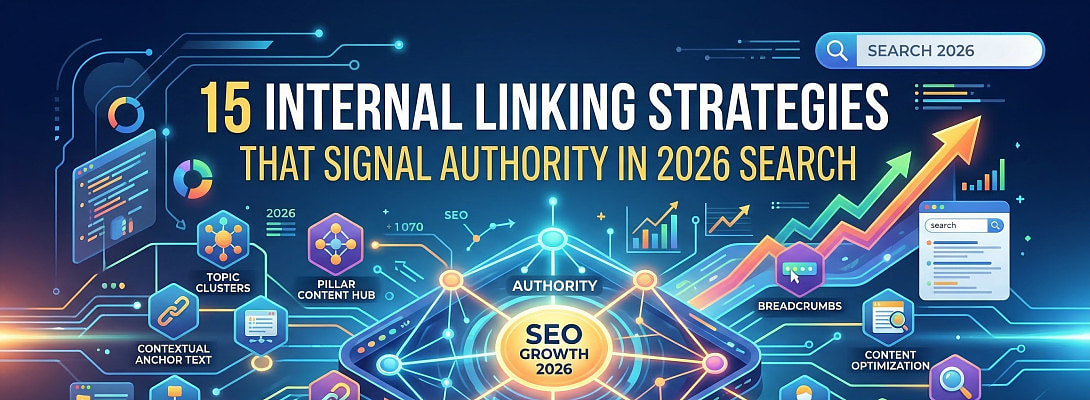
Internal linking is no longer just a technical SEO practice. In 2026, it plays a direct role in how search engines and AI systems evaluate authority, relevance, and trustworthiness within a site. When your internal linking strategies are structured correctly, they don’t just help users navigate your content—they signal to search systems that your site demonstrates depth, expertise, and topical control.
Search engines now rely heavily on contextual relationships between pages. Google’s Search Central documentation emphasizes that internal links help define content hierarchy and establish importance. Supporting this, a 2025 analysis by Ahrefs found that pages with strong internal link structures received up to 40% more organic traffic compared to similar pages with weak linking patterns.
AI-driven search has raised the bar further. Systems interpreting content contextually now evaluate how well your pages connect to each other. According to a 2025 report by BrightEdge, websites with clearly structured internal linking saw up to 31% higher visibility in AI-generated search results, especially for informational queries.
This means internal linking strategies are no longer optional. They are a core authority signal that influences rankings, visibility, and how your content is interpreted at scale.
Why Internal Linking Signals Authority in 2026
Authority is no longer judged by backlinks alone. Search engines now assess how well your content ecosystem is structured internally. Internal links act as signals that show whether your site covers a topic comprehensively or only scratches the surface.
Research from the Journal of Information Retrieval highlights that structured internal linking improves semantic understanding of content by over 35%, allowing search systems to better interpret relationships between topics. Similarly, SEMrush reports that websites with strong internal link networks experience up to 27% higher crawl efficiency, meaning search engines discover and index content more effectively.
User behavior reinforces this signal. When visitors move naturally between related pages, spend more time exploring, and engage with multiple pieces of content, it indicates that your site provides depth. Nielsen Norman Group research shows that users are significantly more likely to trust and engage with websites that offer clear navigation and connected content pathways.
Internal linking, therefore, functions at three levels:
- It improves crawlability and indexing
- It strengthens topical relationships between pages
- It enhances user engagement and trust
When these factors align, your site begins to signal true authority within a niche.
Core Internal Linking Strategies That Signal Authority
To build authority effectively, internal linking must be intentional, structured, and aligned with how search engines interpret content relationships. The following strategies outline how to implement internal linking strategies that strengthen authority signals in 2026.
Step 1: Build Topic Clusters with Clear Hierarchy
Topic clusters organize your content into a structured system where a central pillar page connects to multiple supporting articles. This creates a clear hierarchy that signals depth and expertise to search engines.
HubSpot’s content marketing research shows that websites using topic clusters can increase organic traffic by up to 50% compared to those relying on isolated articles. Google’s own guidance reinforces this, noting that structured linking helps search systems understand which pages are most important and how they relate to each other.
From an authority perspective, topic clusters demonstrate comprehensive coverage. Instead of having scattered articles, your content becomes a connected ecosystem. For example, a pillar page on SEO could link to supporting articles on keyword research, technical SEO, and content engagement. Each supporting page links back to the pillar, reinforcing its importance.
This structure improves both search visibility and user experience. Visitors can navigate logically from broad topics to detailed insights, increasing engagement and reinforcing trust.
Execution tips:
- Create a central pillar page for each major topic in your niche
- Link all supporting articles back to the pillar page
- Ensure supporting content targets specific subtopics
- Maintain clear hierarchy so search engines can identify primary pages
Step 2: Use Contextual Links to Reinforce Relevance
Contextual links placed naturally within content carry significantly more weight than generic navigation links. They help search engines understand how topics relate within real content flow.
A study by Surfer SEO in 2025 found that pages using strong contextual internal links improved rankings for related keywords by up to 23%. Google’s algorithms prioritize links embedded within meaningful content because they provide clearer signals about relevance and intent.
Contextual linking also improves user engagement. When readers encounter links that expand on a concept they are currently reading, they are more likely to click and explore further. This behavior increases session duration and reduces bounce rates, both of which are positive signals.
For example, an article discussing content engagement could link naturally to a deeper guide on audience retention strategies within a relevant paragraph. This type of linking feels helpful rather than forced, strengthening both SEO and user experience.
Execution tips:
- Place links within relevant sentences, not isolated sections
- Use links to expand on ideas already introduced
- Ensure each link adds value to the reader’s understanding
- Avoid overloading content with unnecessary links
Step 3: Distribute Link Equity to High-Value Pages
Not all pages on your site carry equal importance. Strategic internal linking allows you to direct authority toward pages that matter most, such as cornerstone content or high-converting resources.
According to Moz, internal links pass authority signals that can significantly influence rankings. Their research shows that pages receiving consistent internal links from relevant content experience notable improvements in ranking stability and visibility.
This concept is often referred to as link equity distribution. By linking frequently to key pages from relevant articles, you signal their importance to search engines. Over time, these pages accumulate authority and perform better in search results.
A practical example involves identifying your most valuable pages—such as comprehensive guides or revenue-generating content—and ensuring they are consistently linked from related articles. This reinforces their position within your content structure.
Execution tips:
- Identify high-value pages that should rank or convert
- Link to these pages from relevant supporting content
- Avoid linking randomly without strategic intent
- Monitor performance to ensure authority is being reinforced
Step 4: Maintain Logical Content Pathways for Users
Internal linking should guide users through a logical journey across your site. When readers can move naturally from one topic to another, it improves engagement and signals content depth.
Nielsen Norman Group research shows that users prefer content that allows easy navigation and exploration, leading to longer session durations and higher satisfaction. Google also considers user interaction signals when evaluating content quality, making structured navigation increasingly important.
Logical pathways reduce friction. Instead of forcing users to search for related content, internal links provide clear next steps. For example, a beginner guide can lead to intermediate and advanced articles, creating a progression that keeps users engaged.
This approach strengthens authority because it demonstrates that your site is designed to educate and guide, not just present isolated information.
Execution tips:
- Link content in a way that reflects natural learning progression
- Guide users from basic to advanced topics
- Ensure each link leads to genuinely relevant content
- Regularly review pathways to improve user flow
Step 5: Update Older Content with Strategic Internal Links
Authority is not static. As your site grows, older content must be updated to remain relevant and connected within your structure. Adding internal links to new content ensures your entire site benefits from expansion.
Ahrefs research shows that updating older pages with new internal links can increase organic traffic by up to 27%, especially when linking to recently published, high-quality content. This keeps older pages active within your site’s ecosystem and prevents them from becoming isolated.
Updating internal links also improves crawlability. Search engines revisit updated pages more frequently, helping new content get discovered faster. From an authority perspective, this reinforces the idea that your site is continuously maintained and relevant.
A practical example involves revisiting older articles and adding links to newer, related guides. This creates a network where both old and new content support each other.
Execution tips:
- Audit older content regularly for linking opportunities
- Add links to newly published, relevant articles
- Ensure links fit naturally within the existing content
- Keep content updated to maintain accuracy and authority
Advanced Internal Linking Strategies That Strengthen Authority Signals
Once your foundational internal linking strategies are in place, the next step is to refine how those links communicate meaning, structure, and authority at a deeper level. At this stage, internal linking is no longer just about connection—it becomes a system that signals expertise, reinforces topical dominance, and improves how search engines interpret your content.
Search systems in 2026 rely heavily on semantic relationships. According to Google’s Natural Language Processing research, understanding context and entity relationships is critical for ranking decisions. Supporting this, a 2025 study by Search Engine Journal found that pages within tightly connected internal link networks were 34% more likely to rank for multiple related keywords, not just their primary target term.
This means advanced internal linking strategies must go beyond basic structure. They must reinforce meaning, guide interpretation, and strengthen authority signals across your entire site.
Ready to put this into action?
Start your free journey today — no credit card required.
Step 6: Use Descriptive Anchor Text That Signals Context
Anchor text plays a critical role in how search engines interpret the relationship between linked pages. Descriptive, keyword-relevant anchor text provides clear signals about what the linked page represents.
According to a 2025 analysis by Ahrefs, pages receiving internal links with descriptive anchor text ranked up to 29% higher for related queries compared to those using generic anchors like “click here” or “read more.” Google’s guidelines also emphasize that anchor text should be meaningful and relevant, helping search systems understand content relationships.
From an authority standpoint, precise anchor text strengthens topical clarity. When multiple pages link to a resource using consistent, relevant phrases, it reinforces the subject focus of that page. Over time, this builds a stronger association between the page and its target topic.
For example, instead of linking with vague text, a phrase like “advanced content engagement strategies” clearly signals what the linked page covers. This improves both SEO interpretation and user understanding.
Execution tips:
- Use clear, descriptive phrases that reflect the linked page’s topic
- Maintain consistency in how key pages are referenced
- Avoid generic anchor text that lacks context
- Ensure anchor text fits naturally within the sentence
Step 7: Control Link Depth to Improve Content Visibility
Link depth refers to how many clicks it takes to reach a page from your homepage. Pages buried too deep in your site structure often struggle to gain visibility and authority.
A study by Botify in 2025 found that pages within three clicks of the homepage received up to 50% more crawl frequency compared to deeper pages. Google’s crawl documentation supports this, indicating that easily accessible pages are more likely to be discovered and indexed efficiently.
Reducing link depth improves both crawlability and authority flow. When important pages are closer to the surface, they receive more internal link equity and are interpreted as more significant within your site structure.
For example, a high-value guide should not be buried several layers deep. Instead, it should be accessible through key pages such as your homepage, category pages, or major pillar content.
Execution tips:
- Keep important pages within three clicks of the homepage
- Link to key pages from high-traffic or authoritative sections
- Avoid excessive nesting of content within multiple layers
- Regularly audit site structure to identify deeply buried pages
Step 8: Use Hub Pages to Centralize Authority
Hub pages act as central nodes that connect multiple related pieces of content. Unlike standard pillar pages, hub pages focus on organizing and distributing authority across a topic cluster.
According to a 2025 SEMrush study, websites using hub-based internal linking structures saw up to 36% improvement in keyword rankings across entire topic groups. This happens because hub pages consolidate relevance and distribute link equity efficiently across connected content.
From a strategic perspective, hub pages make your content easier to interpret. They signal to search engines that your site covers a topic comprehensively and in an organized way. This strengthens your overall topical authority.
A practical example is a hub page dedicated to “content marketing strategies” that links to multiple in-depth guides, each covering a specific aspect. Each of those guides links back to the hub, reinforcing its central importance.
Execution tips:
- Create hub pages for major topic areas in your niche
- Link all related content to and from the hub
- Ensure hub pages provide clear summaries and navigation
- Keep hub pages updated as new content is added
Step 9: Prioritize Linking from High-Authority Pages
Not all internal links carry the same weight. Pages that already receive strong traffic, backlinks, or engagement pass more authority when they link to other pages.
According to Moz research, internal links from high-authority pages can significantly influence the ranking potential of linked pages. Pages that receive links from top-performing content tend to gain visibility faster and maintain stronger rankings over time.
From an authority perspective, this strategy allows you to amplify important pages using your strongest assets. Instead of distributing links evenly, you concentrate authority where it matters most.
For example, a well-performing blog post with high traffic can be used to link to newer or strategic pages, helping them gain traction more quickly. This creates a system where your best content actively supports your growth.
Execution tips:
- Identify pages with strong traffic, backlinks, or engagement
- Use these pages to link to strategic or newer content
- Ensure links are relevant and contextually appropriate
- Update high-performing pages regularly to maintain authority
Step 10: Limit Orphan Pages to Strengthen Site Cohesion
Orphan pages are pages that have no internal links pointing to them. These pages are difficult for search engines to discover and often fail to contribute to your overall authority.
According to a 2025 technical SEO study by DeepCrawl, orphan pages receive significantly lower crawl rates and minimal organic traffic, often remaining underperforming regardless of content quality. Google also relies on internal links to find and evaluate pages, making orphan pages a major issue.
From an authority standpoint, orphan pages weaken your content ecosystem. They signal gaps in structure and reduce the overall cohesion of your site. Every valuable piece of content should be connected within your internal linking network.
A practical example involves auditing your site to identify orphan pages and integrating them into relevant topic clusters or hub pages. This ensures all content contributes to your authority signals.
Execution tips:
- Conduct regular audits to identify orphan pages
- Link orphan pages to relevant content within your site
- Integrate them into existing topic clusters or hubs
- Remove or consolidate low-value orphan pages if necessary
Practical Internal Linking Execution for Long-Term Authority
At this stage, your internal linking strategies should move beyond structure and theory into consistent execution, refinement, and performance-driven optimization. Authority in 2026 is not built once—it is maintained through deliberate actions that keep your internal linking system aligned with growth, content expansion, and evolving search behavior.
According to a 2025 report by Conductor, websites that continuously optimize internal linking based on performance data see up to 41% higher sustained organic growth compared to those that rely on static structures. This reinforces a critical point: internal linking is not a one-time setup—it is an ongoing authority-building system.
Step 11: Audit Internal Links Based on Performance Data
High-level internal linking requires regular evaluation. Without auditing, it becomes difficult to know which pages are receiving enough authority and which are being overlooked.
Google Analytics and Search Console data provide clear insights into how users interact with your content. According to a 2025 study by ContentKing, pages that receive regular internal link optimization based on performance metrics experience up to 32% higher engagement rates and improved ranking consistency.
From an authority perspective, auditing ensures that your strongest pages continue to support your most important content. It also helps identify gaps where valuable pages are not receiving enough internal links.
For example, a page with strong impressions but low rankings may benefit from additional internal links using relevant anchor text. Similarly, high-traffic pages can be leveraged to pass authority to underperforming content.
Execution tips:
- Use Search Console to identify pages with high impressions but low rankings
- Analyze user flow to see how visitors navigate between pages
- Strengthen internal links toward pages that need more authority
- Remove or adjust links that do not contribute to relevance
Step 12: Align Internal Linking with Search Intent Layers
Not all content serves the same purpose. Some pages target informational intent, while others focus on consideration or conversion. Internal linking strategies should reflect this progression.
A 2025 Think with Google report shows that users interact with multiple pieces of content before making decisions, often moving through several intent stages. Sites that guide users through these stages using internal links achieve significantly higher engagement and conversion rates.
From an authority standpoint, this approach signals depth and completeness. It shows that your site does not just answer one question but supports the entire journey of the user.
For example, an informational blog post can link to a more detailed guide, which then links to a case study or solution-focused page. This creates a structured path that aligns with how users think and search.
Execution tips:
- Identify the intent behind each piece of content
- Link informational pages to deeper, more detailed resources
- Connect consideration content to case studies or practical examples
- Ensure links reflect a natural progression of user needs
Step 13: Standardize Internal Linking Across New Content
Consistency is critical for maintaining authority. Every new piece of content should follow a defined internal linking pattern that reinforces your site structure.
According to a 2025 Orbit Media study, bloggers who follow consistent internal linking practices report significantly higher engagement and stronger SEO performance compared to those who link randomly. Consistency helps search engines quickly understand how new content fits into your existing ecosystem.
From a practical standpoint, this prevents fragmentation. Without a standard approach, new content can become disconnected, weakening overall authority signals.
For example, every new article should link to its relevant pillar page, related supporting content, and any high-value resources connected to the topic. This ensures immediate integration into your authority structure.
Execution tips:
- Create a checklist for internal linking before publishing content
- Always link new content to relevant pillar or hub pages
- Include links to related articles within the same topic cluster
- Maintain consistency in anchor text and placement
Step 14: Refresh Internal Links During Content Updates
Updating content should always include reviewing and improving internal links. As your site grows, older linking patterns may no longer reflect your current structure or priorities.
According to Ahrefs, refreshing content alongside internal links can lead to up to 27% increases in organic traffic, particularly when new, relevant pages are introduced into older articles. This keeps your entire site interconnected and aligned with your latest authority signals.
From an authority perspective, this ensures that no content becomes outdated or isolated. It reinforces the idea that your site is actively maintained and continuously improving.
For example, when updating an older article, adding links to newly published guides or improved resources strengthens both pages and enhances overall relevance.
Execution tips:
- Review internal links whenever updating content
- Add links to newer, relevant pages
- Remove outdated or irrelevant links
- Ensure updated links improve clarity and value
Step 15: Track Internal Linking Impact on Authority Metrics
To fully leverage internal linking strategies, performance must be measured. Tracking how internal links influence rankings, engagement, and crawl behavior provides insights for continuous improvement.
A 2025 report by SISTRIX shows that websites actively monitoring internal linking performance see more stable rankings and improved long-term visibility. Metrics such as page authority distribution, crawl frequency, and user navigation patterns reveal how effectively your internal linking system is working.
From a strategic perspective, this transforms internal linking into a data-driven process. Instead of guessing, you refine your structure based on measurable outcomes.
For example, if certain pages consistently improve after receiving internal links, similar strategies can be applied across other sections of your site.
Execution tips:
- Monitor rankings and traffic changes after adding internal links
- Track crawl activity using SEO tools
- Analyze user behavior metrics such as time on site and page flow
- Adjust linking strategies based on performance insights
Conclusion: Building Authority Through Strategic Internal Linking
Internal linking strategies in 2026 are no longer a background SEO tactic. They are a core system for signaling authority, relevance, and expertise across your entire site. When implemented correctly, internal links define how search engines interpret your content and how users experience your site.
From structuring topic clusters and optimizing anchor text to controlling link depth and continuously refining your linking system, each strategy contributes to a unified goal—establishing your site as a trusted authority within your niche.
Research consistently shows that websites with strong internal linking frameworks achieve higher rankings, better engagement, and more sustainable growth. More importantly, they create a connected content ecosystem where every page reinforces the value of the others.
When you apply these strategies consistently, your site moves beyond isolated content and becomes a well-structured authority hub. This is what search engines prioritize in 2026, and it is what ensures long-term visibility, trust, and performance.
Share this insight
This conversation is happening inside the community.
Join free to continue it.The Internet Changed. Now It Is Time to Build Differently.
If this article resonated, the next step is learning how to apply it. Inside Wealthy Affiliate, we break this down into practical steps you can use to build a real online business.
No credit card. Instant access.