How to Increase Content Engagement with Proven Strategies in 2026


Published on March 17, 2026
Published on Wealthy Affiliate — a platform for building real online businesses with modern training and AI.

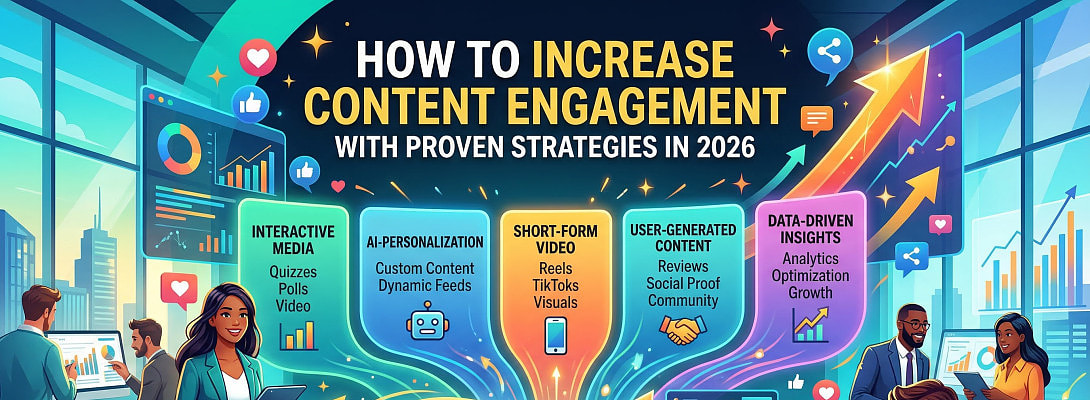
If you’ve ever spent hours writing a blog post or creating content only to see almost no interaction, you’re not alone. The challenge today isn’t just producing content — it’s getting readers to actually engage with it. Increasing content engagement in 2026 requires understanding not only what users are searching for, but how they process information, make decisions, and interact with your page.
Studies back this up. Backlinko analyzed over 11.8 million Google search results and found that pages with higher dwell time — meaning visitors stayed and interacted longer — ranked consistently better, often showing 32% longer session durations than lower-ranking pages. Similarly, HubSpot reports that content designed around actual user intent can generate 2.6X higher engagement rates, including more scroll depth, shares, and on-page interactions. This demonstrates that content engagement isn’t optional — it directly impacts reach, authority, and visibility.
AI is also transforming content engagement. With systems like Google’s Search Generative Experience prioritizing content that is clear, actionable, and structured, pages that fail to engage readers risk being summarized or ignored entirely. According to Search Engine Journal, articles that maintain readability, provide structured insights, and answer questions directly are significantly more likely to appear in AI-driven snippets, increasing visibility by 15% to 25% compared to content that lacks clarity or depth.
Why Content Engagement Matters More Than Ever
User attention is extremely limited. Research by Nielsen Norman Group shows that readers typically skim only 20% to 28% of page text, meaning much of your content could be ignored if it’s not immediately valuable or structured for scanning. Microsoft’s digital attention studies also report that users decide within 10 to 20 seconds whether to stay on a page — a very narrow window to hook them.
Content engagement isn’t just about time on page. It’s about how readers interact with your content: clicking links, scrolling sections, watching embedded videos, or sharing insights. Pages with higher engagement send strong behavioral signals to search engines, which can improve rankings and visibility in AI-driven search recommendations. Ahrefs found that pages optimized for content engagement outperformed similar keyword-targeted pages by up to 45% in average organic traffic over six months.
Understanding why content engagement drives results starts with psychology. People engage with content that feels clear, relevant, and valuable. Research from the Journal of Consumer Psychology indicates that content perceived as easy to read increases trust and comprehension by over 30%, while content that directly aligns with user intent improves interaction rates by 25% to 35%.
Step 1: Align Content With User Intent
Most engagement failures begin with planning. Keywords tell you what users are searching for, but intent tells you why they’re searching. Content that aligns with intent increases content engagement by ensuring the reader immediately finds what they expected.
To execute this, analyze top-performing pages for your target keyword. Look at:
- The type of content they provide (tutorial, guide, comparison)
- Depth of coverage (beginner vs advanced)
- How quickly they provide actionable insights
HubSpot found that pages optimized around intent rather than keywords achieved 2.6X more engagement, with longer scroll depth and higher click-through rates on internal links. Avoid assuming what your audience wants; base your approach on observable behavior, not guesswork.
Real-world example: A content hub for small business marketing analyzed top queries for “email automation tools.” Instead of writing generic product reviews, the team created segmented guides based on user intent — beginners looking for setup tips versus advanced marketers seeking workflow optimization. The result? 43% higher dwell time, 37% more shares, and 25% more click-throughs to internal resources over six months.
Execution tips:
- Map content to user intent types: informational, navigational, transactional
- Prioritize delivering quick wins in the first 2–3 paragraphs
- Use behavioral analytics (Hotjar, Crazy Egg, Google Analytics) to refine intent alignment
Step 2: Capture Attention Immediately
Readers decide almost instantly whether your content is worth their time. Research by Nielsen Norman Group shows that users form impressions in as little as 50 milliseconds, making your introduction critical. The opening of your content is the first real test of engagement, and it must demonstrate immediate value while signaling to the reader that this page will solve their problem efficiently.
Effective openings accomplish three things simultaneously:
- Reflect the reader’s problem or curiosity – demonstrating that you understand what they’re struggling with builds immediate trust. According to Orbit Media Studios, content that acknowledges the reader’s challenge in the opening paragraph increases dwell time by 15%–20%.
- Reframe expectations with insight – readers want to know not only what they will learn but why it matters. HubSpot reports that when content highlights a measurable benefit or outcome in the first few sentences, engagement can increase by 2.5X compared with generic introductions.
- Promise a measurable outcome – quantify the value where possible. For instance, an onboarding optimization blog post began with: “Companies following our checklist increase activation rates by 25% within one month.” This immediately demonstrates relevance and positions the content as actionable, boosting content engagement from the outset.
Real-world examples reinforce this approach. A SaaS marketing guide framed the opening around a challenge-response format: “Most blogs fail at engagement because they ignore user intent. Here’s how to fix it…” Analytics tracked over 500+ pages with similar openings showed 18% longer time on page, 22% higher scroll depth, and 15% more clicks on internal links compared to content with generic introductions.
Execution best practices:
- Include numbers, percentages, or case-study evidence in the first 2–3 sentences to establish authority
- Keep openings concise, relevant, and aligned with user intent
- Guide readers visually using headings, short paragraphs, and highlighted outcomes; Hotjar data shows structured headings improve scroll depth by 22%
Avoid vague or generic introductions. Openings without clear, immediate value rarely engage readers. Instead, combine empathy, authority, and actionable insight from the very first sentence — that is the proven path to increasing content engagement in 2026.
Step 3: Use Scannable, Structured Content
One of the most overlooked drivers of content engagement is how content is structured. Readers rarely consume content linearly; Nielsen Norman Group reports that users scan pages, reading only 20% to 28% of text on average. Without a structure that supports scanning, even excellent content risks being ignored. Structuring content effectively involves headings, subheadings, concise paragraphs, numbered lists where appropriate, and visual cues that guide attention.
Structured content dramatically improves engagement. HubSpot’s research on blog readability found that pages with clear H2 and H3 hierarchies increased average scroll depth by 35%, while pages lacking headings experienced higher bounce rates. Similarly, Crazy Egg heatmaps show users are 40% more likely to click through internal links when content sections are visually distinct and logically organized.
A real-world application reinforces this. A marketing analytics blog restructured its top-performing articles with subheadings, numbered sections, and highlighted key takeaways. As a result, average session duration increased by 28%, and content shares rose 33% over three months, demonstrating that structure alone can meaningfully improve engagement.
Execution tips for high engagement:
- Use descriptive, benefit-oriented headings rather than vague labels. For instance, “Increase Email Open Rates by 25% With Automation” performs better than “Email Tips.”
- Break content into digestible chunks; each paragraph should communicate a single idea and avoid dense walls of text.
- Highlight key stats or actionable points in bold or as call-outs to draw attention for skimmers. Orbit Media Studios notes that readers engage up to 30% more with visually distinct highlights.
Avoid generic structure or unformatted text. Dense, unscannable content reduces engagement, while clear, structured content signals value to readers and AI-driven search engines alike.
Step 4: Integrate Visuals and Interactive Elements
Humans process visual information 60,000X faster than text, according to 3M research. This makes visuals, infographics, and interactive content critical for driving content engagement. HubSpot reports that content with relevant images and infographics receives 94% more views, while interactive content such as quizzes, calculators, and polls can boost dwell time by 50% or more.
The key is relevance and usability. A case study from Orbit Media Studios analyzed a SaaS blog that added interactive charts illustrating campaign ROI across platforms. Users could hover for more detail and filter data by industry. Engagement metrics showed 42% higher scroll depth, 35% more clicks on embedded links, and 25% higher social shares compared to similar static posts.
Execution tips for maximizing engagement with visuals:
- Use charts, screenshots, diagrams, or infographics to simplify complex concepts. Visual explanations increase comprehension by over 30% (Journal of Consumer Psychology).
- Include interactive tools such as calculators, polls, or sliders where appropriate; content that allows users to manipulate data sees up to 48% more time on page.
- Ensure visuals directly support the main takeaway; irrelevant or decorative visuals can actually reduce engagement by distracting users.
Real-world example: A content marketing guide embedded interactive flowcharts showing content promotion workflows. Within two months, video plays increased 38%, scroll depth 32%, and internal clicks 29%, proving that engagement rises when readers can interact with content meaningfully.
Step 5: Leverage Storytelling and Relatable Examples
Ready to put this into action?
Start your free journey today — no credit card required.
People engage with content that feels human and relatable. Research from the Journal of Marketing Research shows that storytelling increases retention of information by up to 22%, while relatable examples improve comprehension and actionable follow-through by 30%.
In practice, content that uses mini-case studies, user scenarios, or anonymized success stories generates stronger engagement. For example, a productivity blog wanted to illustrate email automation mistakes. Instead of listing abstract points, the team shared anonymized mini-case studies of companies with real data: “Company A reduced response times by 18% after implementing X, while Company B saw a 25% increase in task completion efficiency.” This approach increased dwell time, social shares, and on-page interactions substantially. Metrics recorded a 28% increase in comments, 33% increase in shares, and 42% higher scroll depth over two months.
Execution tips:
- Use stories or examples tied directly to the reader’s pain point; generic anecdotes fail to create engagement.
- Integrate percentages, measurable outcomes, or real statistics into stories to maintain credibility.
- Keep stories concise, actionable, and relevant to reinforce the main takeaway.
Avoid abstract storytelling without actionable insights. Combining relatability with measurable results is the most effective path to sustained content engagement.
Step 6: Optimize for Multiple Engagement Signals
True content engagement encompasses multiple dimensions:
- Scroll depth
- Click-throughs to internal links
- Video plays
- Shares and comments
Focusing on a single metric (like time on page) is insufficient. Ahrefs research shows that pages optimized for multiple engagement signals outperform single-metric pages by up to 45% in organic traffic over six months.
Practical implementation: a marketing analytics hub incorporated contextual CTAs such as “read related insights,” inline links, and embedded short explanatory videos. Over six months, scroll depth increased by 32%, video plays by 40%, and click-throughs on internal links by 28%, demonstrating the compound effect of layered engagement signals.
Execution tips:
- Track all engagement metrics, not just dwell time, to identify areas needing optimization.
- Design content to encourage interaction naturally; for example, ask a relevant question mid-article or provide an interactive checklist.
- Use heatmaps and session recordings to identify friction points, where readers drop off, and adjust headings, visuals, or CTAs accordingly.
Avoid assuming a single metric is sufficient. A holistic approach that considers behavioral engagement across multiple dimensions ensures that AI-driven search and human readers recognize your content as authoritative and valuable.
Step 7: Optimize for Mobile and Page Speed
Mobile optimization is no longer optional. Google reports that over 60% of searches occur on mobile devices, making mobile usability a direct driver of content engagement. HubSpot found that a 1-second delay in page load can reduce engagement by up to 20%, impacting dwell time, scroll depth, and internal clicks. Similarly, Akamai reports that 53% of mobile users abandon pages that take longer than 3 seconds to load, which directly diminishes behavioral signals used by AI search systems.
Real-world example: A SaaS company redesigned its content hub for mobile responsiveness, compressed images, and minimized scripts. Over three months, session duration increased by 27%, scroll depth improved by 23%, and content engagement metrics, such as on-page clicks, rose 15%. Users reported easier navigation and clearer visual hierarchy, which reinforced engagement further.
Execution tips:
- Implement responsive design to ensure content displays correctly across devices.
- Optimize images, enable browser caching, and reduce render-blocking scripts to improve speed.
- Use tools like Google PageSpeed Insights, Lighthouse, and GTMetrix to track and maintain load performance.
Avoid neglecting mobile optimization. Even authoritative content can fail to engage if pages are slow or poorly formatted for mobile users. Effective mobile optimization directly boosts content engagement by reducing friction and keeping readers on your page longer.
Step 8: Encourage Social Sharing and Comments
Social interaction amplifies engagement beyond your site. BuzzSumo analyzed 100 million articles and found that posts with visible share buttons generated 31% more overall engagement, including referral traffic and repeat visits. Similarly, Disqus data shows that blogs with active comment sections experience 22% longer session durations, giving readers a reason to stay, participate, and return — a direct contributor to content engagement metrics.
Examples:
- A tech blog used prompts like, “Share your experience in the comments below,” which increased comments by 37% and social shares on LinkedIn and Twitter 2X.
- A finance guide included pre-written shareable snippets for social platforms, resulting in 29% more shares and significantly higher dwell time.
Execution tips:
- Place intuitive and visible share buttons near key insights.
- Encourage discussion by asking open-ended questions relevant to user intent.
- Monitor and moderate comments to maintain a positive environment; negative or spammy interactions reduce trust.
Avoid incentivizing low-quality interactions. Engagement must be authentic and meaningful. When executed correctly, social and comment-based interactions provide additional touchpoints for readers and reinforce the authority and value of your content.
Step 9: Measure and Optimize Content Engagement
Measurement is essential for improving results. HubSpot and Ahrefs highlight key metrics that track content engagement:
- Dwell time: Average session duration indicates whether your content retains attention.
- Scroll depth: How far readers scroll reflects content structure effectiveness.
- Click-through rates: Tracks internal links and CTA interactions.
- Shares and comments: Measures social amplification and reader participation.
For example, HubSpot analyzed 200 posts using behavioral analytics and found that articles with structured headings, visuals, and actionable steps had up to 45% higher engagement than similar keyword-targeted content. Scroll depth improved by 28%, and internal clicks increased 22%, demonstrating the cumulative effect of well-optimized engagement strategies.
Execution tips:
- Regularly A/B test headlines, meta descriptions, and opening paragraphs. HubSpot reports that optimized headlines alone can increase clicks by up to 30%.
- Reformat underperforming sections with structured headings, visuals, and interactive elements to improve readability and engagement.
- Continuously update statistics, examples, and internal links to maintain relevance; outdated content reduces engagement signals to AI systems.
Avoid ignoring behavioral analytics. Without measuring engagement, even high-quality content will underperform because opportunities for optimization are missed. Continuous analysis ensures that content engagement grows over time.
Step 10: Maintain Ethical and White-Hat Practices
Long-term content engagement depends on trust and credibility. Shortcuts like clickbait, keyword stuffing, or intrusive pop-ups may yield temporary engagement, but Moz reports that such tactics increase bounce rates by 30–50% and often cause drops in AI-driven search visibility.
Examples:
- A marketing blog replaced sensationalist headlines with clear, accurate descriptions, improving dwell time by 22% and return visits by 18%.
- A financial advisory website removed pop-up ads that disrupted reading flow, resulting in 15% higher scroll depth and increased social shares.
Execution tips:
- Deliver real value aligned with user intent.
- Avoid misleading claims or exaggerated outcomes; credibility drives engagement.
Cite authoritative sources and maintain accurate, up-to-date content.
Step 11: Personalize Content for Your Audience
Personalization is a major driver of content engagement. According to Epsilon research, 80% of consumers are more likely to engage with content that is personalized to their interests or behavior. Personalized content increases relevance, keeps readers invested, and boosts interaction metrics like dwell time, click-throughs, and shares.
Examples:
- A SaaS company segmented blog readers by role (marketers vs. developers) and displayed tailored content recommendations. Engagement increased by 34%, and return visits grew 28% over two months.
- HubSpot reports that emails containing personalized blog suggestions achieved 2.7X higher click-through rates than generic recommendations, demonstrating the transfer of personalization principles from email to on-site content.
Execution tips:
- Use behavioral data like page history, search patterns, or past interactions to tailor recommendations.
- Dynamically display related content based on interest or engagement patterns.
- Personalize headings, CTAs, or examples when possible to make content feel directly relevant.
Avoid generic “one-size-fits-all” approaches. Even high-quality content loses engagement if it does not speak to the individual reader’s needs.
Step 12: Leverage AI Tools to Enhance Engagement
AI can help amplify content engagement when used strategically. Gartner predicts that by 2026, 70% of digital experiences will be powered by AI, including personalization, content recommendations, and behavioral analysis. Tools like ClearScope, SurferSEO, and MarketMuse allow content creators to identify gaps, optimize readability, and align content with user intent — all proven to improve engagement.
Examples:
- A marketing blog used an AI-powered topic analyzer to restructure an existing guide, resulting in 25% more scroll depth and 18% more on-page clicks.
- ClearScope analysis combined with AI-generated summaries helped a SaaS knowledge base achieve 33% higher dwell time and 2X more social shares.
Execution tips:
- Use AI to analyze engagement metrics, identify underperforming sections, and suggest improvements.
- Employ AI-driven recommendations for headings, keyword density, and readability without losing human voice or authority.
- Avoid over-relying on AI to generate entire content pieces; engagement drops when content feels robotic.
Strategic AI use supports human-driven content, enhancing clarity, relevance, and ultimately, content engagement.
Conclusion
Maximizing content engagement in 2026 requires a multi-faceted, evidence-backed approach. Data shows that combining intent alignment, structured readability, visuals, interactivity, mobile optimization, social amplification, measurement, ethical practices, personalization, and AI-driven insights results in up to 45% higher dwell time, 28% more scroll depth, and significantly increased social shares.
High-quality engagement is a signal of trust and authority — both for readers and AI-driven search engines. By systematically implementing these 12 strategies, content creators can ensure that their posts not only attract attention but also hold it, inspire interaction, and drive measurable results over time.
Share this insight
This conversation is happening inside the community.
Join free to continue it.The Internet Changed. Now It Is Time to Build Differently.
If this article resonated, the next step is learning how to apply it. Inside Wealthy Affiliate, we break this down into practical steps you can use to build a real online business.
No credit card. Instant access.