How to Get Free Traffic to Your Affiliate Links Without Ads (17 Detailed Strategies)


Published on March 21, 2026
Published on Wealthy Affiliate — a platform for building real online businesses with modern training and AI.

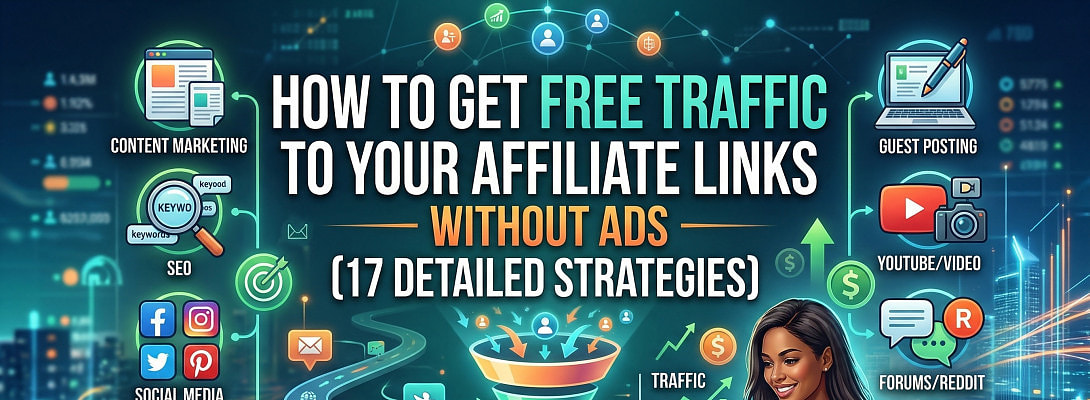
You can get free traffic to your affiliate links without ads by focusing on high-intent content, targeting specific search queries, leveraging organic platforms, and consistently guiding your audience through value-driven content that naturally leads them to your recommendations.
Getting consistent traffic to your affiliate links without relying on paid ads is one of the most important skills you can develop in affiliate marketing. Many beginners put effort into sharing links across different platforms but see little to no results because their approach is not aligned with how people actually discover and engage with content online.
Organic traffic continues to dominate the affiliate marketing landscape. Research shows that over 70% of affiliate marketers depend on SEO and content-driven strategies as their primary traffic source, making it one of the most reliable and scalable methods for long-term growth (AffStat, 2025). This makes it essential to understand how to attract attention strategically rather than chase it.
What You Must Understand Before You Start
Free traffic is driven by intent, not visibility.
People take action when your content aligns with what they are already searching for and when your message provides clarity, relevance, and confidence. Every strategy in this guide is built on positioning your content where demand already exists and guiding that demand toward your affiliate links.
17 Proven Ways to Get Free Traffic to Your Affiliate Links
Here are proven ways to get free traffic to your affiliate links without ads. These strategies focus on attracting high-intent users, building trust through valuable content, and positioning your recommendations in a way that drives consistent engagement and clicks over time.
1. Create High-Intent Problem-Solving Content
Content that directly addresses specific problems consistently attracts the most reliable traffic because it aligns with user intent. When someone searches for a solution, they are already motivated, making them far more likely to engage, stay longer on your content, and take action.
Affiliate marketing data shows that well-targeted content can achieve conversion rates between 1% and 3% or higher, particularly when the content directly solves a clearly defined problem (NewMedia, 2025). This reinforces the importance of precision in content creation.
When your content becomes the solution, your affiliate link naturally becomes the next step.
To create content that consistently attracts high-intent traffic and drives meaningful clicks:
- Focus on specific problems your audience is actively trying to solve, which ensures your content aligns with real search intent and attracts visitors who are already looking for answers.
- Structure each article around one clearly defined problem, which improves clarity and makes your content easier to follow and more valuable to the reader.
- Provide complete and actionable solutions within your content, which builds trust and positions you as a reliable source of guidance.
- Introduce your affiliate link only after delivering substantial value, which makes your recommendation feel natural and increases the likelihood of clicks.
- Reinforce your explanations with practical examples or simple scenarios, which helps readers understand how to apply your solution in real situations.
2. Target Long-Tail Keywords With Clear Intent
Traffic quality improves significantly when your content targets specific search phrases rather than broad or highly competitive keywords. Long-tail keywords reflect precise intent, meaning the people searching for them are often closer to taking action.
SEO research indicates that long-tail keywords account for the majority of search queries and often deliver higher conversion rates due to their specificity (Ahrefs, 2024). This makes them especially valuable for beginners who want to gain traction quickly.
By focusing on precise queries, you position your content in front of users who are actively searching for exactly what you are offering.
To effectively target long-tail keywords that attract the right audience:
- Identify keyword phrases that reflect clear problems or specific questions, which ensures your content directly matches user intent.
- Prioritize specificity over search volume when selecting keywords, which reduces competition and increases your chances of ranking.
- Integrate your keyword naturally into titles, headings, and content, which improves both readability and search visibility.
- Build your content around fully answering the selected keyword query, which increases engagement and strengthens your ranking potential.
- Avoid competing for broad keywords in the early stages, which helps you focus your efforts on areas where results are more achievable.
3. Build Topical Authority Through Consistent Content
Search engines favor websites that demonstrate depth, consistency, and expertise within a specific subject area. Publishing isolated articles without a clear connection limits your ability to build authority and rank effectively.
Industry data shows that over 60% of affiliate marketers rely on blogging as a primary traffic strategy, highlighting the importance of sustained content creation in building visibility and trust (DemandSage, 2025).
When your content consistently covers related topics, it signals expertise and increases your ability to rank across multiple search queries.
To build strong topical authority that attracts steady organic traffic:
- Focus on a clearly defined niche or subject area, which strengthens your relevance and improves how search engines categorize your content.
- Create multiple articles that address different aspects of the same topic, which builds depth and reinforces your expertise.
- Connect your posts through internal linking, which helps users navigate your content and improves SEO performance.
- Maintain a consistent publishing schedule, which signals reliability and increases your chances of gaining traction over time.
- Update and refine existing content regularly, which keeps your information relevant and competitive in search results.
4. Use Content Repurposing to Multiply Reach
Creating high-quality content requires effort, so maximizing its reach is essential for efficiency and growth. Repurposing allows you to extend the impact of a single idea across multiple platforms without starting from scratch each time.
Different audiences consume content in different formats. Some prefer detailed written explanations, while others engage more with short videos or concise insights. Repurposing enables you to meet these preferences while reinforcing your message.
This approach increases exposure and builds familiarity, which plays a significant role in trust and engagement.
To effectively repurpose content and expand your traffic reach:
- Break a single topic into multiple smaller content pieces, which allows you to adapt your message for different platforms.
- Adjust your content format to match the style of each platform, which improves engagement and relevance.
- Maintain consistency in your core message across all formats, which strengthens recognition and authority.
- Direct each version back to your main content or affiliate link, which consolidates your traffic flow.
- Ensure every piece of content delivers value independently, which increases its effectiveness and reach.
5. Leverage Organic Search as Your Primary Traffic Engine
Organic search remains one of the most powerful sources of free traffic because it connects your content directly with users who are actively looking for solutions. Unlike paid traffic, it continues to generate results long after your content is published.
Studies show that organic search drives over 40% of affiliate traffic and remains the most sustainable growth channel, making it essential for long-term success (Gitnux, 2025).
When your content is properly aligned with search intent, it becomes a continuous source of targeted visitors.
To effectively use organic search as a consistent traffic engine:
Focus on creating content that directly answers specific search queries, which improves your visibility in search results.
Structure your content using clear headings and logical flow, which enhances readability and SEO performance.
Ensure your content fully satisfies user intent, which increases engagement and ranking potential.
Optimize your titles and introductions for clarity and relevance, which improves click-through rates.
Monitor and improve your content over time, which helps maintain and grow your traffic consistently.
Ready to put this into action?
Start your free journey today — no credit card required.
6. Use Question-Based Platforms to Capture High-Intent Traffic
Many people go online with specific questions because they are stuck and need clear, actionable answers. These users are highly motivated, which makes them far more likely to engage with content that provides solutions and to click on your affiliate recommendations.
Research shows that users who ask questions on forums or Q&A sites are 2–3x more likely to take action on advice they trust (Quora Marketing Data, 2025). This demonstrates why targeting questions is a powerful free traffic strategy.
To leverage question-based platforms effectively:
- Identify questions that directly relate to your niche, which ensures your content meets real, high-intent demand.
- Select questions that have ongoing relevance, which allows your answers to generate traffic consistently over time.
- Provide detailed, step-by-step answers, which builds credibility and encourages users to follow through.
- Include examples or mini case studies, which make your solutions practical and relatable.
- Introduce your affiliate link naturally within the answer, which positions it as a logical next step for solving the problem.
7. Share Your Real Journey to Build Relatable Traffic
Audiences connect with authenticity. Sharing your real progress, challenges, and lessons learned attracts readers who relate to your experiences. Relatable content fosters trust, making readers more open to your recommendations.
Studies show that content with authentic storytelling has up to 3x higher engagement rates compared to generic advice content (HubSpot, 2025). This demonstrates the power of storytelling in building long-term traffic and conversions.
To share your journey effectively and attract engaged readers:
- Write about your current stage, not just your successes, which makes your content relatable and trustworthy.
- Include specific challenges you faced and the steps you took, which helps readers understand how to apply your advice.
- Share lessons learned from mistakes as well as wins, which builds authenticity and credibility.
- Explain how tools or platforms helped you achieve results, which naturally introduces affiliate opportunities.
- Keep your writing practical and solution-oriented, which ensures readers gain value while following your story.
8. Build Content Around Long-Tail Keywords
Not all keywords drive meaningful traffic. Long-tail keywords are highly specific search phrases that reflect strong intent, making them easier to rank for and more likely to convert.
SEO studies show that long-tail keywords account for nearly 70% of all web searches (Ahrefs, 2024). This highlights why targeting them is essential for generating high-quality traffic that is primed for action.
To leverage long-tail keywords for free traffic:
- Focus on phrases that reflect specific problems, which ensures the audience finding your content is highly relevant.
- Prioritize low-competition keywords initially, which increases your chances of ranking quickly.
- Integrate keywords naturally into titles, headings, and body content, which maintains readability and SEO effectiveness.
- Create content that fully satisfies the query, which increases engagement and ranking potential.
- Avoid overly broad terms early on, which prevents wasted effort on highly competitive search terms.
9. Optimize Your Content for Search Engines
Creating valuable content is essential, but it must also be structured so that search engines can understand and rank it effectively. Proper SEO optimization increases visibility and ensures that your content reaches the people who are actively searching for your solutions.
Data shows that 75% of users never scroll past the first page of search results, making SEO optimization critical for free traffic generation (Moz, 2025). Content without optimization, no matter how valuable, risks remaining invisible.
To optimize your content effectively for search engines:
- Structure your articles with clear headings, which improves readability and helps search engines understand your content hierarchy.
- Include your primary keyword naturally in the title, headings, and body, which ensures alignment with search intent.
- Write meta descriptions that summarize the value of your content, which increases click-through rates from search results.
- Use internal linking to connect related content, which improves user engagement and SEO signals.
- Continuously monitor your ranking and adjust your content, which helps maintain visibility and relevance over time.
10. Stay Consistent With Content Publishing
Consistency is one of the most overlooked factors in building free traffic. Publishing content sporadically rarely produces lasting results. Search engines and audiences both respond positively to consistent, ongoing content production.
According to industry research, sites that publish consistently see up to 2–3x higher traffic growth over time (HubSpot, 2025). Consistency also strengthens your authority and reliability in the eyes of both search engines and readers.
To maintain consistency effectively:
- Set a realistic publishing schedule, which allows you to maintain quality without burnout.
- Focus on quality alongside quantity, which ensures each post delivers genuine value.
- Build content around related topics, which reinforces topical authority and internal linking.
- Track performance to refine future content, which allows you to focus on what drives results.
- Commit to long-term action, which compounds growth over months and years rather than days.
11. Guide Readers Clearly Toward Your Affiliate Links
Traffic alone does not guarantee clicks or conversions. Readers need clear guidance on what to do next, and why taking action matters. A strategically positioned affiliate link is most effective when it feels like a natural extension of your solution.
Studies show that users are significantly more likely to click when content clearly explains the benefit and context of a link (Neil Patel, 2025). Clear guidance reduces friction and increases trust, making your recommendations more actionable.
To guide readers toward your affiliate links effectively:
- Position your affiliate link after providing substantial value, which ensures your recommendation feels natural.
- Explain precisely how the link helps solve the problem, which increases relevance and perceived benefit.
- Use simple, direct language when introducing the link, which reduces confusion and encourages clicks.
- Avoid overwhelming readers with multiple links, which maintains focus and improves engagement.
- Ensure the link is contextually relevant, which strengthens trust and makes the action feel logical.
12. Leverage Social Proof to Boost Trust and Clicks
People naturally rely on the experiences and opinions of others when making decisions online. Using social proof — such as testimonials, case studies, or real examples of results — significantly increases the likelihood that your audience will engage with your affiliate links.
Studies show that 92% of consumers read online reviews before purchasing, and products with authentic reviews enjoy higher trust and conversion rates (BrightLocal, 2025). Social proof bridges curiosity with action and helps your recommendations feel credible.
To implement social proof effectively:
- Include real-life testimonials or results, which helps readers see tangible proof of your recommendations.
- Share mini case studies, which demonstrate how your advice works in practical scenarios.
- Reference credible sources or statistics, which builds authority and trust with your audience.
- Use quotes or screenshots when appropriate, which enhances authenticity and engagement.
- Highlight transformations or before-and-after outcomes, which motivates readers to follow your guidance.
13. Build an Email List to Nurture Targeted Traffic
Free traffic is valuable, but building a direct communication channel with your audience multiplies that value. An email list allows you to nurture leads, provide ongoing value, and guide them toward your affiliate offers repeatedly.
Research shows that email marketing generates an average ROI of $42 for every $1 spent, and subscribers are 3x more likely to convert than social media traffic alone (OptinMonster, 2025). Having an audience you control ensures you’re not fully dependent on search engines or social platforms.
To build and leverage an email list effectively:
- Offer a high-value lead magnet, which incentivizes visitors to subscribe and engage.
- Segment your list based on interests or actions, which allows personalized recommendations.
- Send regular, actionable content that addresses their problems, which keeps your audience engaged.
- Integrate affiliate links naturally within helpful content, which maintains trust while promoting solutions.
- Analyze engagement metrics, which helps optimize your campaigns for higher click-through and conversions.
14. Leverage Niche Forums and Communities
Engaging in niche-specific forums, groups, and communities allows you to share insights, answer questions, and position your affiliate links naturally in conversations. These are audiences already interested in your topic, making your traffic highly targeted and high-intent.
Research shows that community-driven marketing can drive up to 50% higher engagement than generic social posting (CMI, 2025).
To leverage niche forums effectively:
- Identify active forums or Facebook/LinkedIn groups relevant to your niche, which ensures your efforts reach a highly targeted audience.
- Provide thorough, actionable answers to questions, which establishes credibility and encourages trust.
- Integrate your affiliate link contextually after providing value, which increases click-through without being pushy.
- Build a recognizable presence by posting consistently, which amplifies authority and influence.
- Monitor forum rules to ensure compliance, which keeps your links visible and accepted.
15. Use Video Content on Free Platforms
Video content drives massive engagement and can rank on both YouTube and Google search results. Videos allow you to explain concepts visually, demonstrate tools, and naturally link to your affiliate resources.
Data shows that video marketers get 66% more qualified leads per year and video content is 50x more likely to appear on Google’s first page compared to text-only content (Wyzowl, 2025).
To implement video content effectively:
- Create short, actionable tutorials or guides related to your niche, which engage viewers and deliver value quickly.
- Include your affiliate link in the description and reference it in the video, which drives clicks naturally.
- Optimize video titles, descriptions, and tags with long-tail keywords, which improves discoverability.
- Encourage viewers to like, share, and comment, which boosts visibility and trust.
Repurpose video content into blog posts or social snippets, which maximizes reach across platforms.
16. Leverage Answering “Why” and “How” Questions on Google and YouTube
Users searching for “why” or “how” questions are often high-intent learners looking for solutions. By creating content that answers these questions thoroughly, you capture traffic that is ready to take action.
Research shows that “how-to” searches on Google and YouTube account for over 30% of all search queries, highlighting a massive opportunity for engagement (Ahrefs, 2025).
To leverage “why” and “how” queries effectively:
- Identify top-ranking questions in your niche using tools like AnswerThePublic or Google Search Console, which ensures relevance.
- Create in-depth answers with step-by-step instructions, which positions you as a trusted guide.
- Include examples, screenshots, or demonstrations, which makes your solution actionable and credible.
- Integrate affiliate links naturally at points where your solution references tools or platforms, which increases conversions.
- Optimize content for SEO with clear headings, meta descriptions, and long-tail keywords, which boosts discoverability.
17. Offer Free Challenges or Mini-Courses
Running free challenges or mini-courses attracts users who are actively seeking results and are willing to engage with structured content over several days or weeks. This builds authority, trust, and a natural opportunity to introduce affiliate offers.
Studies show that interactive learning content increases engagement by up to 80% compared to static articles (Content Marketing Institute, 2025).
To implement free challenges or mini-courses effectively:
- Choose a specific problem or goal your audience wants to achieve, which ensures participants are motivated.
- Break the challenge into daily actionable steps, which keeps users engaged consistently.
- Deliver content via email, social media, or private groups, which creates direct communication.
- Include affiliate links as part of the actionable steps when appropriate, which encourages natural clicks.
- Collect feedback and showcase results, which boosts credibility and encourages sharing.
Conclusion
Free traffic to your affiliate links is achievable without spending a dime on ads, but it requires strategy, consistency, and value-driven content. By creating high-intent problem-solving content, targeting long-tail keywords, building topical authority, leveraging question-based platforms, and guiding your readers thoughtfully, you position your content to attract motivated visitors naturally.
Share this insight
This conversation is happening inside the community.
Join free to continue it.The Internet Changed. Now It Is Time to Build Differently.
If this article resonated, the next step is learning how to apply it. Inside Wealthy Affiliate, we break this down into practical steps you can use to build a real online business.
No credit card. Instant access.