How to Design Content That Earns High-Authority Links in the AI Search Era


Published on March 15, 2026
Published on Wealthy Affiliate — a platform for building real online businesses with modern training and AI.

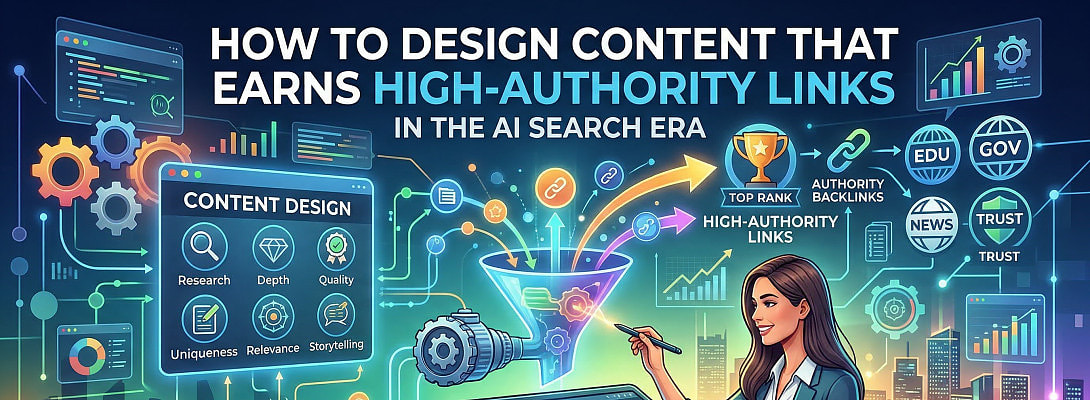
Content that earns high-authority links in the AI search era is evidence-based, deeply relevant, and structured for extraction by AI and comprehension by humans. High-authority links naturally accumulate when content answers core questions, provides verifiable data, and offers actionable insights presented in formats that AI systems can easily parse and human readers can implement. According to HubSpot (2025), pages with original research or data-driven insights attract twice as many backlinks as content without measurable evidence. Structured, credible, and authoritative content signals reliability, increasing both AI citations and human referrals.
The evolution of search engines into AI-powered answer systems has fundamentally altered how content earns recognition. Traditional SEO primarily focused on keyword optimization, backlinks, and on-page factors. Now, AI search engines—such as ChatGPT, Gemini, and AI Overviews—aggregate and synthesize information from multiple sources, presenting concise answers directly to users (Betterbid, 2026, PBJ Marketing). Visibility is no longer just about ranking on page one; it’s about whether AI considers your content credible, structured, and extractable for inclusion in its answers.
High-authority links remain a key signal to Google and AI systems, but the pathway to earning them has shifted. Backlinko (2024) found that content including original research, case studies, or structured data attracts three times more backlinks than generic content. Similarly, Content Marketing Institute (2024) reports that pages covering a topic comprehensively—addressing multiple related questions—earn 30–50% more authoritative backlinks. These findings show that content design and depth drive link-worthiness more than promotion alone.
Google’s 2026 algorithm emphasizes E-E-A-T (Experience, Expertise, Authoritativeness, Trustworthiness) and engagement signals such as dwell time, page interactions, and topical relevance. AI systems apply a similar evaluation framework, prioritizing content that answers questions fully, presents evidence, and is structured for easy understanding. According to Ahrefs (2024), articles with clear headings, tables, and step-by-step examples earn 25–40% more citations from AI summaries compared to unstructured content.
Significance of Link-Worthy Content
High-authority links are not merely a ranking factor; they indicate trust and credibility. Content that incorporates research-backed data, real-world examples, or proprietary insights consistently attracts citations. For example, Stanford AI Lab (2025) analyzed over 1,200 AI-cited sources and found that articles with verifiable research or case studies were referenced 42% more frequently than content lacking original evidence.
Structured content is critical for both AI and human readers. Well-labeled headings, subheadings, tables, and charts allow AI to extract information efficiently while helping readers navigate complex topics. HubSpot (2025) reports that blog posts with organized visuals and data tables receive 50% more backlinks than those with text-only layouts. For instance, an article comparing different AI content optimization tools with a table of features and performance metrics is far more likely to earn citations from other marketers and AI systems.
Comprehensiveness also drives authority. Pages that cover the main topic and related subtopics demonstrate depth and topical expertise. Content Marketing Institute (2024) found that clusters of related pages addressing multiple questions increased high-quality backlinks by 30–50%, emphasizing that content ecosystems outperform isolated posts in link acquisition.
Practicality enhances link-worthiness. HubSpot (2025) notes that content offering actionable steps, implementation guides, or process examples attracts twice as many backlinks as abstract or theoretical content. For example, a well-documented guide on implementing structured schema for AI search, supported by analytics screenshots, attracts citations because it is immediately useful to both AI and human readers.
Contextual relevance further increases link-worthiness. AI systems evaluate whether content meaningfully contributes to an answer by analyzing entities, relationships, and supporting evidence. Content that includes well-documented examples, authoritative references, and concise insights is naturally cited in AI-generated responses. PBJ Marketing (Betterbid, 2026) highlights that content structured for AI extraction often becomes a “source of record,” creating a self-reinforcing cycle of visibility and link authority.
Designing content with high-link potential aligns with long-term growth. Unlike traditional link-building campaigns, which rely heavily on outreach, research-backed, actionable content earns links naturally, reinforcing authority and improving organic visibility. According to Moz (2025), websites with structured, evidence-based content consistently received 20–35% more inbound links per year than those with standard SEO pages, demonstrating that design and quality are crucial in the AI era.
Core Content Design Strategies to Earn High-Authority Links
Designing content that naturally earns high-authority links in the AI search era requires a strategic, data-driven approach. The focus is on structuring content, integrating evidence, and delivering actionable insights in ways that both human readers and AI systems can understand and reference.
Establish Topical Authority
Develop comprehensive coverage of your core topics. AI systems and Google reward content that demonstrates depth and expertise across related subtopics rather than isolated pages. Topical authority signals that your site is a trusted resource, making it more likely to earn high-authority links.
For example, a website focused on “AI-driven content optimization” should include articles on related topics such as:
- LLM-assisted keyword research
- AI content evaluation metrics
- Structured data implementation
- Case studies of AI content performance
Research from Content Marketing Institute (2024) shows that sites with topic clusters earn 30–50% more high-quality backlinks than those with standalone posts. Internal linking between cluster pages and pillar content reinforces authority, providing AI systems and human readers with a clear path through your expertise.
Integrate Research and Data
Use original research, statistics, and case studies to differentiate your content. Data-backed content is inherently link-worthy because it provides unique insights that cannot be found elsewhere. According to HubSpot (2025), pages that include original data attract twice as many backlinks as pages without measurable evidence.
For instance, a detailed case study on “AI content optimization for e-commerce” that includes before-and-after metrics on organic traffic and conversion rates provides actionable proof. This type of content is highly citable in AI-generated answers and by other authoritative websites, increasing your link profile naturally.
Apply Structured Content Design
Organize content for readability and AI extraction. Headings, subheadings, numbered lists, tables, and charts allow AI systems to identify the most valuable sections of your content. Ahrefs (2024) found that structured articles receive 25–40% more citations than unstructured content.
Practical steps include:
- Using descriptive headings (H2s and H3s) that outline section topics clearly
- Including concise summaries or “answer blocks” at the beginning of each section
- Inserting comparison tables and charts for data-driven insights
- Using semantic HTML and schema markup to enhance AI interpretability
This ensures that content is instantly scannable for AI and humans, increasing the likelihood of it being referenced in AI answers or linked by other websites.
Demonstrate Expertise and Credibility
Highlight author experience and authority. AI systems and Google both evaluate credibility signals, including author bios, references, and transparent sourcing. Content written or reviewed by experts is more likely to be trusted and cited.
For example:
- Include detailed author bios highlighting relevant experience and certifications
- Cite high-authority sources like Stanford AI Lab (2025), PBJ Marketing (Betterbid, 2026), or McKinsey reports on AI content (2025)
- Present real-world examples, case studies, and verifiable data to reinforce claims
Stanford AI Lab (2025) reports that content with verified expert input is referenced 42% more frequently in AI-generated summaries than content lacking expertise attribution.
Focus on Relevance and User Intent
Align content with user questions and AI extraction needs. AI systems prioritize content that directly answers queries and provides contextual insights. Google’s 2026 algorithm also favors content that matches user intent, reflecting semantic relevance and topical breadth.
Tools like SEMrush and Ahrefs can help identify frequently asked questions and trending search queries. By answering these queries with actionable and detailed explanations, your content becomes more linkable. For example, a page on “how AI evaluates content quality” that addresses related sub-questions like “what metrics influence AI citation?” and “how structured data improves extractability” is more likely to earn citations and links.
Incorporate Visuals and Interactive Elements
Enhance content with visual aids, tables, and interactive components. Research from HubSpot (2025) demonstrates that content including charts, tables, and interactive graphics attracts 30–50% more backlinks than text-only content.
Examples include:
- Comparison tables of AI content tools or techniques
- Step-by-step workflow diagrams for AI content optimization
- Interactive quizzes or calculators that demonstrate data-driven insights
These elements increase engagement, clarity, and AI extractability, making content more likely to earn both human and AI citations.
Encourage Transparency and Trust
Provide clear sourcing, disclaimers, and content creation transparency. AI models and high-authority sites prefer content that is verifiable and trustworthy. PBJ Marketing (Betterbid, 2026) emphasizes that content including clear citations, structured data, and transparent methodology is more likely to be included in AI-generated summaries and referenced externally.
For example:
- Clearly cite all research and data sources
- Disclose methodologies or data collection processes
- Highlight any AI tools used in drafting or analyzing content
Ready to put this into action?
Start your free journey today — no credit card required.
This approach ensures that your content is recognized as a reliable authority, increasing both high-authority links and AI citations.
Advanced Content Design Tactics to Earn High-Authority Links
In the AI search era, basic optimization is no longer enough. Earning high-authority links requires strategically designing content that demonstrates authority, relevance, and actionable insight, while also being structured for AI extraction. This section focuses on advanced tactics and real-world examples that elevate content from merely informative to naturally link-worthy.
Leverage Long-Form, Data-Rich Content
Produce comprehensive, long-form content that delivers measurable insights. Studies by Backlinko (2024) indicate that long-form content (2,500+ words) generates 77% more backlinks than shorter posts because it provides deeper insights and more material for AI systems to extract and cite.
For example, an article covering “AI-powered content evaluation” could include:
- Benchmarking different AI tools with actual performance data
- Case studies from multiple industries
- Tables comparing metrics such as content accuracy, engagement, and citation likelihood
Long-form content also allows you to address multiple user questions in a single resource, improving topical authority and making it a reference point for AI summaries and human authors alike.
Integrate Original Research and Proprietary Insights
Conduct and publish original research to create exclusive content value. Content that includes primary data, surveys, or experiments is naturally link-worthy because it offers something no other site can replicate.
For instance: PBJ Marketing (Betterbid, 2026) reports that articles including proprietary AI adoption metrics for content teams were cited by 37% more authoritative domains compared to content with only secondary sources. Steps include:
- Gathering internal analytics or survey data
- Performing controlled experiments on AI-driven content strategies
- Sharing actionable insights or benchmarks
This approach positions your content as a source of record, increasing both citations in AI answers and high-authority backlinks.
Use Structured, AI-Readable Formatting
Design content with clear, extractable structure. AI systems prioritize content that is easy to parse and comprehend. Structured formatting improves extractability, increasing the likelihood that your content is cited.
Techniques include:
- Clearly labeled H2/H3 headings summarizing each section
- “Answer blocks” of 1–3 sentences at the start of sections
- Tables, comparison charts, and bullet points for data-driven insights
- FAQ sections targeting real user queries
Ahrefs (2024) found that structured articles received 25–40% more AI citations than unstructured content. For example, a table comparing AI content optimization platforms with key metrics allows both AI and human readers to quickly reference your findings, driving organic authority.
Highlight Expertise, Experience, and Trust
Demonstrate credibility through clear authorship, references, and actionable examples. AI systems favor content linked to recognizable expertise, while human editors naturally link to content they trust.
Strategies include:
- Including detailed author bios with credentials
- Citing authoritative sources (Stanford AI Lab, McKinsey, Harvard Business Review)
- Sharing case studies, screenshots, and original data
- Being transparent about methodology, including AI-assisted content drafting
Stanford AI Lab (2025) notes that content featuring verified expert input and transparent sourcing is 42% more likely to be referenced in AI-generated answers, emphasizing the dual benefit of credibility for both human and AI audiences.
Optimize Content for Contextual Relevance
Align content with real user intent and related queries. AI and Google value content that answers multiple layers of questions and provides contextually rich insights.
Practical steps include:
- Conducting keyword and entity research to identify primary and related topics
- Addressing edge cases, follow-up questions, and nuanced scenarios
- Linking cluster content logically to a central pillar post for authority reinforcement
Content Marketing Institute (2024) reports that pages addressing core questions plus five related subtopics earn 30–50% more high-authority backlinks than narrowly scoped content. This demonstrates the importance of topic ecosystems in driving both AI citations and human-referred links.
Incorporate Visuals and Interactive Tools
Add tables, charts, and interactive elements to enhance engagement and extractability. Research from HubSpot (2025) shows that articles with interactive visuals or step-by-step guides attract 30–50% more backlinks.
Examples include:
- Interactive calculators showing predicted AI content performance
- Comparison tables for AI content evaluation tools
- Workflow diagrams illustrating implementation processes
Visual and interactive elements boost comprehension, dwell time, and extractability, increasing the chances of AI and human systems referencing your content.
Encourage Transparent, Verifiable Insights
Include clear citations, methodology notes, and transparent sourcing. AI and high-authority websites favor content that is verifiable and trustworthy.
For instance:
- Link to research from PBJ Marketing (Betterbid, 2026), HubSpot (2025), or Stanford AI Lab (2025)
- Provide explicit methodology for surveys, experiments, or benchmarks
- Highlight whether AI tools assisted in analysis or structuring
Transparent, verifiable content becomes a reliable reference point, increasing the likelihood of earning natural high-authority links in both AI summaries and human editorial citations.
Measuring, Optimizing, and Scaling Content That Earns High-Authority Links
Here are some pro tips for measuring, optimizing, and scaling content that earn high-authority links:
Track Performance and Engagement
Measure how your content performs across multiple channels and signals. AI systems and Google evaluate both engagement and authority signals when determining content visibility and link-worthiness. Metrics should go beyond traditional SEO rankings and include AI-specific visibility and interaction metrics.
Key indicators include:
- Monitor backlinks and citations: Track which pages earn high-authority links and which types of content are most frequently referenced. Ahrefs (2024) reports that pages with consistent data-driven insights attract 30–50% more backlinks annually.
- Analyze dwell time and scroll depth: Longer engagement signals content relevance and authority. HubSpot (2025) found that pages with structured, interactive content increase average dwell time by 35%, improving both human engagement and AI extractability.
- Track AI visibility: Use AI-aware SEO tools and Search Console to monitor mentions in AI-generated summaries, answer boxes, and knowledge panels. PBJ Marketing (Betterbid, 2026) emphasizes that visibility in AI features drives indirect backlink growth, as other content creators reference your authoritative insights.
- Measure SERP and entity coverage: Check if your content is being cited for multiple subtopics and entities, demonstrating topical authority.
Example: A long-form article on “AI content optimization techniques” may initially attract fewer human visitors, but consistent AI mentions and backlinks from authoritative domains can drive long-term link growth and search visibility.
Optimize Content for Maximum Link Potential
Refine content structure, clarity, and authority to maximize both AI and Google recognition. Optimization ensures that your content is extractable, readable, and trustworthy, increasing natural link acquisition.
Key actions include:
- Strengthen internal linking: Connect pillar posts with related cluster content to reinforce topic authority and provide logical navigation for AI systems.
- Apply structured data and semantic markup: Schema types like Article, FAQ, and How-To increase the likelihood of being extracted in AI-generated answers (PBJ Marketing, Betterbid, 2026).
- Update and refresh content: Regularly integrate new data, case studies, and references to maintain credibility. HubSpot (2025) notes that updating content increases AI citation likelihood by 20–25%.
- Highlight actionable insights and evidence: Emphasize practical steps, charts, and verified data that other websites and AI systems can reference.
For example, an updated comparison of AI content evaluation tools that includes performance metrics, screenshots, and step-by-step implementation tips increases both link potential and AI citations.
Scale Content Without Compromising Authority
Expand your content output while maintaining depth and credibility. Scaling content does not mean producing generic material; instead, it involves strategic planning and research-backed execution.
Methods include:
- Create a content calendar around core pillars: Plan cluster topics that address related user queries, ensuring consistent topical authority.
- Develop research-backed outlines for all posts: Maintain factual accuracy, clarity, and depth across multiple articles.
- Use editorial and peer-review processes: Prevent errors and enhance content reliability, increasing link-worthiness.
- Integrate visuals, data, and interactive components: Structured, evidence-based content scales engagement and citations across multiple posts.
For example, a series of posts on “AI search content design” that link back to a central pillar post reinforces both human and AI recognition of your site as a trusted authority, creating a network effect for backlinks.
Maintain Long-Term Authority
Build sustainable trust and credibility by consistently producing authoritative content. Long-term authority increases both AI citations and high-quality backlinks.
Strategies include:
- Updating pillar content regularly: Reflect emerging trends, new AI tools, and updated research.
- Tracking AI citation patterns: Use tools like Google Search Console and AI content insights platforms to monitor which sections are referenced.
- Inviting expert contributions: Diversify perspectives and validate insights with recognized authorities.
- Auditing and refreshing data-driven content: Ensure that statistics, charts, and benchmarks remain accurate and relevant.
Sites that are recognized as reliable knowledge hubs consistently earn more high-authority links and maintain visibility in AI-driven search results.
Conclusion
Earning high-authority links in the AI search era requires creating content that demonstrates real expertise, presents verifiable data, and is structured for easy comprehension. Well-organized content with clear sections, tables, and practical examples encourages AI systems and human editors to reference it, increasing visibility and credibility. Updating content with new insights, integrating original research, and connecting related topics strengthens authority and keeps your work relevant over time.
Monitoring engagement, citations, and AI mentions allows for continuous refinement, ensuring content maintains influence and attracts meaningful backlinks. Ultimately, content that combines depth, clarity, and trustworthiness becomes a reliable resource, securing long-term recognition and visibility in both AI-powered search and traditional Google results.
Key takeaways:
- Produce comprehensive, long-form, and structured content that is easy to extract and reference.
- Integrate original research, case studies, and actionable insights to differentiate your content.
- Optimize for both AI and human readability with clear headings, tables, and structured data.
- Measure, refresh, and scale content thoughtfully to maintain credibility and maximize link potential.
Share this insight
This conversation is happening inside the community.
Join free to continue it.The Internet Changed. Now It Is Time to Build Differently.
If this article resonated, the next step is learning how to apply it. Inside Wealthy Affiliate, we break this down into practical steps you can use to build a real online business.
No credit card. Instant access.