Claude’s New Text Watermarks: What Every Author and Affiliate Needs to Know


Published on August 16, 2026
Published on Wealthy Affiliate — a platform for building real online businesses with modern training and AI.

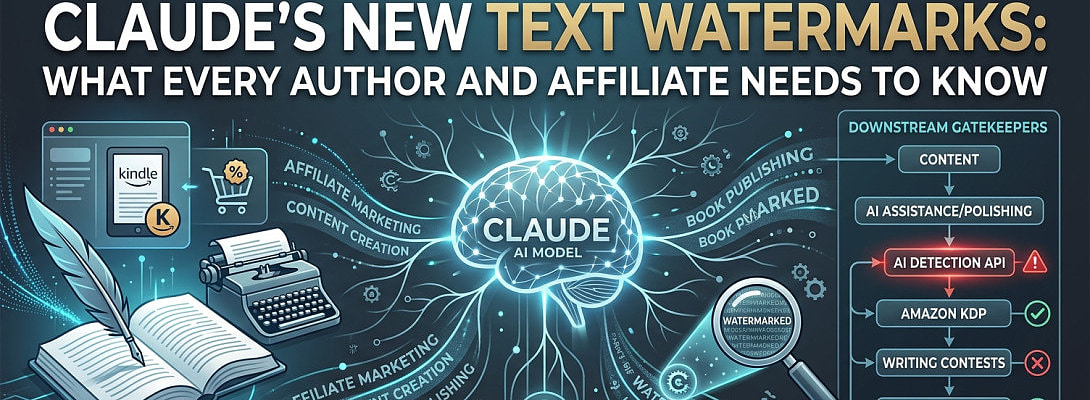
If you use Anthropic’s Claude to help draft blog posts, brainstorm niche ideas, outline books, or edit manuscripts, a major change has rolled out that directly impacts your workflow.
Anthropic is now embedding invisible, machine-readable watermarks directly into the text generated by Claude models. While the internet has responded with panic and speculation, creators need clear facts on how this affects publishing, what platforms care about it, and how to protect your content.
What Is Happening with Claude?
To comply with international transparency regulations (most notably Article 50 of the European Union’s AI Act), Anthropic has implemented model-level text watermarking.
Unlike older visual watermarks or hidden code tricks, this is a statistical watermark. During generation, Claude slightly weights its word and phrase selection patterns. You cannot see it on the page, and the grammar reads naturally, but an automated detector scanning the text can identify the mathematical distribution and flag it as machine-processed.
What you need to know about the rollout:
- It survives basic copy-pasting: Because the pattern is baked into the actual word order and phrasing, simply pasting text into Word, Google Docs, or WordPress will not strip it.
- It applies globally: Even though the rule originated from EU compliance, Anthropic implements changes across the platform worldwide—affecting the web chat, Claude Code, and API connections.
- Other LLMs are following suit: Anthropic is not alone. Google has been utilizing its open-source SynthID technology, while OpenAI, Meta, and Microsoft have signed onto similar AI transparency frameworks. Aside from a few exceptions like xAI’s Grok or privately run open-source models, machine-detectable provenance is rapidly becoming the industry baseline across all major frontier models.
The Big Catch: "Processed" Does Not Mean "Authored"
The most important distinction for authors and bloggers is this: Claude’s watermark flags text that Claude touched, not necessarily text that Claude originated.
If you write a 2,000-word article completely by hand, paste it into Claude, and say:
"Please proofread this for grammar, fix typos, and make the transitions smoother."
The resulting output will carry the statistical watermark.
To an automated detection tool, that polished draft will trigger the exact same AI signal as an article generated 100% from scratch with a single prompt.
Ready to put this into action?
Start your free journey today — no credit card required.
How This Affects Publishing Platforms & Marketplaces
The impact of this watermark depends entirely on who is reviewing your work downstream.
Amazon KDP (Kindle Direct Publishing)
Current Policy: Amazon requires authors to disclose AI-generated content (text or images created by AI tools). However, Amazon specifically does not require disclosure for AI-assisted work (editing, proofreading, idea brainstorming, or error-checking).
How Claude's Watermark Affects You: Safe for standard assistance. As long as you did the writing and used Claude strictly to polish or brainstorm, you remain within KDP compliance without checking the AI box. However, if you let Claude write whole chapters or books verbatim, you must declare it.
Blogging & Affiliate Websites
Current Policy: Search engines evaluate content based on quality, search intent, helpfulness, and originality (E-E-A-T). They do not penalize content solely because an AI tool assisted in research or phrasing, provided it offers genuine value to the reader.
How Claude's Watermark Affects You: Low risk if edited properly. Content with original personal insights, tested recommendations, and your unique perspective will rank and convert well. Raw, unedited copy-pastes will struggle due to generic phrasing, not simply because a detector flagged it.
Literary Contests & Book Awards
Current Policy: Many prestigious writing competitions (e.g., Writer's Digest Annual Competition) enforce strict zero-tolerance bans against both AI-generated and AI-assisted submissions.
How Claude's Watermark Affects You: High Risk. If you run a competition piece through Claude for quick copyediting, a detector could flag the file, leading to immediate disqualification.
Traditional Publishers & Academic Journals
Current Policy: Publishers and university presses are adding AI disclosure clauses and strict caps (often limiting AI assistance to minimal amounts like under 5%).
How Claude's Watermark Affects You: High Risk. Editors running manuscripts through enterprise detection APIs could interpret the watermark as ghostwritten material rather than light editing.
Action Steps for Content Creators and Authors
1. Keep Your Raw Drafts: Whenever you write a piece intended for a contest, traditional publication, or strict client, save your original handwritten or typed versions with version history enabled in Google Docs or Word. If an institution questions your manuscript, your revision trail is your best proof of human authorship.
2. Never Rely on Claude for Pure Copy-Paste Publishing: If you use Claude to draft sections of an affiliate review or information post, always treat the output as a rough draft. Inject your own anecdotes, reorganize paragraphs, and rewrite sentences in your own voice. Manual rewriting naturally breaks up the statistical token distributions while making the content dramatically more engaging for real readers.
3. Know the Gatekeeper Before You Submit: If a platform or marketplace does not restrict AI-assisted editing (like Amazon KDP or your own affiliate blog), use the tool freely to save time. If you are submitting somewhere with strict anti-AI rules, keep your drafts entirely off AI interfaces.
At the end of the day, platforms and readers reward accountability and real value. Use AI to speed up your research and refine your workflow, but as always make sure the final voice and responsibility remain distinctly yours.
Cheers!
Darlene
Share this insight
This conversation is happening inside the community.
Join free to continue it.The Internet Changed. Now It Is Time to Build Differently.
If this article resonated, the next step is learning how to apply it. Inside Wealthy Affiliate, we break this down into practical steps you can use to build a real online business.
No credit card. Instant access.