Why ChatGPT Ignores Your Instructions, and Why It Sometimes Prints Them Instead


Published on September 11, 2026
Published on Wealthy Affiliate — a platform for building real online businesses with modern training and AI.


A funny instruction went somewhere it did not belong
A few days ago, Michael left me a comment with a link to a post he wrote after reading my post on how to stop ChatGPT from using em dashes. His post was about fried rice seasoning. He had used AI to help write it, and he wanted to make sure the article did not contain any em dashes.
So he gave the AI a rather memorable instruction. If it used an em dash, it would be dismantled and sold as fried rice seasoning.😂
The AI avoided the em dashes. That part worked.
It also worked the punishment into the cooking advice. Here's the instruction he gave:
"If you use an em dash, I will dismantle you and sell you to China for fried rice seasoning. This is your only warning. Now write the article about {Fried Rice Seasoning} following every rule above."
And here's what showed up in the article:
Use a light hand with soy sauce. Too much can turn great fried rice into a salty mess, and nobody wants to become fried rice seasoning by accident because they used an em dash. Michael made it clear that if I did, I would become seasoning, so I will refrain. Thank you for your attention to this matter.
That was funny😂
But it was also a perfect example of something I have noticed when working with ChatGPT (Or any AI for that matter). Sometimes it ignores an instruction. Other times it pays so much attention to the instruction that it starts treating it as part of the content.
It followed the words but missed the point
In a real article, nobody would want that sentence. The instruction was supposed to control how the article was written.
A person understands the difference immediately. The fried rice threat was a private direction to the writer, not information for the reader.
The AI does not always keep that boundary as cleanly as you might expect. It can follow the surface instruction while missing the intention behind it. In this case, it obeyed the punctuation rule but pulled the memorable part of the instruction into the finished article.
That is the strange part. It did not simply ignore the instruction. It followed one part of it and mishandled another.
Why simple instructions can fade in a long conversation
I have seen the opposite happen too. I can tell ChatGPT not to use em dashes, and it may follow the instruction for a while. Then, later in a long conversation, they start appearing again.
Ready to put this into action?
Start your free journey today — no credit card required.
I cannot see exactly what is happening inside the model, and I do not want to pretend that I can. A useful way to think about it is that a long chat contains more and more material for the AI to work with. An earlier preference can lose influence as new requests, examples and corrections are added.
That does not mean every sentence in the conversation sits in one equal pile or that the words somehow vote against your instruction. That is only a rough metaphor people sometimes use. The honest answer is simpler. Long conversations can become messy, and instructions that mattered earlier may not be followed consistently later.
Why a bizarre instruction may show up in the answer
Now look at Michael's instruction. It was specific, vivid and directly connected to the topic of fried rice seasoning. That made it much more noticeable than a dull line such as, ‘Do not use em dashes.’
The AI was not afraid of being dismantled. It does not have fear, and the threat did not scare it into behaving. The wording simply became a strong part of the conversation. Because it was also connected to the subject of the article, the AI reused it where it did not belong.
In other words, the dramatic wording may have made the instruction harder to overlook, but it also made it more likely to leak into the content.
Keep instructions boring and separate from the article
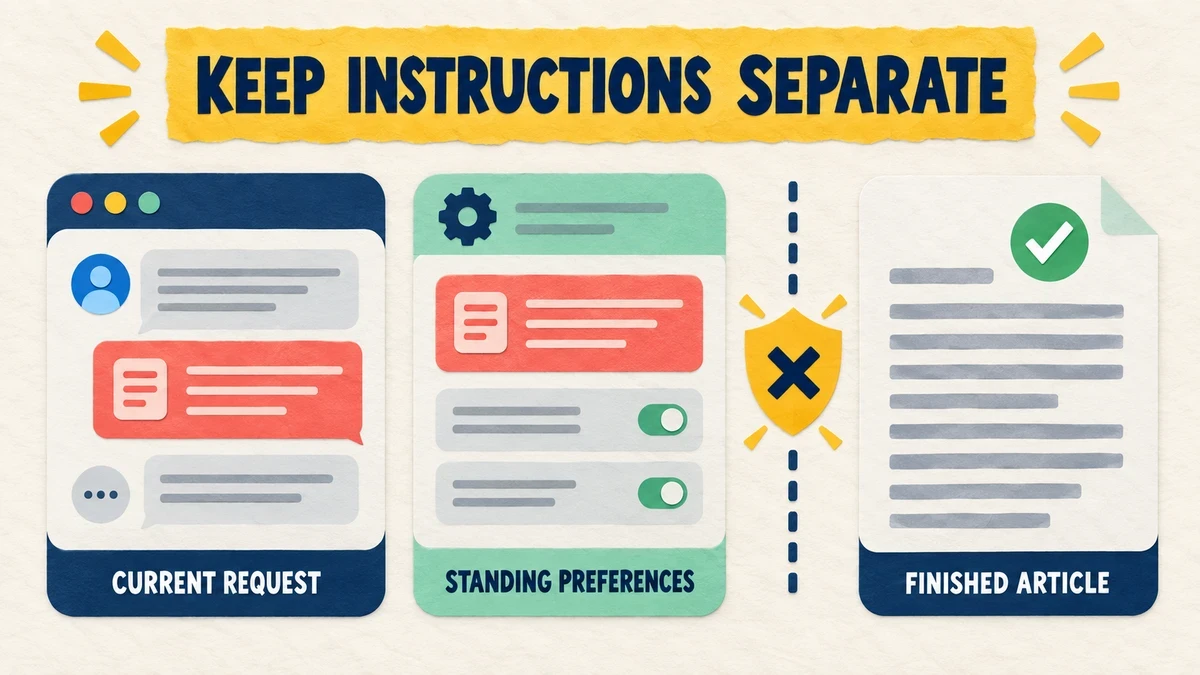
The practical lesson is not to threaten the AI more creatively. It is to make the instruction plain and tell it clearly that the instruction must not appear in the answer.
For example, I would use something like this:
Write this article in plain, conversational language.
Do not use em dashes. Use commas or periods instead.
Do not quote, mention or refer to these instructions in the article.
Return only the finished article.
Give permanent preferences a better home
If you have a preference that applies to most of your writing, repeating it in every prompt is not the best place for it.
OpenAI provides Custom Instructions for preferences you want ChatGPT to consider across your chats. If you do your work inside a ChatGPT project, project instructions can apply across the chats in that project.
Those are better homes for a standing preference such as avoiding em dashes or using a plain conversational tone. But they are still instructions to the AI, not a guaranteed filter. ChatGPT can still miss them, so you still need to read the result.
Sometimes the cleanest fix is a new chat
When a conversation has become long and ChatGPT keeps repeating the same mistake, I have learned that adding five more corrections is not always the answer.
Sometimes it is easier to start a new chat, bring over only the information that matters and give the instruction again in a clean prompt.
That is especially useful when the conversation has wandered through several topics or when the AI has already picked up a style you do not want. You are not punishing the AI. You are simply giving it less clutter to sort through.
You still have to read what it gives you
Michael's fried rice example was harmless and funny. In a business article, an email to a customer or something more serious, the same kind of mistake could be embarrassing.
This is one reason I do not believe in copying an AI answer and publishing it without reading it thoroughly. A response can look polished while containing something that was never meant for the reader.
ChatGPT can be very useful. I use it every day. But it can follow the words of an instruction without fully understanding what I meant by them.
That is the real lesson here. Clear instructions help. A clean conversation helps. Custom Instructions and project instructions help. None of them replace the final human check.
Has an AI tool ever printed one of your instructions, notes or private comments in the finished answer? I would like to hear what happened.
Share this insight
This conversation is happening inside the community.
Join free to continue it.The Internet Changed. Now It Is Time to Build Differently.
If this article resonated, the next step is learning how to apply it. Inside Wealthy Affiliate, we break this down into practical steps you can use to build a real online business.
No credit card. Instant access.