What Do You Do When Your Audience Is Deadlocked? Creating Content for Both Sides of the Fence


Published on August 17, 2026
Published on Wealthy Affiliate — a platform for building real online businesses with modern training and AI.

One of the things I've learned building Wildfoot Explores is that sometimes your analytics don't give you an easy answer. Sometimes they hand you more questions instead. I was recently going through the audience demographics across three of my platforms, Facebook, Pinterest and Instagram, and when I lined all three up side by side, something jumped out at me right away. Who exactly am I supposed to be creating content for?
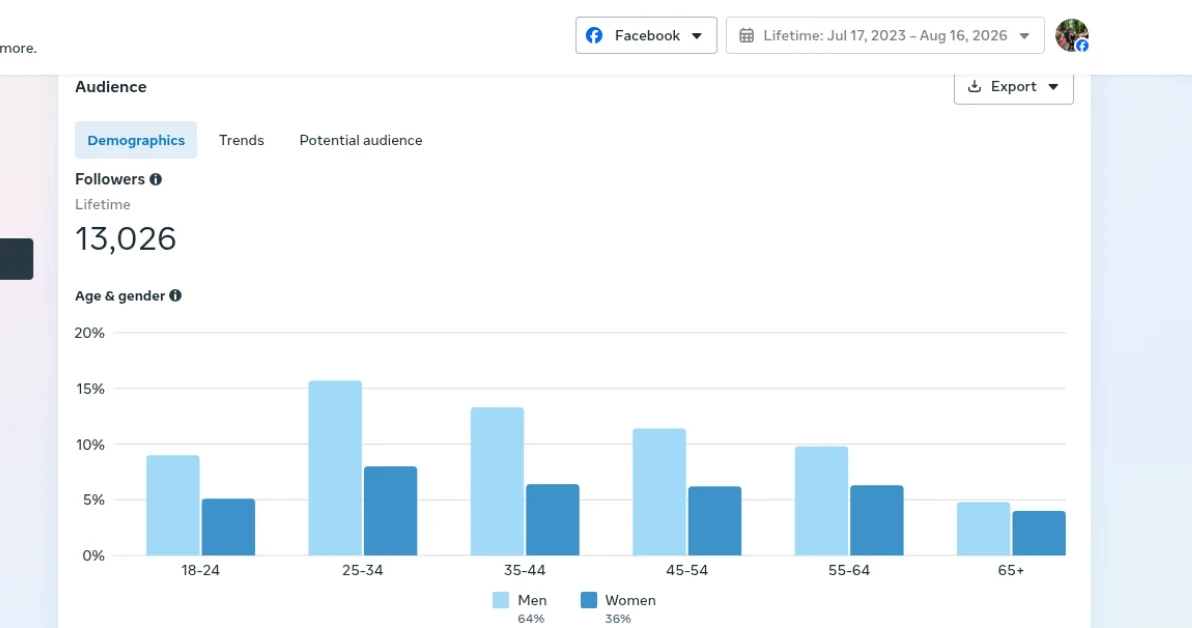
On Facebook, Wildfoot Explores has grown to 13,026 followers, sitting at roughly 64% men and 36% women. That's a clear male majority, sure, but 36% is still a massive chunk of the audience. I can't look at more than a third of the people following that page and just write them off as not part of the strategy.
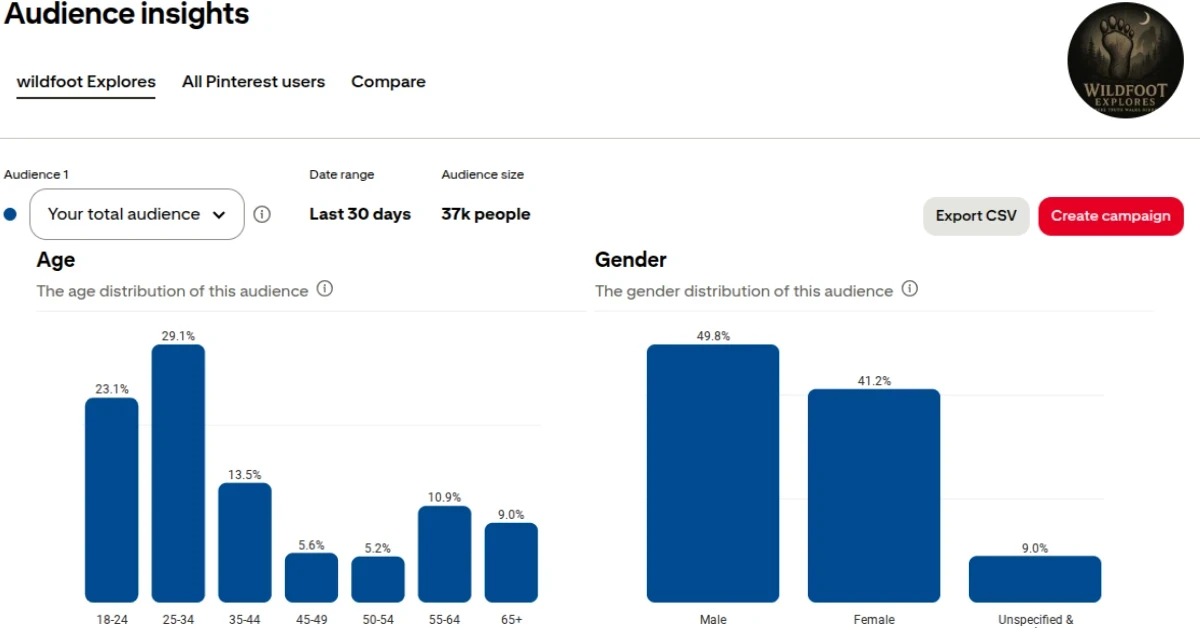
Then I looked at Pinterest, and that's where it gets interesting. The Pinterest audience is 49.8% male and 41.2% female, with another 9% sitting in unspecified or custom. That's about as close to deadlocked as it gets.
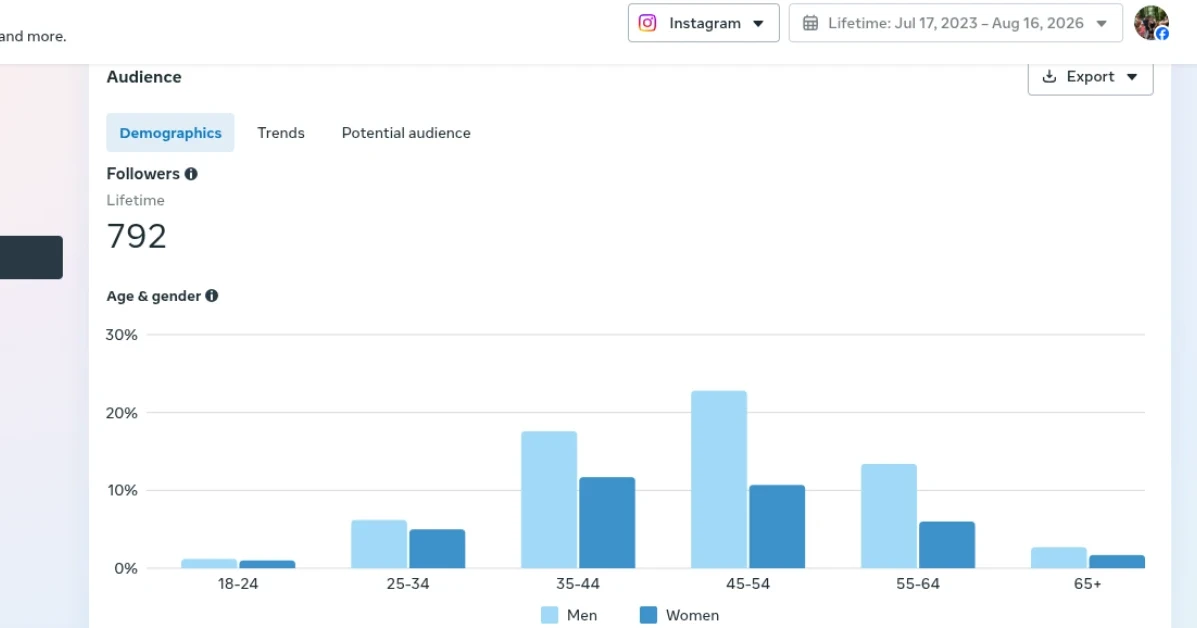
Then there's Instagram. Only 792 followers right now, still leaning male, but the age spread is a completely different animal. The strongest groups there are 35 to 44, 45 to 54, and 55 to 64. So now I've got three platforms, three different audience profiles, a handful of different age brackets, and a subject that pulls people in for a hundred different reasons to begin with.
So Who Do You Create For?
This is where I think analytics can actually turn dangerous if you look at them too narrow. Say I looked only at Facebook and figured, my audience is mostly male, so I'll build everything for men. I'd be ignoring 36% of that page right out of the gate. Take that same approach to Pinterest and it makes even less sense, since that audience is almost split right down the middle. Same problem shows up with age. If you build everything around your biggest bracket, what happens to everyone sitting just above or below it? They're still your audience. A lot of the time they're your most engaged followers too.
That's why I've started looking at demographics differently. Demographics tell me who's in the room. They don't tell me what everyone in that room actually wants to talk about. That's a big difference, and it changes how I approach content.
Find the Common Interest Instead
Wildfoot Explores is a good testing ground for this because the subject matter can go in a hundred directions. Some people are drawn in because they love wilderness and outdoor research. Some come for the eyewitness encounters. Others are folklore and history people through and through. Some lean paranormal, others want nothing to do with paranormal explanations and come at everything from a physical or scientific angle. And then there's the crowd that's just fascinated by a good mystery. If I tried building separate content for every demographic and every belief system out there, I'd drive myself into the ground. So instead I concentrate on what they all share, and that's curiosity. Instead of telling my audience what to think, I try to give them something worth thinking about. That's where questions have become one of the most powerful tools I've got.
One Question Can Reach Several Audiences

Say I put up a post asking why people can witness the same unexplained event and walk away with completely different interpretations of what happened. I didn't write that question for a 35-year-old man. I didn't write it for a 55-year-old woman. I didn't tell the paranormal crowd they're right, and I didn't tell the scientific crowd they're wrong. What I did was open a door into the conversation, and everyone who walks through it brings their own angle. I've watched that play out over and over growing Wildfoot Explores, and I think it holds true well past my own niche. Whether your site is about travel, cooking, fitness, woodworking, pets, tech, affiliate marketing or anything else, there's usually a central reason your audience gathered around you in the first place. Find that reason and build from there.
Ready to put this into action?
Start your free journey today — no credit card required.
Don't Confuse Your Audience With Your Customer Avatar
We've all heard the advice, know your audience, and that's true. But somewhere along the way that advice tends to get flattened into reduce your audience to one imaginary person. That's a useful exercise when you're just getting started and still learning to write with someone specific in mind. But once you've got real traffic and real numbers coming in, pay attention to what they're actually telling you. Your real audience is probably a lot broader than the person you first imagined. Mine sure is, and I don't see that as a problem, I see it as an opportunity. If I'm reaching men and women across several generations on more than one platform, I've built something that already crosses a lot of demographic lines most creators worry about. Now the real work is figuring out why. What subjects bring them together? What questions get people talking? What posts get shared? What makes somebody stop scrolling, and what makes them come back tomorrow? Those answers are worth a lot more than knowing someone's age or gender on a spreadsheet.
Analytics Should Guide You, Not Control You
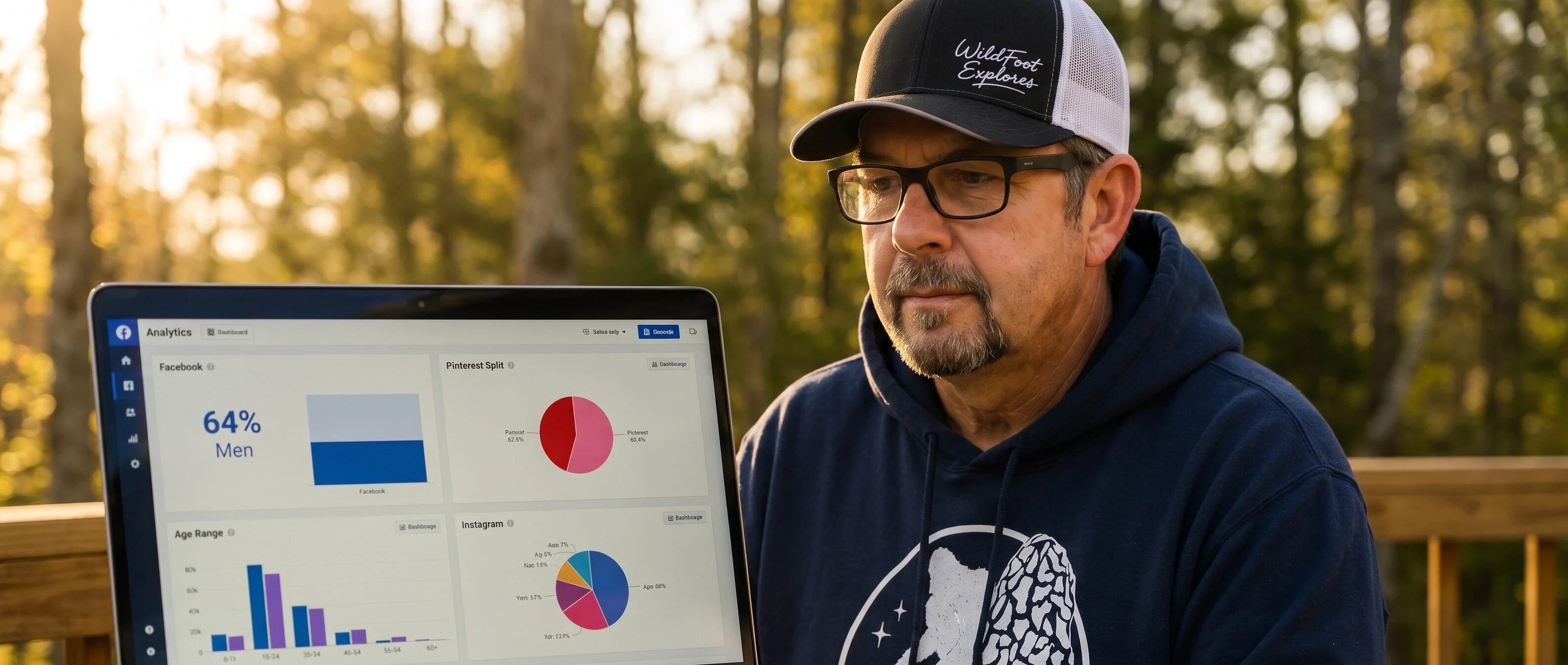
I believe in checking the numbers, that's exactly why I'm sharing these screenshots. But numbers need context around them. If 64% of my Facebook followers are men, that's useful to know. It doesn't mean 64% of my content needs to be built specifically for men. If Pinterest is nearly split down the middle, that tells me something different again. And if Instagram is pulling a different age range entirely, that's one more piece of the puzzle. Together, all those numbers help me understand the community I've built. They don't dictate every word I write, and that's probably the biggest lesson I've taken out of all this. Use analytics to understand who's listening, then use your content to figure out what keeps them listening.
A Real Example: The Trackway Post
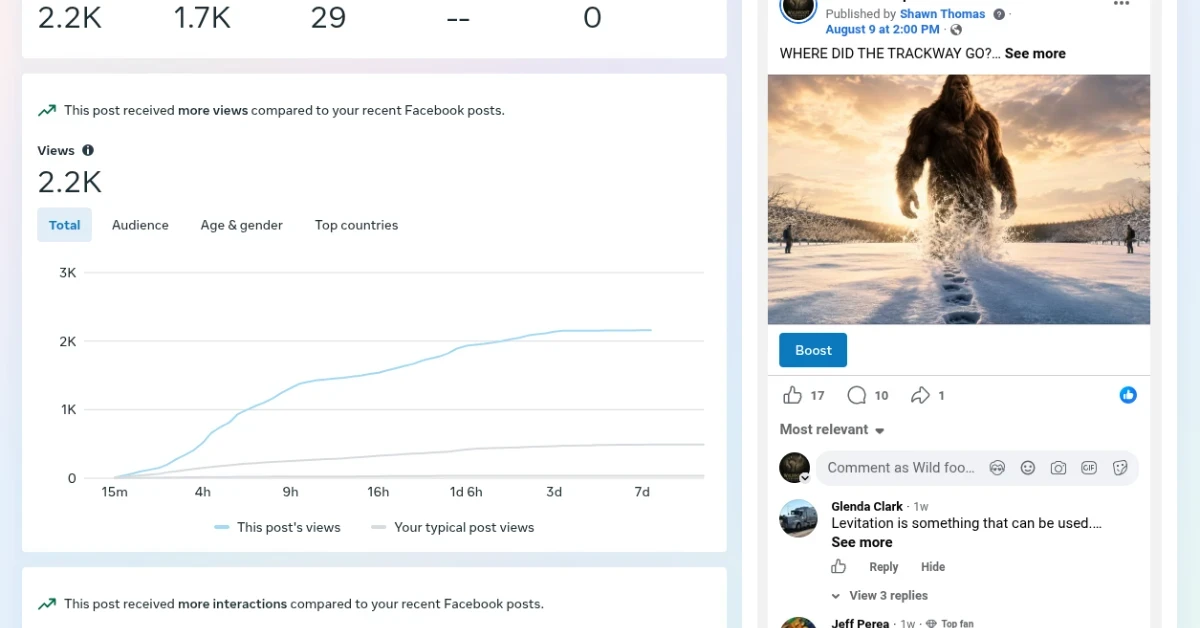
I don't want to just talk theory here, so let me show you a post that proves the whole point.
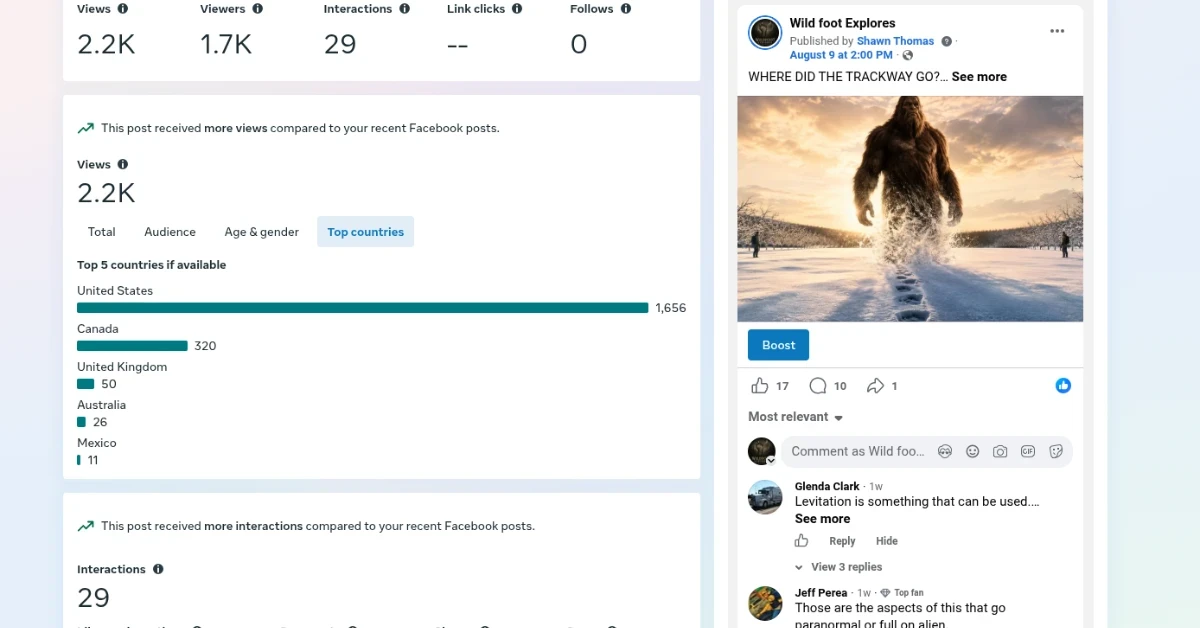
On August 9th I put up a post titled "Where Did the Trackway Go?" about a massive trackway that continues through the snow for nearly a mile and a half before it just disappears. No explanation, just a question hanging out there. That single post pulled in 2.2K views and 1.7K unique viewers, which is well above what I normally see on a Facebook post. Here's the overview and the top countries it reached.
The United States drove 1,656 of those views, Canada brought in 320, and the rest trickled in from the UK, Australia and Mexico. That's already interesting on its own, a Canadian-run page pulling most of its engagement out of the US, but the number that really backs up everything I said above is the age and gender breakdown.
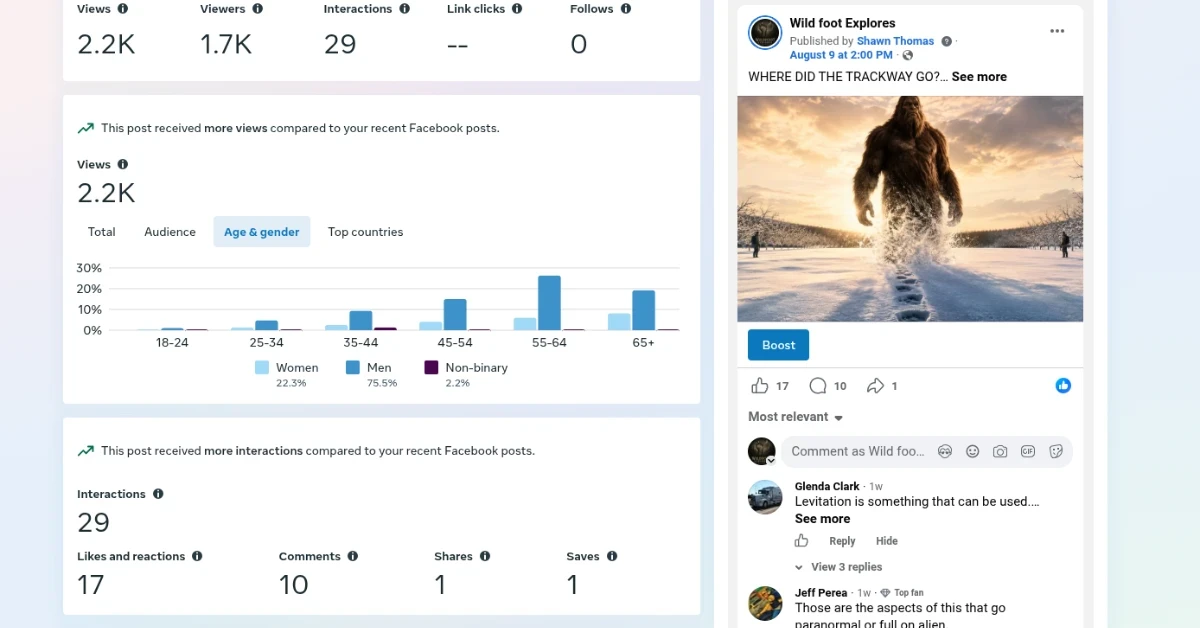
On this specific post, the split was 75.5% men, 22.3% women and 2.2% non-binary. Compare that to my overall Facebook audience sitting at 64/36. This post skewed even harder male than my page average, but look at the comments and you'll see exactly what I mean about one question reaching more than one camp. Glenda came in talking about levitation. Jeff called out the aspects that go paranormal or full on alien. Same trackway, same photo, two completely different lenses. Nobody told them how to interpret it, the post just asked where the trackway went and let people bring their own theory to the table.
Then there's the follower breakdown. Out of that 2.2K views, only 263 came from people who already follow the page. The other 1,897 were non-followers, meaning this post was getting pushed out to brand new eyes almost seven to one over my existing crew. That's the reach side of the coin. The engagement side was 17 likes and reactions, 10 comments and a share and a save on top of it, 29 total interactions on a post that reached almost nine times more strangers than followers.
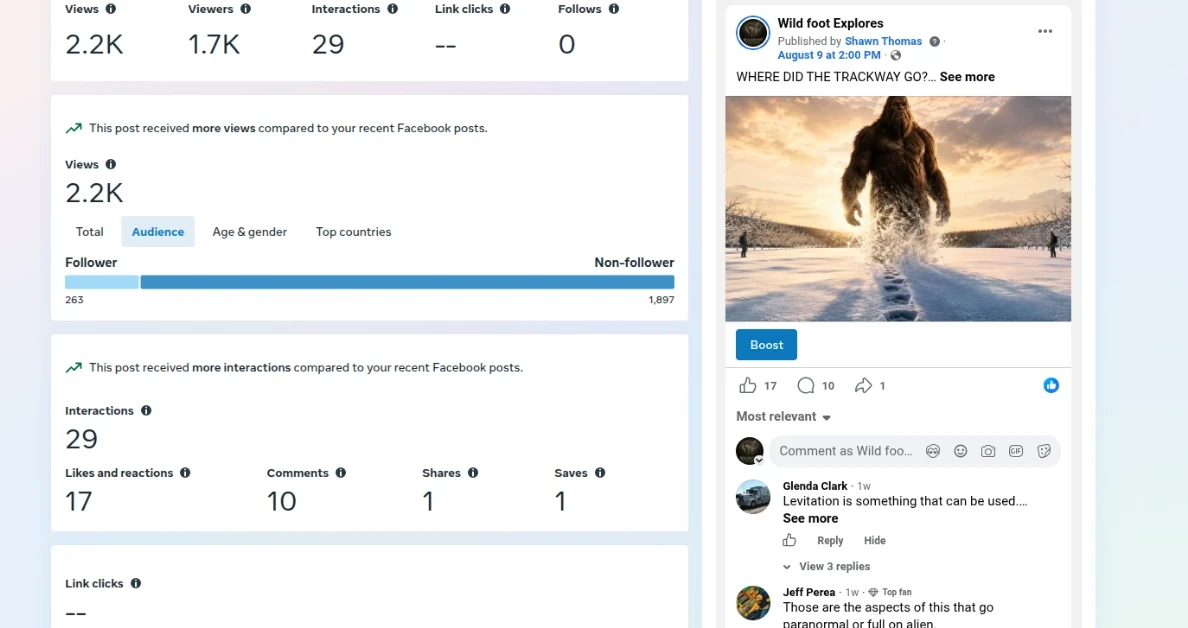
So when I talk about finding the bridge instead of picking a demographic, this is the post I point to. It skewed heavily male in the numbers, but it still pulled in comments from both a paranormal angle and a straight up physical evidence angle, and it reached way outside my existing follower base while doing it. The question did the work, not the demographic targeting.
Maybe Being Deadlocked Isn't a Bad Thing
At first glance, having an audience spread across different ages, genders, interests and viewpoints sounds like it makes content creation harder. But I'm starting to think it's actually one of the best spots a creator can be in, because it means your subject has already proven it can reach across those lines. Your job isn't to pick a side anymore. Your job is to find the bridge. For Wildfoot Explores, that bridge is curiosity about the unknown. For your niche, it might be solving a problem, learning a skill, saving money, building something, improving something, or just belonging to a community of people who care about the same subject you do just like here at Wealthy Affiliates. That's the part worth digging into.
So I'll leave this one with a question for everyone here at Wealthy Affiliate.
If your analytics showed an audience spread across completely different demographics, would you narrow your content down toward your biggest group, or would you go looking for the common interest that keeps all of them coming back?
I'd be curious to hear how other creators handle this, because I think it's a challenge more of us run into as our audiences grow.
Appreciate you reading, Hopefully it helps you along the way.
Shawn
Share this insight
This conversation is happening inside the community.
Join free to continue it.The Internet Changed. Now It Is Time to Build Differently.
If this article resonated, the next step is learning how to apply it. Inside Wealthy Affiliate, we break this down into practical steps you can use to build a real online business.
No credit card. Instant access.