AI Can Do Many Things; It Can’t Create Agency


Published on March 13, 2026
Published on Wealthy Affiliate — a platform for building real online businesses with modern training and AI.

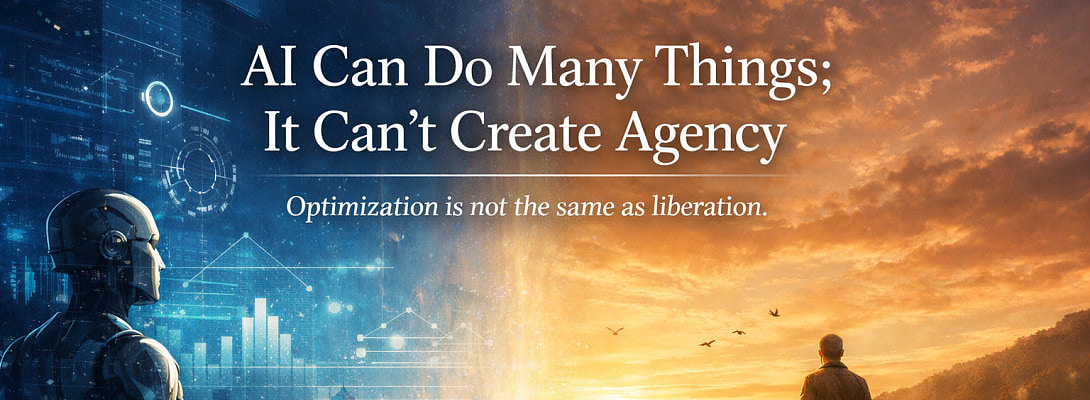
AI Can Do Many Things; It Can’t Create Agency
Better systems can improve selection. They cannot restore agency.
We live in a time obsessed with optimization.
Better filters.
Better frameworks.
Better habits.
Better prompts.
Better tools.
Better systems for thinking, deciding, prioritizing, and producing.
And to be fair, many of these things help.
A cleaner system can reduce overwhelm.
A better process can reduce waste.
A sharper filter can reduce noise.
AI can summarize, compare, organize, and surface options faster than ever before.
It can begin to feel as though freedom is finally becoming more accessible.
As though, with enough intelligence applied to the problem, life itself might become cleaner.
Lighter.
More navigable.
Less costly to carry.
AI has only intensified that promise.
With better synthesis, better filtering, and better cognitive support, freedom can begin to look like a systems problem — something that might eventually yield to smarter tools, cleaner inputs, and more elegant decision-making.
And yet many thoughtful, high-functioning people discover something strange:
They become more efficient without becoming more free.
They make better decisions, yet still feel inwardly trapped.
They reduce friction, yet still feel pressure.
They clarify options, yet still feel as though they do not really have a choice.
That is the deeper distinction.
Because orientation is not optimization.
And until that difference is seen clearly, it is very easy to mistake sophisticated functioning for freedom.
Why this confusion is so convincing
Optimization is persuasive because it often produces experiences that resemble freedom.
When your inputs are cleaner, life feels lighter.
When your decisions are more organized, life feels clearer.
When your workflows are more efficient, life feels less chaotic.
When your tools reduce cognitive load, you feel less mentally crowded.
That relief is real.
This matters, because the point here is not that systems are fake, or that AI is hollow, or that structure does not matter. It does. Sometimes enormously.
Optimization can genuinely improve life. It can help you sort through complexity, reduce friction, prioritize more intelligently, improve consistency, waste less energy, and avoid obvious mistakes.
That matters.
But resemblance is not equivalence.
Something can feel like freedom without actually being freedom.
Relief is not always agency.
Clarity is not always sovereignty.
A better process is not necessarily a freer self.
What optimization can do — and where it stops
Optimization improves movement within a frame.
It helps you operate more effectively inside the structure you are already living from.
It can make you faster.
Cleaner.
More disciplined.
Less scattered.
More strategic.
More capable of choosing among available options.
That is real value.
But optimization does not question the deeper structure beneath those choices.
It does not reveal why one option feels safe and another feels dangerous.
It does not tell you why stopping feels threatening.
It does not explain why rest feels undeserved.
It does not show you why certain forms of achievement still feel compulsory, even when they no longer feel meaningful.
Optimization can improve the quality of selection.
It cannot, by itself, tell you whether the one selecting is actually free.
That is the boundary.
The part better systems cannot reach
A person can have excellent systems and still be driven by fear.
A person can have remarkable decision hygiene and still be run by identity maintenance.
A person can use AI skillfully, organize life intelligently, track goals carefully, and reflect regularly — while still living inside a state of internal bracing.
Outwardly, this person may look clear and intentional.
Inwardly, life still feels tight.
There is still pressure to keep going.
Still the subtle sense of being cornered.
Still the feeling that if they stop, something important will collapse.
Still the need to maintain a version of themselves, prove something, avoid something, stay ahead of something.
This is where many capable people become difficult to help.
Not because they lack intelligence.
Because they have become very good at functioning from within contraction.
They assume that because their decisions are becoming better, they themselves are becoming freer.
But those are not the same thing.
A conditioned self can become extremely refined.
A pressured self can become highly productive.
A fearful self can become impressively disciplined.
A defended self can become very articulate about its choices.
None of that, on its own, proves the return of agency.
It may only prove that conditioning has become more sophisticated.
Better selection is not the same as real choice
This is the heart of the matter:
Better selection is not the same as returned choice.
A person can get better at selecting among options without ever questioning the structure that makes certain options feel mandatory in the first place.
That is not freedom.
That is sophisticated adaptation.
And sophisticated adaptation is often praised precisely because it looks so functional.
It can look like maturity.
It can look like discipline.
It can look like self-leadership.
It can even look like peace.
But sometimes what appears to be clarity is simply well-managed compulsion.
Sometimes what appears to be intentionality is only a more elegant response to pressure.
Sometimes what appears to be control is just fear wearing better clothes.
This is not an accusation. It is a recognition.
Many people have had to become highly adapted in order to survive, succeed, or stay intact inside demanding environments. Of course they learned to optimize.
But optimization is not the same as liberation.
A polished response to pressure is still a response to pressure.
What orientation actually is
Orientation is deeper than process.
Orientation is the internal position from which life is interpreted and action is taken.
Ready to put this into action?
Start your free journey today — no credit card required.
It shapes what feels urgent.
What feels threatening.
What feels possible.
What feels necessary.
What feels irresponsible.
What feels like failure.
What feels like, I do not really have a choice.
This matters because human beings do not respond to life in some neutral way. We respond to life through an inner orientation.
That orientation quietly determines the meaning of events before we ever consciously explain them.
The same circumstance can be interpreted as opportunity, threat, obligation, collapse, invitation, or proof of inadequacy depending on the orientation beneath it.
And from there, the same action can be performed from two completely different places.
One person works late because they feel cornered.
Another works late because they genuinely choose to.
One person says yes because they are afraid not to.
Another says yes because the response is clean.
From the outside, the behavior may look identical.
From the inside, the experience is entirely different.
That difference is not optimization.
That difference is orientation.
Agency is quieter than people think
One of the more subtle confusions of modern life is that efficiency is often mistaken for freedom.
But efficiency only tells you how well movement is happening.
It does not tell you whether the movement is free.
Agency is not the ability to do anything.
Agency is not the absence of constraints.
Agency is not endless optionality.
Agency is the return of real choice within constraint.
It is quieter than people think.
Not dramatic.
Not infinite.
Not the fantasy of total control.
It is the difference between:
I have to.
and
I can see clearly enough to choose.
That distinction can sound small on paper.
In lived experience, it is enormous.
A person with low efficiency may still have agency.
A person with very high efficiency may still lack it.
Because agency is not fundamentally about output.
It is about whether action is arising from compulsion or from clarity.
It is about whether the self is braced, defended, narrowed, and inwardly cornered — or whether something in that structure has softened enough for real choice to reappear.
What AI can do — and what it cannot
AI is powerful.
It can reduce cognitive clutter.
It can organize information.
It can compare options, accelerate synthesis, improve workflows, and help people think through complex decisions more quickly.
That is real leverage.
But leverage is not the same as freedom.
AI can improve the field of options.
It cannot, by itself, transform the inner structure from which those options are being interpreted.
It can help you see more possibilities.
It cannot dissolve fear for you.
It can help you structure a decision.
It cannot make you less defended.
It can help you clarify tradeoffs.
It cannot create inner permission.
It can support reflection.
It cannot stabilize the one who is reflecting.
This is not a criticism of AI. It is simply a boundary.
We keep trying to use better tools to solve problems that are not only informational or procedural in nature.
But many of the deepest problems people experience are not caused by lack of data.
They are caused by unstable orientation.
The issue is not always that the person cannot see their options.
Sometimes it is that the self seeing them is still shaped by fear, urgency, shame, pressure, or identity maintenance.
No amount of better filtering automatically changes that.
The trap for capable people
This misunderstanding shows up most strongly in capable people.
People who are intelligent, reflective, disciplined, and competent often become extremely good at managing themselves.
They know how to optimize.
They know how to cope.
They know how to organize complexity.
They know how to keep moving.
Which means they can remain trapped for a very long time without appearing obviously trapped.
Their life does not look chaotic enough to trigger concern.
Their systems are too good.
Their performance is too stable.
Their self-explanations are too coherent.
But beneath the surface, something still feels tight.
There is still a subtle inability to stop.
Still a fear of falling behind.
Still an internal obligation that never quite relaxes.
Still an undercurrent of self-protection driving decisions that appear rational on the surface.
This is one reason optimization can become such a seductive substitute for freedom.
If the pressure remains, the mind assumes the answer must be better systems.
Better prompts.
Better routines.
Better strategy.
Better filtering.
Sometimes those help.
But sometimes what is missing is not a cleaner method.
Sometimes what is missing is the return of choice.
What changes when orientation shifts
When orientation shifts, the external facts of life do not necessarily change first.
The internal environment does.
Urgency softens.
Bracing eases.
Attention widens.
The body no longer feels quite so cornered.
Decision-making becomes less defensive.
Rest feels less like risk.
Action feels less like self-preservation.
This does not make a person passive.
It does not make them vague, lazy, or uncommitted.
It makes them less driven by contraction.
And that changes everything.
From a shifted orientation, discernment becomes cleaner because the self is less threatened. Effort becomes more honest because it is no longer being used to outrun an inner condition. Ambition becomes less compensatory. Strategy becomes less defensive.
The person may still build, decide, lead, create, and move powerfully.
But the movement no longer feels like being secretly chased.
That is why orientation matters so much.
Freedom is not only about what you do.
It is about the state from which doing happens.
This is not an argument against systems
To say that orientation is not optimization is not to reject optimization.
Systems matter.
Planning matters.
Good filters matter.
Discipline matters.
Tools matter.
AI matters.
These can all be meaningful supports.
But they are supports.
They are not sovereignty.
A system can support agency.
It cannot generate it.
A tool can reduce noise.
It cannot restore choice on its own.
A framework can improve decisions.
It cannot free the chooser if the chooser remains inwardly trapped.
This distinction matters because people often feel disappointed when optimization does not produce the depth of change they hoped for.
So they conclude they need more optimization.
But the problem may not be that they are using the wrong tools.
The problem may be that they are asking tools to do the work of orientation.
What people are really looking for
Underneath the search for better systems is often a deeper longing.
Not just for efficiency.
Not just for clarity.
Not just for improved workflows or more intelligent filtering.
But for relief from compulsion.
For a loosening of pressure.
For the return of real choice.
For the sense that life is no longer only happening through reaction.
That is the deeper freedom.
And it does not appear simply because the menu becomes cleaner.
It appears when the internal structure of urgency begins to loosen.
When defense no longer defines perception.
When identity maintenance stops masquerading as necessity.
When action is no longer an expression of pressure, but a genuine response to life.
Optimization can make life more functional.
But functionality is not the same thing as freedom.
A cleaner process is not the same thing as returned choice.
No matter how advanced our tools become, that distinction will remain.
Because better systems can improve selection.
Only a shift in orientation can restore agency.
The deepest trap is not that we lack better tools.
It is that we keep asking them to give us back the chooser.
And that is the one thing no tool can do.
If this resonated, you may also want to read:
https://my.wealthyaffiliate.com/justinkon/blog/when-choice-returns
Share this insight
This conversation is happening inside the community.
Join free to continue it.The Internet Changed. Now It Is Time to Build Differently.
If this article resonated, the next step is learning how to apply it. Inside Wealthy Affiliate, we break this down into practical steps you can use to build a real online business.
No credit card. Instant access.