AI Isn’t Taking Your Job… But It Is Changing the Rules (From Panama)


Published on March 30, 2026
Published on Wealthy Affiliate — a platform for building real online businesses with modern training and AI.

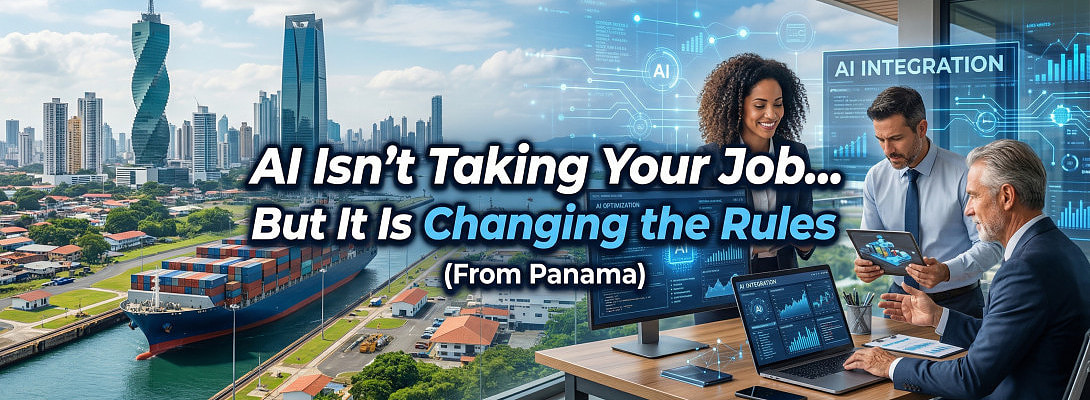
We just left Costa Rica.
Not in a dramatic, “that chapter is over forever” kind of way… more like packing up the truck and trailer, wrapping up another stretch, and heading into the next stop. Right now, that stop happens to be Panama for a few days.
Different country, different pace, but the same thing keeps showing up no matter where we land.
AI.
And not the helpful, “this tool saved me a few hours” version either. I’m talking about the kind of conversations that feel like someone just stood up on a mountain and started yelling that everything is about to collapse.
I came across one of those posts this morning on Facebook. You’ve probably seen something similar. It ran through the full list:
- lawyers,
- doctors,
- accountants,
- real estate agents,
- influencers
...and basically wrapped it all up with the idea that most white-collar jobs are on borrowed time.
And sitting there with my tea, I had that same split reaction I’ve been noticing more and more lately.
Part of me was thinking… yeah, there’s truth in this.
And the other part was thinking… this isn’t the full picture.
The more I’ve actually used AI in my own day-to-day, the more one thing stands out that doesn’t get talked about enough.
It doesn’t just go off and do things on its own. There’s always someone behind it.
Someone asking the right questions. Someone deciding what direction to take. Someone filtering what’s useful and what’s just noise. You can hand AI a task, but it still needs a person to frame it, guide it, and ultimately decide if the output is even worth using.
That “operator” role is the piece that gets quietly skipped over in most of these fear-driven conversations.
Because yes, AI can draft documents, analyze data, write content, and automate processes at a level that would have sounded ridiculous a few years ago. But it’s not sitting there taking responsibility for outcomes or navigating real-world consequences on its own. Not in any meaningful way.
And that distinction changes how you look at everything.
Around the same time I was reading that post, I opened an email that couldn’t have been a better contrast.
It was a list of remote jobs currently hiring.
Not hypothetical ones. Not “future of work” predictions. Real companies, actively looking for people right now.
- Marketing roles.
- SEO strategists.
- Product managers.
- Account executives.
- Software engineers.
- Operations specialists.
A pretty wide spread.
So now you’ve got two things sitting side by side.
Ready to put this into action?
Start your free journey today — no credit card required.
One voice saying jobs are disappearing.
Another quietly showing that companies are still hiring… just in a different way.
That’s when it starts to click. It’s not that work is vanishing. It’s that it’s moving.
Most of these roles weren’t tied to a physical location anymore. They weren’t built around someone showing up to the same building every day. And almost all of them assumed a certain level of comfort with digital tools, systems, and workflows.
AI wasn’t listed as “the job.”
But you could feel it sitting underneath everything. That's now part of the expectation and part of the environment. Almost like an unspoken requirement that you know how to work alongside it.
That’s a very different shift than “AI is replacing everyone.” It’s more like… AI is becoming part of the baseline.
I saw another version of this play out last night watching Dragon's Den, which is a Canadian program on CBC.
A team came in with an AI-based system. Solid idea, well thought out, clearly a lot of work behind it, and the Dragons passed.
Not because AI wasn’t impressive, but because the companies already sitting on massive amounts of data (like Peloton) are in a completely different position. They don’t just have the tools. They have the data, the users, and the infrastructure.
That moment said more than any headline ever could.
It’s not just about AI. It’s about who knows how to use it, where it’s applied, and what it’s connected to.
And yeah, if you let your mind wander far enough, it’s easy to drift into that sci-fi version of all this.
Fully autonomous systems, decisions being made without people, everything running on its own. (Terminator, anyone?) .... I’ve gone there too.
But when you pull it back to reality, everything being built still has layers of control. There are systems, guardrails, and yes… some version of a kill switch sitting behind it all.
This isn’t machines running wild. It’s people building tools.
The real risk isn’t AI taking over, it’s people not adjusting to how it’s being used.
This is where things start to separate a bit.
Because a lot of people are still operating with the same assumptions that used to work. For example; stable job, predictable path, long-term security tied to a role.
Meanwhile, under the surface, things are shifting toward something else entirely.
- Work that’s location-independent.
- Income tied to output instead of hours.
- Systems that keep running whether you’re sitting at a desk or not.
And AI is speeding that up, not creating it from scratch… just accelerating what was already happening.
Living this way (moving between places, building things online, figuring it out as we go) you notice these shifts a little differently.
AI didn’t come in and replace anything I was doing.
But it just made certain parts faster, more efficient and sometimes a lot easier, but only because I chose to use it that way.
Same with those remote jobs...They didn’t disappear, they adapted.
So the question isn’t really whether AI is going to change things. We know that part’s already happening.
The better question is what you do with that information.
You can ignore it and hope things stay the same or, you can panic and assume everything’s collapsin or, you can start paying attention to where things are actually moving and adjust accordingly.
That might mean learning how these tools work instead of avoiding them. It might mean building something of your own on the side. It might mean stepping into spaces where digital skills actually matter.
That’s where platforms like the one we use here come into the picture for a lot of people. Not as some magic fix, but as a place to understand how this whole online ecosystem works... how content connects to traffic, how traffic connects to income, and how to build something that isn’t tied to a single role or employer.
At the end of the day, AI isn’t the end of work.
It’s the end of doing things the same way without adapting.
And the people who feel like it came out of nowhere will probably be the ones who just didn’t see the shift happening in front of them.
If you’ve been getting that feeling lately—that something’s changing, even if you can’t fully explain it yet—you’re probably not wrong.
You’re just early enough to do something about it.
Share this insight
This conversation is happening inside the community.
Join free to continue it.The Internet Changed. Now It Is Time to Build Differently.
If this article resonated, the next step is learning how to apply it. Inside Wealthy Affiliate, we break this down into practical steps you can use to build a real online business.
No credit card. Instant access.