Congrats: Image Studio Is a Real Language… and I’m Still Learning the Accent!


Published on February 3, 2026
Published on Wealthy Affiliate — a platform for building real online businesses with modern training and AI.


I’ve got news: Image Studio is officially a real language now. How do I know? Because you can study AI at university… and I’m still speaking it with an accent.
There’s a funny little “rule” I recently bumped into:
If you can study it at a university, it suddenly becomes a Real Language™.
Not because it’s spoken by millions.
Not because it has ancient poetry.
Not even because your grandmother uses it to scold you with terrifying precision.
No. It becomes “official” the moment it gets a syllabus.
And that’s where the whole language vs. dialect thing gets hilariously awkward.
Because the difference often isn’t about “is it a language?” but more like:
Does it come with homework?
A language tends to arrive dressed in formal clothing:
- Textbooks with serious covers
- Grammar rules that look like they were invented to punish joy
- Exams where one wrong comma makes your teacher sigh like you personally ruined civilization
- Professors who can say “interesting” in a way that means “no.”
A dialect, on the other hand, is treated like the lovable street cousin:
- It lives in kitchens, jokes, and everyday life
- It’s learned by being around people, not by being around PowerPoint
- It doesn’t ask permission
- It doesn’t care about footnotes
- It has vibes, not “academic framework.”
So basically:
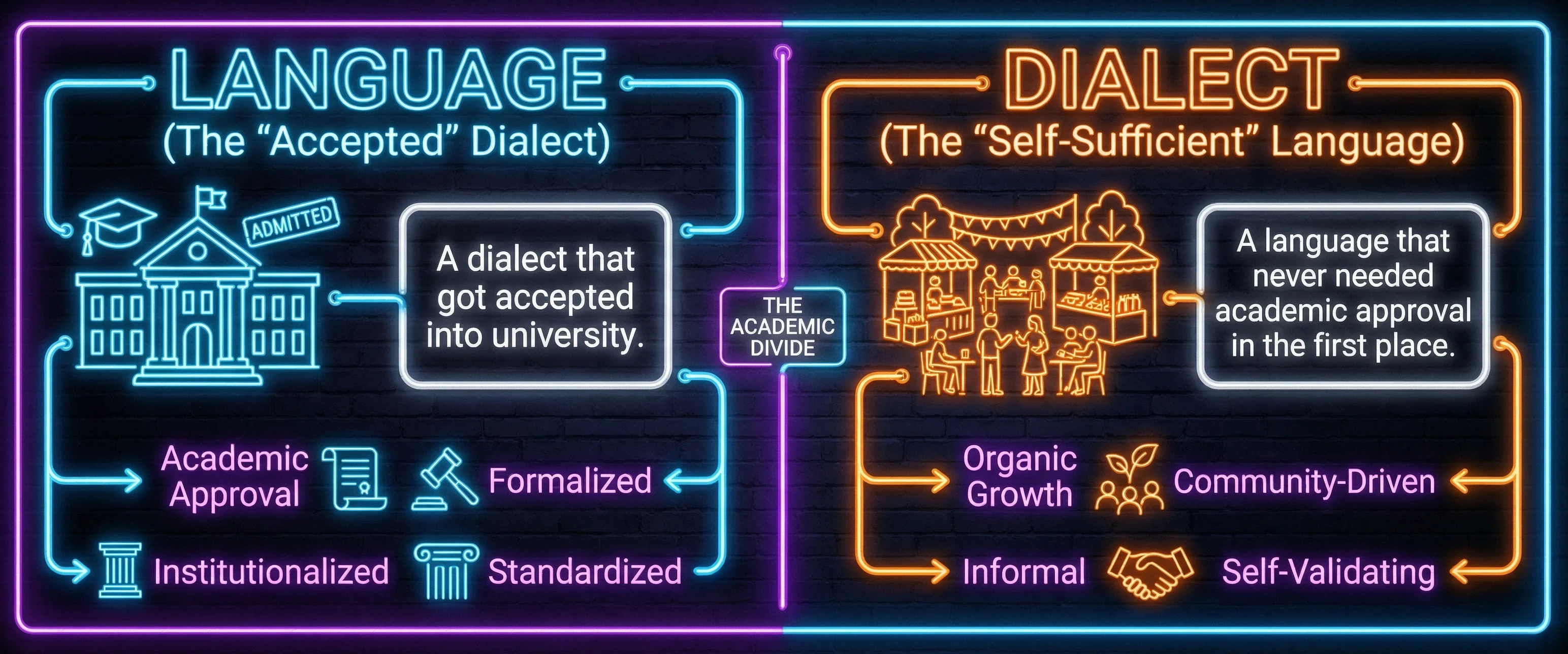
A language is a dialect that got accepted into university.
A dialect is a language that never needed academic approval in the first place.
Ready to put this into action?
Start your free journey today — no credit card required.
Now here comes the part that made me laugh out loud:
We’re doing the same thing with AI.
Because AI is now something you can study at university too. Which means—by the sacred logic of academia—AI is quietly turning into… a language.
Not a spoken language like French or Spanish, but a new kind of language:
Promptish. Promptanese. GPT-ese. Image-Studio-ish.
And you can hear it when people “speak” it.
Beginners go:
“Uh… make it nice… cinematic… you know… like cool.”
Intermediate speakers go:
“Ultra realistic, soft lighting, shallow depth of field, 8K, rule of thirds…”
And the advanced ones?
They don’t even write prompts. They compose them like legal contracts:
“Subject: one. Mood: three. Lighting: divine. Negative prompts: forty-seven.
Do not generate extra fingers. Do not generate extra fingers. DO NOT—”
It’s basically a new university department waiting to happen:
- Introduction to Promptology (with mandatory suffering)
- Advanced Semantics: Why “Epic” Sometimes Creates a Wet Sock With Wings
- Pragmatics: How to Stay Polite While Asking the Same Tool 12 Times
- Historical Linguistics: The Early Dialects of “Make It Pop”
And here’s the punchline:
Once something becomes “studyable,” people treat it like it’s “official.”
So now we’re all casually pretending we’re multilingual:
“I speak a bit of Image Studio.”
“I’m fluent in ChatGPT.”
“I’m currently learning Midjourney, but I still have an accent.”
And the world nods, as if that’s totally normal.
Which, let’s be honest, is the best part.
Because the future isn’t just about learning languages anymore.
It’s about learning interfaces.
And apparently… if it comes with homework, it counts. 😄
Farid
Share this insight
This conversation is happening inside the community.
Join free to continue it.The Internet Changed. Now It Is Time to Build Differently.
If this article resonated, the next step is learning how to apply it. Inside Wealthy Affiliate, we break this down into practical steps you can use to build a real online business.
No credit card. Instant access.