Martial Arts Disciplines in Focus: An Introduction


Published on December 23, 2025
Published on Wealthy Affiliate — a platform for building real online businesses with modern training and AI.

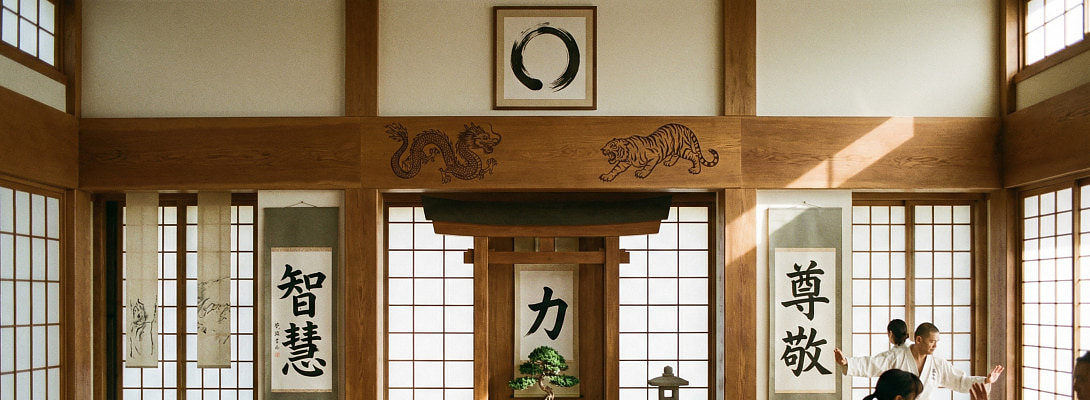
Hello again, everyone! As many of you probably already know, I'm doing blog posts on several different subjects, with pretty much all of them about my niches. This particular blog is going to focus on the numerous disciplines of the martial arts. My website on this niche offers a general overview of just a few of the disciplines specified. In this blog, I'm going to be breaking down each discipline in alphabetical order and doing a deep dive on them. I hope you find it fascinating and enjoyable to read.
This week, I'll be starting out with the Japanese discipline of Aikido, which, roughly translated, means "the way of harmonizing energy."
 https://tacomaaikikai.com/wp-content/uploads/2022/09/aikido-martial-arts-adults-mobile.jpg" width="546.96875" height="305.2140751347709" data-image-anchor="">
 https://budojapan.com/wp/wp-content/uploads/IAI2305_P13-Irimi-nage-Throw.jpg" width="547" height="410.25" data-image-anchor="">
 https://aikidoclub.ca/wp-content/uploads/2020/05/Yumi-wrist-lock-sankyo-06012-946x1024.jpg" width="525.984375" height="569.35838682152" data-image-anchor="">
Aikido is a modern Japanese martial art founded in the early 20th century that emphasizes blending with an opponent’s energy rather than meeting force with force. Its name reflects its philosophy:
- Ai (合) – harmony
- Ki (気) – energy or spirit
- Dō (道) – way or path
Together: “the way of harmonizing energy.”
Origins & Founder
Aikido was created by Morihei Ueshiba (1883–1969), often called Ō-Sensei. Ueshiba was a highly skilled martial artist, particularly in Daitō-ryū Aiki-jūjutsu, but his spiritual studies—especially Shintō and later Ōmoto-kyō—reshaped his view of combat. He believed true martial mastery meant protecting life, including that of the attacker.
Aikido emerged in the 1930s–40s as a discipline aimed at self-defense without domination.
Core Principles
Unlike many martial arts, Aikido does not focus on competition or sparring for victory. Its central ideas include:
- Non-resistance: Redirecting force instead of blocking or striking
- Circular movement: Turning linear attacks into spirals
- Centering: Maintaining balance and calm through posture and breath
- Control without injury: Using joint locks and throws to neutralize threats
Aikido techniques are designed to work regardless of size or strength, emphasizing timing, positioning, and awareness.
Techniques & Training
Aikido practice typically includes:
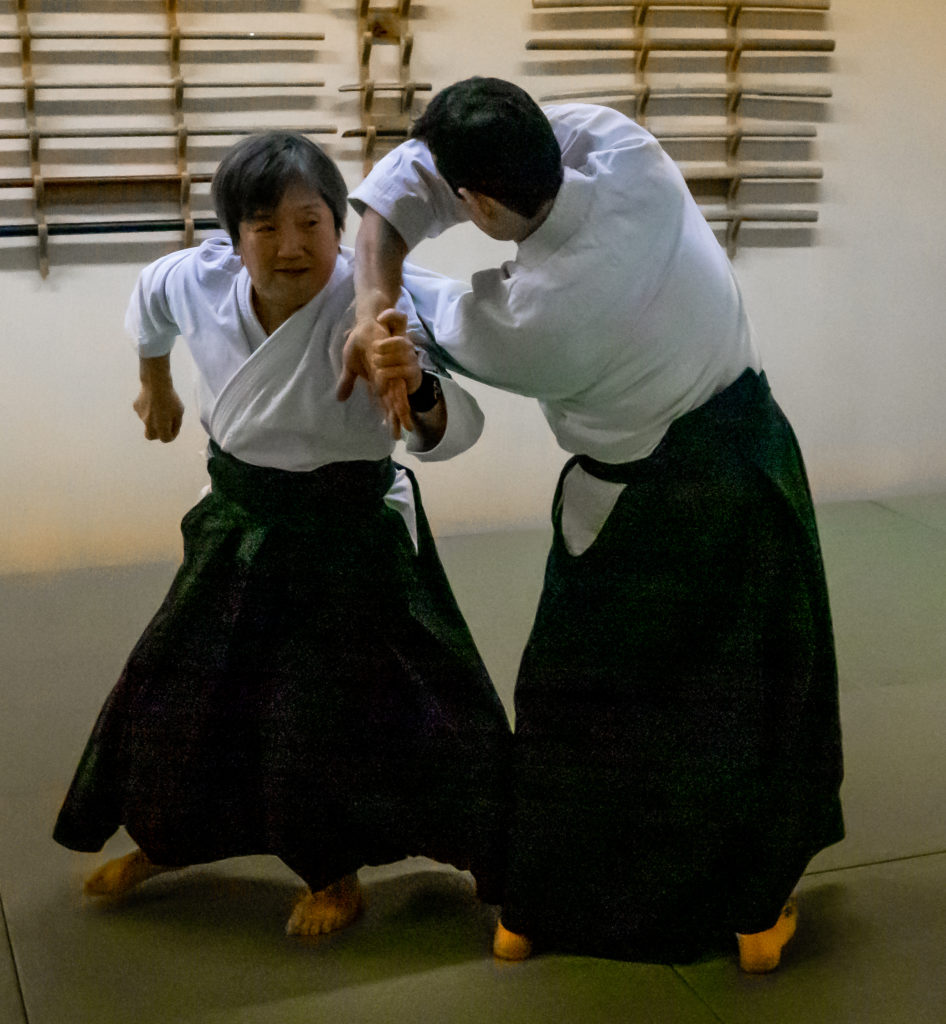
- Joint locks (kansetsu-waza): Such as nikyō, sankyō, and yonkyō
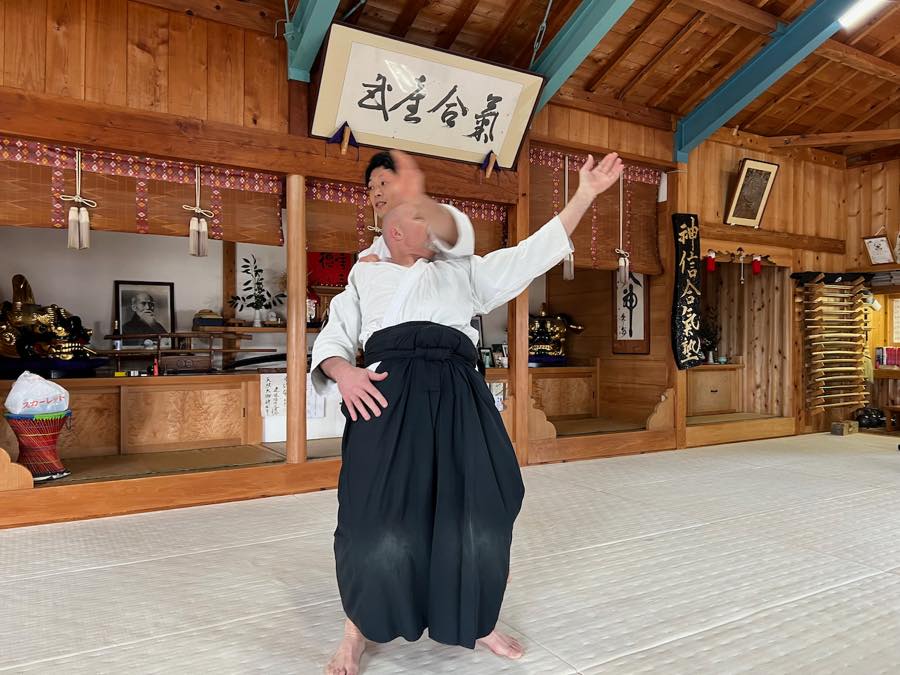
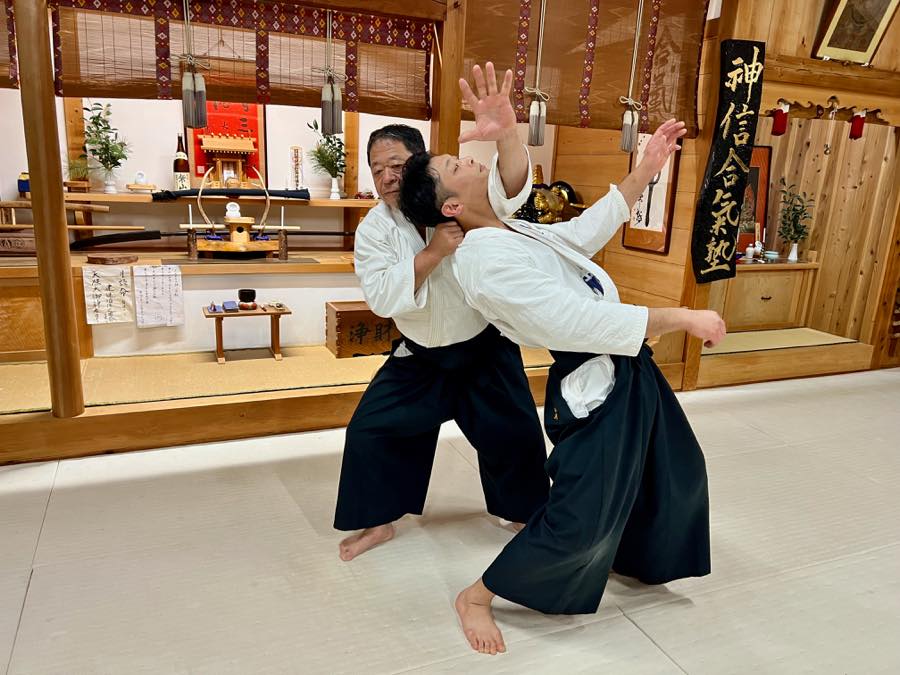
- Throws (nage-waza): Including iriminage (entering throw) and kote-gaeshi (wrist turn)
- Ukemi: Learning how to fall safely—a vital skill in Aikido
- Weapons work: Practice with bokken (wooden sword), jō (staff), and sometimes tantō (knife) to reinforce distance, timing, and movement
Training is cooperative rather than adversarial. Partners alternate roles between uke (attacker) and nage (defender).
Philosophy & Ethics
Aikido is often described as a moving meditation. Practitioners aim to cultivate:
- Emotional control under stress
- Awareness of surroundings and intent
- Compassion and responsibility in conflict
Ueshiba famously said:
“The ultimate aim of martial arts is not to defeat people, but to defeat the negativity within ourselves.”
Styles of Aikido
After Ueshiba’s death, several branches developed, each with a different emphasis:
- Aikikai: The most widespread, balanced and traditional
- Yoshinkan: More rigid and structured; used by Japanese police
- Iwama-ryū: Strong focus on weapons integration
- Shodokan (Tomiki Aikido): Includes limited competition formats
All share the same philosophical core but vary in intensity and structure.
Modern Practice & Who It’s For
Aikido is practiced worldwide by people of all ages. It appeals especially to those interested in:
- Self-defense without aggression
- Mind-body discipline
- Longevity and injury-conscious training
- Philosophical or spiritual aspects of martial arts
It’s less suited for those seeking sport competition or high-impact striking, but ideal for practitioners drawn to control, balance, and inner development.
How Aikido Works in Real-World Self-Defense
 https://budojapan.com/wp/wp-content/uploads/IAI2305_20230422-IwamaRyu-IrimiNage-06.jpg" width="501" height="375.75" data-image-anchor="">
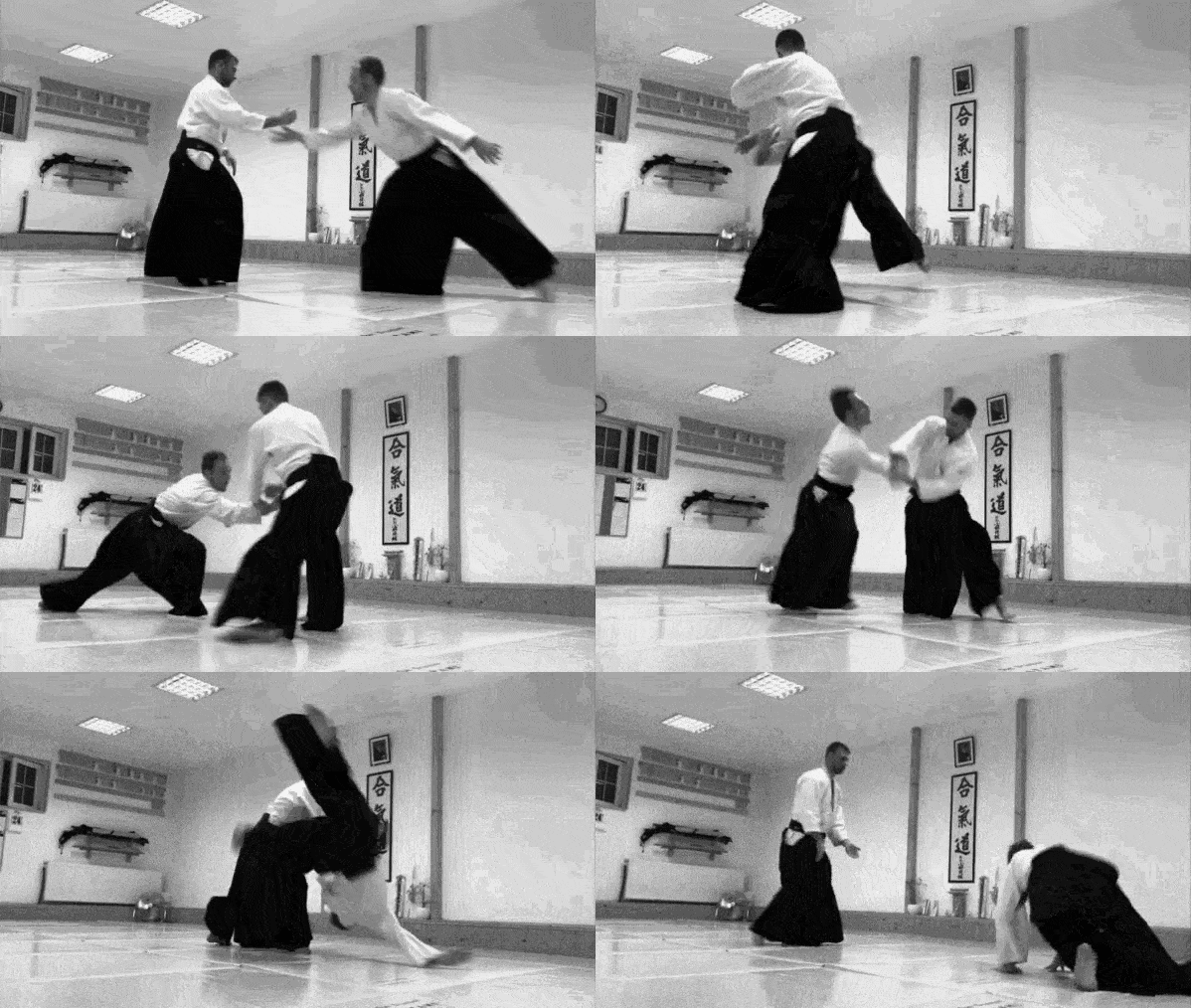 https://www.grapplearts.com/wp-content/uploads/2023/05/aikido-kotegaeshi-wristlock.gif" width="481" height="271.41569282136896" data-image-anchor="">
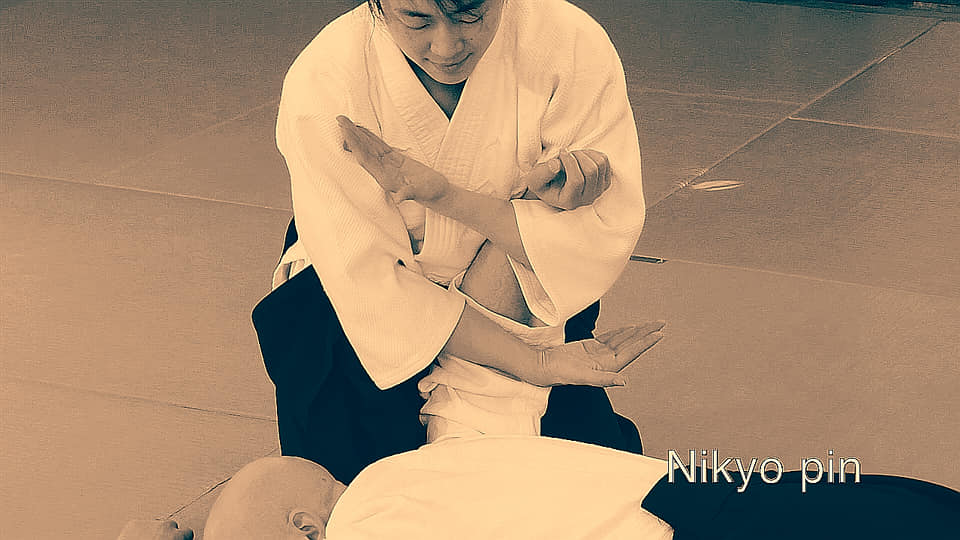 https://boec.com/wp-content/uploads/2020/09/aikido-nikyo.jpg" width="463" height="260.4375" data-image-anchor="">
Ready to put this into action?
Start your free journey today — no credit card required.
Aikido’s real-world usefulness is often misunderstood because it doesn’t look violent and avoids competitive sparring. In practice, though, it’s built around managing common human attacks—grabs, shoves, swings, tackles—rather than formalized striking exchanges.
1. What Aikido Is Best At
Aikido excels in situations involving:
- Grabs (wrist, lapel, shoulder, bear hugs)
- Overcommitted strikes (haymakers, lunging punches)
- Close-range confrontations
- Multiple attackers (movement and positioning)
Instead of trading blows, aikido teaches you to:
- Enter (irimi) safely
- Blend (awase) with the attack
- Redirect balance (kuzushi)
- Control or disengage
A properly applied technique can end a confrontation without escalation, which is especially relevant in civilian self-defense contexts.
2. Mechanics That Translate to Reality
Aikido techniques rely on anatomy and physics, not compliance.
Joint locks
Wrist, elbow, and shoulder joints are vulnerable when rotated beyond their natural range. Techniques like nikyō or kote-gaeshi exploit this safely in training—but decisively if needed.
Balance disruption
You don’t need to throw someone hard; you need to take away their base. Aikido uses subtle shifts in posture and timing to make attackers fall under their own momentum.
Off-line movement
Rather than backing up, aikidoka step off the line of attack, avoiding impact while maintaining proximity and control.
3. Stress, Resistance, and Criticism
A common criticism is that aikido training is “too cooperative.” This depends heavily on the dojo.
What aikido does well
- Builds calm under pressure
- Develops spatial awareness
- Trains control rather than rage
- Reduces injury risk
What it requires to be realistic
- Progressive resistance
- Pressure testing
- Honest ukemi (attacks must be real)
- Cross-training (boxing, wrestling, judo help immensely)
Aikido is most effective when viewed as conflict management, not a stand-alone fighting system.
4. Weapons Awareness
Even unarmed techniques are structured around weapon logic:
- Distance like a sword
- Angles like a blade
- Entry timing based on armed combat
This gives aikidoka a heightened awareness of knives, sticks, and improvised weapons, though specialized weapons training is still recommended.
Aikido Ranks, Belts, and Dojo Culture
1. Rank Structure
Aikido follows the traditional Japanese kyū / dan system.
Kyū ranks (student levels)
Usually:
- 6th kyū → 1st kyū
Belts are typically white, though some dojos use yellow or brown at higher kyū levels.
Dan ranks (black belt levels)
- Shodan (1st dan) – foundational understanding
- Nidan–Sandan – refinement and adaptability
- Yondan+ – leadership, teaching, and embodiment
A black belt in aikido means you understand the basics, not that you’ve “mastered” the art.
2. The Hakama
After reaching shodan (or sometimes earlier in traditional dojos), practitioners wear the hakama—a pleated garment symbolizing:
- Humility
- Responsibility
- Classical budō values
It also obscures footwork, forcing cleaner technique and posture.
3. Dojo Etiquette (Reishiki)
Aikido places strong emphasis on respect and mindfulness:
- Bowing when entering/leaving the mat
- Addressing instructors as Sensei
- Cleaning the dojo (sōji) together
- Practicing quietly and attentively
This isn’t empty ritual—it trains situational awareness and emotional regulation, crucial in real conflict.
4. Roles in Training
- Uke – the attacker; learns awareness, resilience, and falling
- Nage / Tori – the defender; applies technique
Good aikido requires both roles to be practiced seriously. Advanced aikidoka are often excellent uke.
5. Teaching Culture
Aikido instruction is typically:
- Demonstration-based
- Corrections are physical, not verbal
- Emphasis on feeling rather than force
- Long-term development over quick results
Progress can feel slow—but the payoff is deep body intelligence.
Bottom Line
Aikido works best in the real world when:
- Used to avoid, control, or disengage
- Practiced in a dojo that encourages realism
- Supplemented with basic striking or grappling knowledge
It’s less about winning fights and more about ending conflict safely—for yourself, your attacker, and anyone nearby.
Share this insight
This conversation is happening inside the community.
Join free to continue it.The Internet Changed. Now It Is Time to Build Differently.
If this article resonated, the next step is learning how to apply it. Inside Wealthy Affiliate, we break this down into practical steps you can use to build a real online business.
No credit card. Instant access.