How to Structure and Write the Perfect Blog: A guide


Published on August 5, 2025
Published on Wealthy Affiliate — a platform for building real online businesses with modern training and AI.


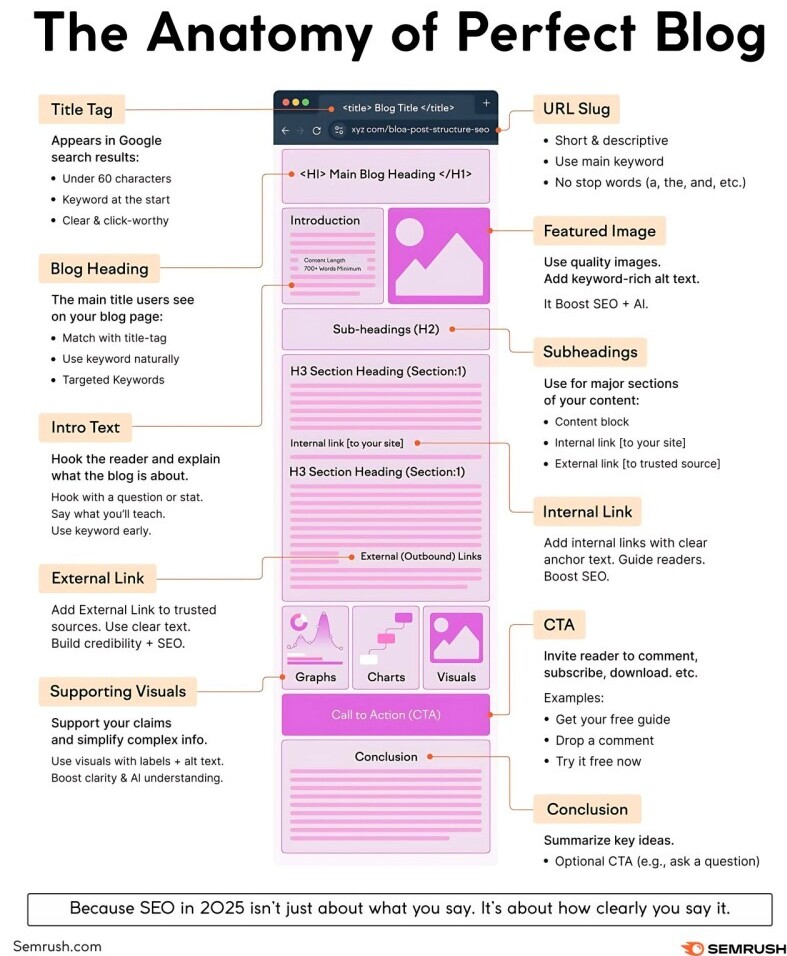
Source: Madhav Mistry (Linkedin, 2025)
This excellent diagram, credited to Semrush and Madhav Mistry on linkedin, provides a clear, detailed blueprint for a blog post for maximum visibility in 2025. The core idea is simple: "Because SEO in 2025 isn't just about what you say. It's about how clearly you say it".
The image above breaks down "The Anatomy of a Perfect Blog" into its essential components , explaining what each part is , why it's important for both users and search engines , and how to implement it . Let's go through each element of this perfect blog structure .
The Essential On-Page SEO Elements
These are the foundational pieces that ensure your blog is found and understood by search engines.
Ready to put this into action?
Start your free journey today — no credit card required.
- The title tag is the most crucial element for search results. It's what appears as the clickable link in Google. It should be under 60 characters , include your main keyword near the beginning , and be clear and compelling .
- The URL slug (not the one in the garden) is a short and descriptive URL that is easy for both users and search engines to understand . It should contain words like your main keywords, avoid using words such as "and", "a", "like" and "the".
- Use a blog heading like H1. This heading is the main title on your blog page . It should be a single H1 tag, match your Title Tag and should incorporate with your main key word.
The Content Structure: Guiding the Reader and the AI.
This part of the framework focuses on how you organize the body of your blog post to make it scannable and easy to digest .
- The intro text (first few paragraphs) are critical for hooking the reader. Start with a question, a statistic, or a statement that immediately tells them what they are going to learn. Use your main keyword early.
- Subheadings (H2, H3) These break up your content into logical sections . H2 tags are for major sections and H3 tags are for sub sections within those. They make the post easy to understand its structure.
- Supporting visuals like graphs, charts and images to support claims and simplify complex information . Use descriptive alternative texts on your images . This is key for both accessibility and for AI to understand your visuals .
Trust and Authority Signals: Building Credibility
This part of the diagram demonstrates the elements that builds trust , with both readers and with search engines .
- Internal Links: These links point to other pages on your own website. They help readers guide readers to more of your content and improve your sites overall SEO.
- External Links: These links are the point of trust. Authoritive sources outside of your site. They build credibility by showing that you have done your research. Use clear anchor text for these links.
- Supporting Visuals: High quality visuals with proper alt text are a key part of building trust and authority , as they provide evidence and context for your claims .
Conclusion
By following this comprehensive anatomy, you're not just writing a blog post. You are creating a great piece of content that is optimized for both human readers and AI run search engines. The structure of the diagram ensures your message is not only well-written but also perfectly packaged for discovery and engagement
Share this insight
This conversation is happening inside the community.
Join free to continue it.The Internet Changed. Now It Is Time to Build Differently.
If this article resonated, the next step is learning how to apply it. Inside Wealthy Affiliate, we break this down into practical steps you can use to build a real online business.
No credit card. Instant access.